
Toronto’s condo market stopped building in 2026. The interesting part is what happens in 2029.
Sunny Gawri · 27 August 2026
For the first three months of 2026, not a single new condominium project launched anywhere in the Greater Toronto and Hamilton Area. Not one. Urbanation, which has tracked this market since the 1980s, says it had never recorded an empty quarter before, no launches in more than thirty years of data.
That is the headline that travelled, and it deserves the attention. But it was published in April, and a lot has happened since. The second-quarter numbers landed on July 20 and they complicate the story in a way most of the commentary has not caught up with.
Here is the honest version of both halves.
Part one: the quarter nothing happened
Q1 2026 was the bottom. 246 new condominium units sold across the entire GTHA — 52% below the same quarter a year earlier, and 94% below the ten-year Q1 average of roughly 4,000 units. It was the weakest quarter since 1990.
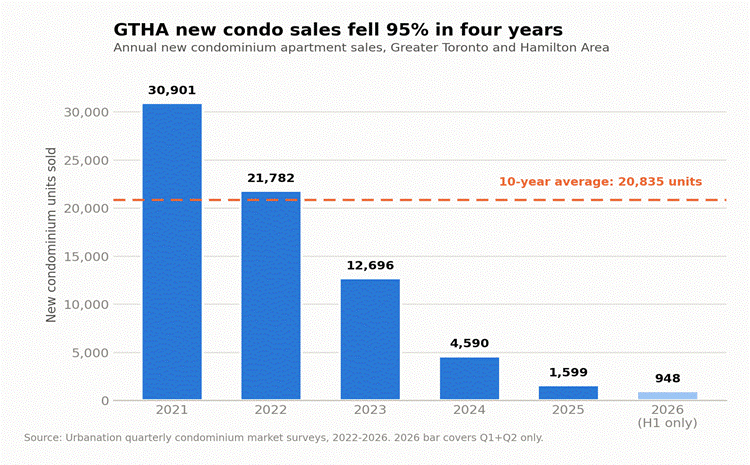
Figure 1 — Annual GTHA new condominium sales, 2021 to mid-2026. Source: Urbanation.
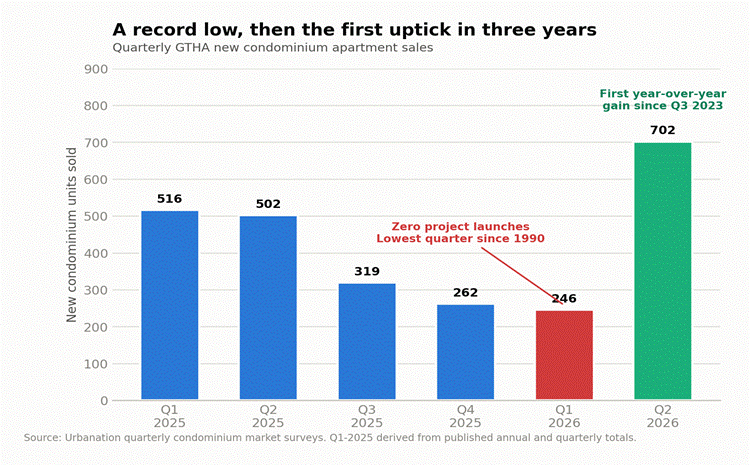
Figure 2 — Quarterly GTHA new condominium sales. Source: Urbanation.
The zero-launch statistic is usually reported as though builders delayed or quietly shrank what they had planned. They didn’t. There was nothing to delay. Projects that would have opened sales centres simply never opened them, because the arithmetic no longer worked.
That arithmetic is worth spelling out, because it explains everything downstream.
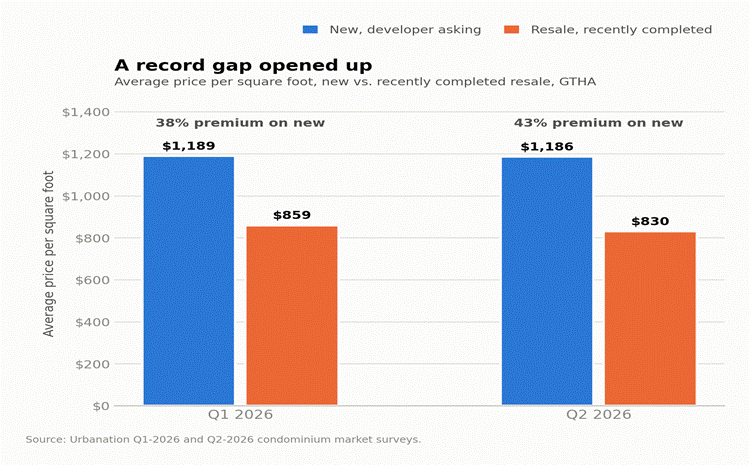
Figure 3 — New vs. resale price per square foot, GTHA. Source: Urbanation.
In Q1, developers were asking an average of $1,189 per square foot for new inventory. A buyer could get a comparable, recently completed unit on the resale market for $859. That is a 38% premium to buy something that does not exist yet, from a builder, with a deposit schedule and a three-to-five year wait. By Q2 the gap had widened to 43%.
No sales strategy closes a 43% gap. A builder cannot cut to $900 a foot, because construction costs, development charges, land and financing do not move down to meet them — and a builder who tries is selling below cost and explaining that to a lender. So the rational move was to not launch at all. Which is exactly what the industry did, for two consecutive quarters now.
Meanwhile, finished units kept arriving.
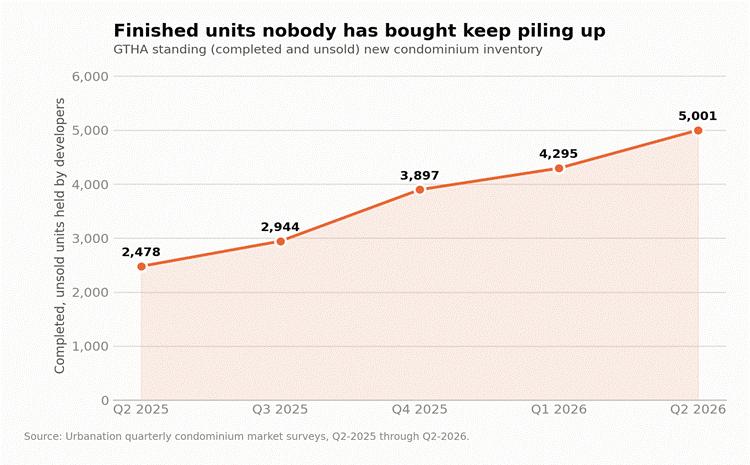
Figure 4 — Completed, unsold new condominium inventory held by developers. Source: Urbanation.
Standing inventory — completed condominiums, keys ready, nobody has bought them — doubled over the year, from 2,478 units in mid-2025 to 5,001 by mid-2026. At Q1’s sales pace, Urbanation calculated 92 months of completed supply. Nearly eight years.
Part two: the number that changed in July
Then Q2 2026 came in at 702 sales — up 52% year over year, the first annual increase since Q3 2023.
Before anyone declares a recovery: that is still 86% below the ten-year Q2 average. Calling it a bottom is defensible. Calling it a turn is not, and here is why.
Of those 702 sales, 535 were in completed buildings — units that already exist, discounted by builders who need them off the balance sheet. Only 50 were true pre-construction sales. Pre-construction, the thing that actually produces future housing, fell 80% year over year.
So the mechanism is inventory clearing, not demand returning. It was helped along by a real policy change: effective April 1, 2026, HST relief on new homes was extended from first-time buyers to all buyers of new housing up to $1.5 million, with a rebate capped at $130,000. That takes up to $130,000 of tax off a new purchase, and it landed in the exact quarter sales rose. It did not, however, produce a single new project launch.
Two quarters. Zero launches. That is the number that matters.
Part three: the part nobody is pricing in
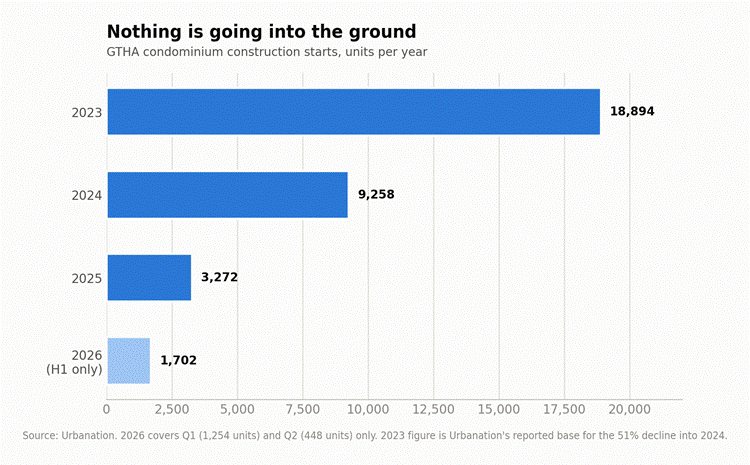
Figure 5 — GTHA condominium construction starts by year. Source: Urbanation.
Condominium construction starts have gone from 18,894 units in 2023 to 9,258 in 2024 to 3,272 in 2025. The first half of 2026 produced 1,702. The active pipeline — everything in pre-construction plus everything under construction — now sits at 48,710 units, down 37% year over year and 62% from the 2022 peak.
Construction runs on a fixed clock. A GTA high-rise takes roughly four to five years from launch to occupancy. Nothing started in 2026 delivers before 2030. Nothing launched in 2026 — because nothing launched — delivers at all.
That flows straight through to completions.
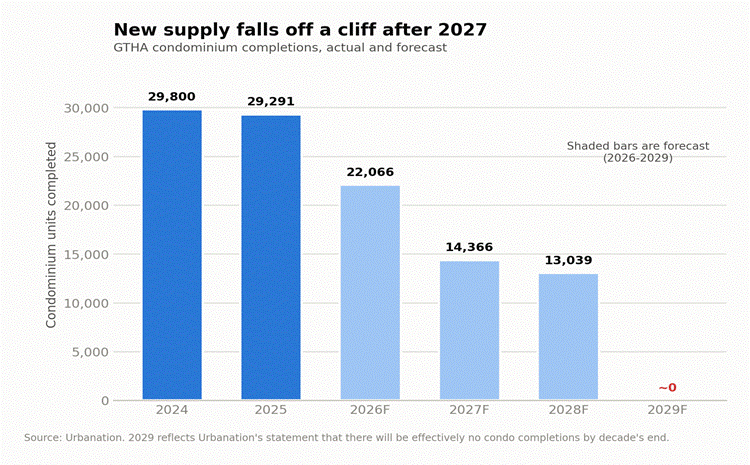
Figure 6 — GTHA condominium completions, actual and forecast. Source: Urbanation.
The market finished 29,800 units in 2024 and 29,291 in 2025. Urbanation forecasts 22,066 in 2026, 14,366 in 2027, and roughly 13,000 in 2028. Shaun Hildebrand, Urbanation’s president, has put the end state plainly: “By the end of the decade, there won’t be any new condo completions.”
Read that in sequence with the demand side. Toronto’s overall housing starts are now at their lowest level since 2009 — behind Calgary, Montreal and Vancouver for the first time, according to CMHC’s Spring 2026 Housing Supply Report. The rental market is already absorbing what the condo market is not producing: GTHA condo rental listings fell 13% year over year in Q2 2026, months of supply dropped to 0.9, and 34,150 condo leases were signed in the first half of the year, up 11%.
Rents are still soft — down 1.3% year over year for condos. But vacancy in stabilized purpose-built buildings fell from 7.9% to 6.8% in a single quarter, and purpose-built rental starts rose 50% in H1 2026. That last figure is the one genuinely encouraging supply number in this entire dataset. It is also 6,291 units, which does not replace 25,000 condo completions a year.
The correction that looks like an oversupply problem in 2026 is a supply problem in 2029. Both are true at once, and the market is currently priced only for the first one.
Four numbers worth correcting
Much of the commentary circulating right now repeats figures that are either stale or slightly wrong. If you are going to cite this market, cite it properly.
| Claim in circulation | What the source actually says |
| “77% of investors are cash-flow negative by $597 a month” | Both figures come from the same July 2024 CIBC/Urbanation report — which also put the share above 80% for units completing that year. It is two years old either way, and condo rents have fallen since, which does not make the carry math better. Treat it as a direction, not a current number. |
| “Ontario housing starts are at two-decade lows” | CMHC’s Spring 2026 Housing Supply Report says Toronto starts are at their lowest level since 2009 — a 16-year low, not a 20-year one, and Toronto specifically rather than Ontario. |
| “The average GTA condo is $180,000 off its 2022 peak” | That figure is anchored to a March 2026 average. By July 2026 TRREB reported an average condo price of $636,323, down 2.3% year over year, while the HPI apartment benchmark sat at $535,200, down 7.4%. The average and the benchmark are telling different stories; say which one you mean. |
| “Sales are still collapsing” | They stopped collapsing in Q2 2026. They are not recovering either. Either statement needs the launch count attached to mean anything. |
What to actually watch
Sales volume is the least useful indicator in this market right now. Three things matter more.
1. Launches
The first quarter with a real launch — a project that opens sales and gets meaningful absorption above $1,000 a foot — is the signal that development economics have reset. Until then, every sales figure is inventory clearing.
2. The price gap
New at $1,186 against resale at $830 is the binding constraint. It closes from one of two directions: resale rising, or new-build costs falling far enough that builders can price near resale. Development charge relief and the HST change work on the second lever. Neither has closed it yet.
3. Rental absorption
Vacancy at 6.8% and falling, months of supply at 0.9, leases up 11% — the rental market is where the demand that used to buy pre-construction has gone. If purpose-built rental starts keep climbing, some of the 2029 gap gets filled. If they stall, it does not.
The read for anyone holding land
For owners of sites with high-rise entitlements, the calculus has changed shape rather than disappeared. A condominium pro forma does not pencil at today’s revenue assumptions — not at a 43% gap to resale. A purpose-built rental pro forma, with MLI Select financing and the current cost environment, sometimes does, and it delivers into a window when almost nothing else will be completing.
That is not a prediction about prices. It is an observation about a construction calendar that is already largely set. TD Economics expects the resale correction to run roughly six years in total, with prices bottoming in the back half of 2027 and trending higher in earnest from 2028. That timeline and the completions cliff arrive at about the same moment.
Sunny Gawri is the founder of Urban Land Group, a land development advisory and commercial brokerage based in Mississauga, Ontario. This article is market commentary, not investment advice.
Sources: Urbanation Q4-2025, Q1-2026 and Q2-2026 GTHA condominium market surveys; Urbanation GTHA rental market report, Q2-2026; TRREB July 2026 Market Watch and the March 25, 2026 HST announcement; CMHC Spring 2026 Housing Supply Report; TD Economics, GTA Resale Condo Market Outlook, May 2026; CIBC/Urbanation GTA condo investment reports.