
The province has set out how it will decide which data centres get built — and municipalities are moving faster than Queen’s Park.
Urban Land Group · August 17, 2026
On August 13, 2026, Ontario released the draft framework for its Data Centre Playbook, the province’s first consistent test for where data centres are built and on what terms. Public comment runs to September 12, 2026, with the final version expected alongside Ontario’s forthcoming AI Industrial Strategy.
If you hold or underwrite serviced employment land in the GTA, Halton, Hamilton or Niagara, the rules just changed for one of the most active bidders in that market.
Three pillars, one filter
The Playbook is an assessment tool, not a zoning change. Proposals get scored against three pillars:
- Economic development — investment scale, job quality, tax revenue, support for domestic supply chains.
- Data security and digital sovereignty — Canadian ownership and operation, protection of critical data, alignment with federal data-residency policy.
- Community investment — financial and non-financial benefit to the host community.
It publishes no scoring weights, no dollar thresholds for community benefit, and no specific noise or water limits. Discretion sits with the province, not with a published test a proponent can underwrite against.
Power is the binding constraint
Ontario has received roughly 7,000 MW of data centre connection requests — more than a quarter of the province’s roughly 25,000 MW peak demand, and about double the volume reported five months earlier, per The Canadian Press. The IESO’s 2026 Annual Planning Outlook now puts data centres at 8.6 per cent of Ontario demand by 2050, some 60 per cent above its prior forecast. Requests are not approvals, but the volume is what drove the province’s response.
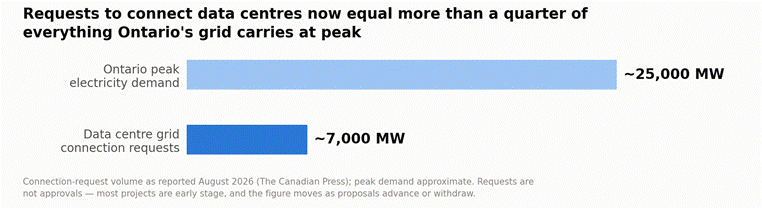
Figure 1 — Data centre connection requests against Ontario’s approximate peak demand.
What actually changed
The Protect Ontario by Securing Affordable Energy for Generations Act, 2025 (Royal Assent December 11, 2025) added section 28.1 to the Electricity Act: a transmitter or distributor cannot connect a “specified load facility” unless requirements set out in regulation are met. That regulation is itself part of what is now out for comment.
Two measures follow. No financial incentives — the province will offer non-financial support only. A separate rate class — Ontario proposes amending O. Reg. 429/04 to create a distinct electricity rate class for new data centres above 1 MW, billed separately for Global Adjustment and excluded from the Industrial Conservation Initiative. Existing facilities keep their classification. The province also favours projects that generate their own power and use closed-loop or waterless cooling.
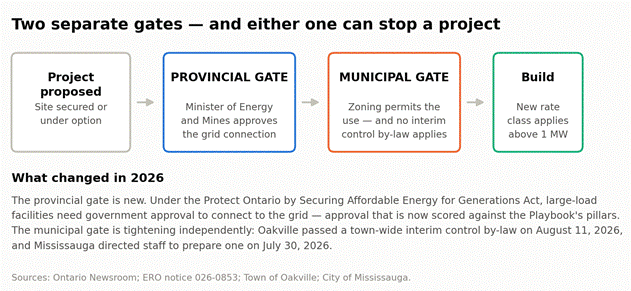
Figure 2 — The two approval gates a new large data centre must now clear.
Municipalities are moving faster than the province
Oakville approved a town-wide interim control by-law on August 11, 2026 — a one-year pause, extendable to two, while it studies noise, emissions, land use compatibility, energy and water supply. Mississauga council directed staff on July 30, 2026 to prepare a similar by-law covering the employment areas where data centres are currently permitted, including Meadowvale Business Park.
The province decides whether a project gets power. The municipality decides whether the use is permitted at all. A proponent needs both.
| THE ULG VIEW A data centre offer on employment land now carries two conditions that did not exist a year ago: provincial connection approval on criteria that have not been published, and municipal permission that may be frozen for up to two years. Treat the premium as compensation for that risk, not a new floor under your land value — and confirm the site still works on a conventional industrial or logistics use if the data centre falls away. |
Have your say. Comments are open to September 12, 2026 through the Environmental Registry of Ontario (notice 026-0853), the Ontario Regulatory Registry, or data.centre.consultation@ontario.ca.
Sources
· Ontario Newsroom, “Ontario Launches Data Centre Playbook,” Aug 13, 2026. https://news.ontario.ca/en/release/1007871/ontario-launches-data-centre-playbook
· Data Centre Playbook framework (PDF), Government of Ontario. http://news.ontario.ca/assets/files/20260813/652439f5209093b5a8a7f0f12c795c1e.pdf
· Environmental Registry of Ontario, notice 026-0853. https://ero.ontario.ca/notice/026-0853
· IESO, 2026 Annual Planning Outlook summary. https://ieso.ca/Sector-Participants/Planning-and-Forecasting/Annual-Planning-Outlook/2026-APO-Summary
· The Canadian Press via BNN Bloomberg, Aug 13, 2026. https://www.bnnbloomberg.ca/business/artificial-intelligence/2026/08/13/new-data-centres-will-pay-all-energy-costs-get-no-cash-incentives-under-ontario-plan/
· Town of Oakville, interim control by-law news release, Aug 11, 2026. https://www.oakville.ca/town-hall/news-notices/2026-news-releases-archive/oakville-council-approves-interim-control-by-law-to-support-further-study-related-to-data-centres/
· City of Mississauga, “Mississauga moves to pause data centre development,” Jul 30, 2026. https://www.mississauga.ca/city-of-mississauga-news/news/mississauga-moves-to-pause-data-centre-development/
· Torys LLP, key takeaways on the Protect Ontario … Act, 2025, Dec 2025. https://www.torys.com/our-latest-thinking/publications/2025/12/key-takeaways-and-next-steps-on-new-energy-law
Figures by Urban Land Group—general commentary; not legal, planning or investment advice.