
Hamilton is being paid $572 million to eliminate residential development charges for three years. Vaughan gets $697.2 million to halve them. The saving is real — the question is who ends up with it.
Urban Land Group · September 1, 2026
On August 27, 2026 the Governments of Canada and Ontario announced the first agreements under the Development Charge Reduction Program. Hamilton receives up to $572 million and must eliminate residential development charges entirely from March 30, 2026 to March 31, 2029. Vaughan receives up to $697.2 million for a 50% reduction over the same period.
Strip away the announcement language and this is a straightforward transaction: senior governments are buying development charge revenue off municipalities, and paying for housing-enabling infrastructure with the proceeds. For anyone who underwrites land, that is not a housing-policy story. It is a change to a line item in every residual land value calculation you run in those two cities.
What actually came out of the cost stack
The federal release for Hamilton is unusually specific. Eliminating residential development charges is estimated to reduce costs by up to $100,442 per home. Ontario’s HST relief on new homes, running April 1, 2026 to March 31, 2027, is estimated at up to $130,000 per home. Together, the release says, up to $230,000 per home. Hamilton estimates the measures could unlock more than 31,000 homes.
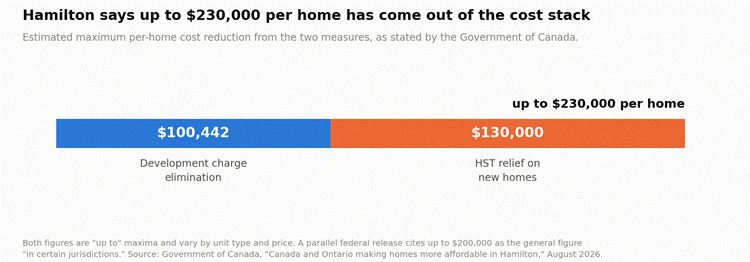
Figure 1 — The two per-home reductions, as stated by the Government of Canada.
Treat both as maxima, not averages. They vary by unit type and price, and a parallel federal release cites up to $200,000 as the general figure “in certain jurisdictions.” But even discounted heavily, a six-figure per-unit cost reduction is the largest single change to Ontario development economics in years.
Who captures it
Here is the part the announcements do not address. A cost reduction of this size does not stay where it is put. It is competed for, and it settles with whichever party in the chain has the most pricing power at the moment it lands.
If new-home prices are set by the market rather than by cost, then removing a cost does not lower the price — it widens the margin. That margin is then bid for. Builders bid it into land. Landowners ask for it. And in a soft sales market, some of it does reach buyers as discounts, because it has to for anything to sell.
Which of those three happens is an empirical question about bargaining power, not a policy question. And on that, the housing starts data is the most useful thing published this month.
The binding constraint is not approvals
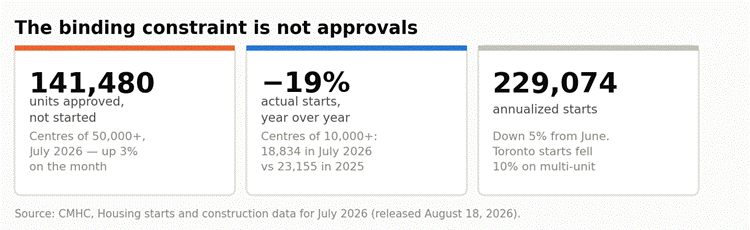
Figure 2 — CMHC’s July 2026 housing starts release.
CMHC reported the annualized pace of housing starts fell 5% in July to 229,074 units. Actual starts in centres of 10,000 or more were 18,834, down 19% from July 2025. And in centres of 50,000 or more, 141,480 units were approved and had not started — up 3% on the month. CMHC’s deputy chief economist noted fewer new projects being started “notably in Vancouver, Calgary and Toronto.”
That is the context that should discipline land pricing. The system is not short of approvals. It is short of projects that pencil. Which means a vendor arguing that the DC saving belongs entirely to the land is arguing against a market with 141,480 approved units sitting still.
Two windows, two expiry dates
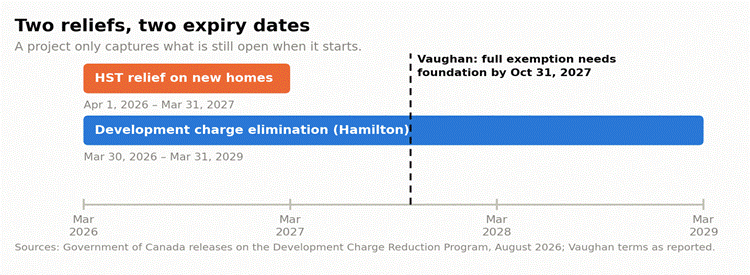
Figure 3 — The reliefs do not run for the same period.
The HST relief runs one year, to March 31, 2027. Hamilton’s development charge elimination runs three, to March 31, 2029. Vaughan additionally offers a temporary full exemption for qualifying projects reaching prescribed foundation milestones by October 31, 2027, according to trade reporting of the agreement.
A project that starts in 2028 captures one relief, not two. A project that cannot reach foundation before the windows close captures neither. The relief is not attached to the land; it is attached to a construction start inside a defined period.
The wider structure
These agreements sit inside the $8.8-billion Canada-Ontario Partnership to Build, announced in March 2026, cost-matched between the two governments, with the federal share flowing through the Build Communities Strong Fund. Alongside the Development Charge Reduction Program and the HST relief, a third stream puts $1 billion into municipalities that do not levy development charges at all — split evenly between Ontario’s Municipal Housing Infrastructure Program and the federal fund, with applications opening October 29, 2026.
The programme prioritizes municipalities cutting residential development charges by 30 to 50 per cent or more, for at least three years. More than 200 of Ontario’s 444 municipalities levy development charges. Hamilton and Vaughan are the first two agreements, not the last.
| THE ULG VIEW Residual land value is what is left after revenue less hard costs, soft costs, charges and profit. Take $100,442 of development charge out of a unit and hold everything else constant, and the residual rises by $100,442 a unit. The relief does not automatically reach the homebuyer. It reaches whoever has the pricing power. So on any Hamilton or Vaughan land priced this quarter, assume the relief is already in the ask. The counter-argument is in Figure 3: with 141,480 approved units nationally not starting, land supply is not the binding constraint, which limits how much of the saving a vendor can actually hold. Expect a negotiation, not a windfall — and be able to show the vendor the CMHC number. The second discipline is timing. The reliefs expire on different dates, and a project only captures what is still open when it starts. Underwrite the relief a site can realistically reach, not the headline. A parcel that cannot get to foundation before the windows close is worth what it was worth in February. |
| WHAT THIS NOTE LEAVES OUT The source material behind this note also covered tariffs, CUSMA and a federal package of business supports. Those figures have been left out deliberately. They sit outside land and development feasibility, they came from promotional material rather than a primary source, and each would need separate verification against federal releases before ULG put its name to them. Every figure in this note traces to a Government of Canada, City of Hamilton, City of Vaughan or CMHC release. Vaughan’s specific reduction terms are as reported and should be confirmed against the City’s by-law. |
Sources
· Government of Canada — “Canada and Ontario making homes more affordable in Hamilton,” August 2026. https://www.canada.ca/en/housing-infrastructure-communities/news/2026/08/canada-and-ontario-making-homes-more-affordable-in-hamilton.html
· Government of Canada — “$1 Billion to Help Non-Development Charge Municipalities Build More Homes,” August 2026. https://www.canada.ca/en/housing-infrastructure-communities/news/2026/08/the-government-of-canada-and-ontario-investing-1-billion-to-help-non-development-charge-municipalities-build-more-homes.html
· City of Vaughan — Mayor Del Duca statement on the $697.2 million investment. https://www.vaughan.ca/news/mayor-del-duca-welcomes-record-investment-6972-million-vaughans-housing-future
· CMHC — Housing starts and construction data for July 2026. https://www.cmhc-schl.gc.ca/media-newsroom/news-releases/2026/housing-starts-construction-data-july-2026
· Association of Municipalities of Ontario — Canada-Ontario Development Charge Reduction Program. https://www.amo.on.ca/policy/finance-infrastructure-and-economy/canada-ontario-development-charge-reduction-program
· Connect CRE Canada — “Hamilton, Vaughan Cut Development Charges In $1.27B Funding Deal.” https://www.connectcre.ca/stories/hamilton-vaughan-cut-development-charges-in-1-27b-funding-deal/Charts by Urban Land Group from the sources above. General commentary on public policy; not legal, planning, tax or investment advice