
Ontario is consulting on regulations that would replace every local municipal code of conduct with a single provincial one. They are proposed to take effect November 15, 2026, three weeks after the municipal election.
Urban Land Group · August 20, 2026
On August 18, 2026, the Ministry of Municipal Affairs and Housing posted proposed regulations under the Municipal Accountability Act, 2026 (Regulatory Registry posting 26-MMAH054). If made, they would do three things: establish a single standardized code of conduct applying to all members of council and of certain local boards; standardize the inquiry process municipal integrity commissioners must follow; and set education and training requirements for members, for local integrity commissioners, and for the Integrity Commissioner of Ontario.
Comments close October 2, 2026. The regulations are proposed to be in effect November 15, 2026.
The date is the story
Ontario’s municipal election is October 26, 2026. The new council term begins on November 15, 2026 — the same day these regulations are proposed to come into force.
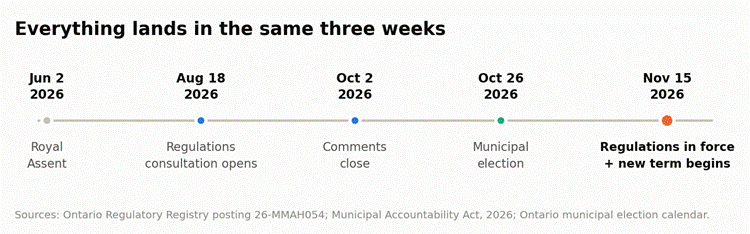
Figure 1 — From Royal Assent to in-force, with the election in between.
Which means the councillors who will decide your rezoning in 2027 start their term under a conduct regime none of them has worked under before, written by the province rather than by their own council, with mandatory training they have not yet completed.
What actually changes
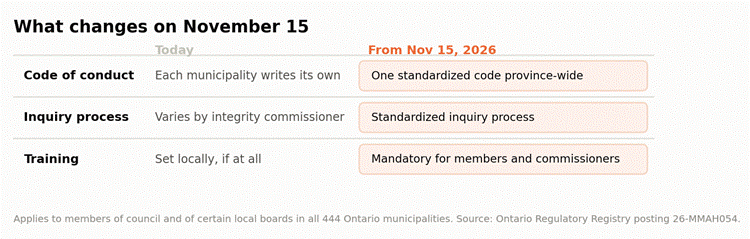
Figure 2 — The three elements of the proposal.
Today each of Ontario’s 444 municipalities writes its own code, and each integrity commissioner runs its own process. The proposal replaces both with one provincial standard. The ministry’s own regulatory impact analysis is candid about the trade: short-term administrative and compliance cost — commissioner, member and staff time to learn a new framework — against reduced duplication, greater consistency and clearer expectations.
The removal power that may never be used
The Act, which received Royal Assent on June 2, 2026, is best known for something the regulations do not address: the power to remove a sitting member from office and disqualify them for four years. The path there is deliberately narrow.
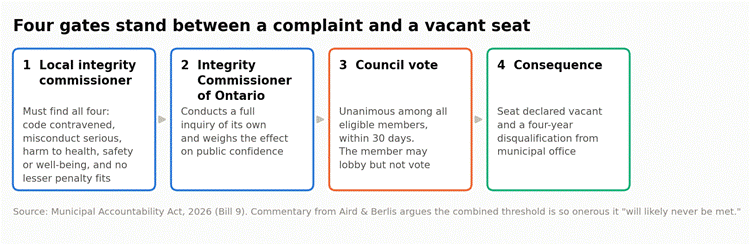
Figure 3 — The removal mechanism under the Municipal Accountability Act, 2026.
A local integrity commissioner must find all four statutory tests met. The Integrity Commissioner of Ontario must then run a full inquiry of its own. Council must then vote unanimously, within 30 days — and the member under inquiry may lobby colleagues even though they cannot vote on their own removal. Aird & Berlis has argued the combined threshold is so onerous it “will likely never be met.”
Treat the removal power as signalling. The operative change is the standardized code and the mandatory training, because those govern every interaction, every day — including every interaction a councillor has with an applicant.
| THE ULG VIEW This reads as a governance story. For anyone who files applications, it is a process story. A brand-new council, three weeks into its term, operating under an unfamiliar province-written code with training still in progress, will be cautious. Expect more councillors declining informal meetings with applicants and referring them to staff. Expect gift, hospitality and confidential-information rules to be applied conservatively while everyone learns where the lines sit. And expect integrity commissioner complaints to appear as a delay tactic on contested applications, because a standardized process makes them easier to file. None of this touches the Planning Act clock. It changes how much informal relationship-building is available to you in the first two quarters of the new term. If you have a contested application you were planning to socialize with councillors in late 2026, socialize it with staff instead — and put anything sensitive in writing. |
| WHAT THIS NOTE DOES NOT COVER The substance of the proposal — the actual rules that would sit inside the standardized code — is set out in a consultation document linked from the registry posting, not in the posting itself. This note covers the framework, the mechanism and the timing. Read the linked consultation document before relying on any characterization of the specific conduct rules, including this one. |
Have your say. Comments are open to October 2, 2026 through the Ontario Regulatory Registry (posting 26-MMAH054) or by email to localgov@ontario.ca. Municipalities, clerks’ associations and integrity commissioners will comment in volume. Applicants and the development industry generally do not — which is one reason these rules tend to be written without them in mind.
Sources
· Ontario Regulatory Registry — posting 26-MMAH054, posted August 18, 2026; comments to October 2, 2026. https://www.regulatoryregistry.gov.on.ca/search
· Legislative Assembly of Ontario — Bill 9, Municipal Accountability Act, 2026. https://www.ola.org/en/legislative-business/bills/parliament-44/session-1/bill-9
· Hicks Morley — Ontario’s Municipal Accountability Act receives Royal Assent, June 3, 2026. https://hicksmorley.com/2026/06/03/ontarios-municipal-accountability-act-2025-receives-royal-assent/
· Aird & Berlis — Does the Municipal Accountability Act, 2026 really strengthen municipal accountability? https://www.airdberlis.com/insights/publications/publication/does-the-municipal-accountability-act–2026-really-strengthen-municipal-accountability
· Association of Municipalities of Ontario — municipal elections and term dates. https://www.amo.on.ca/about-us/municipal-101/municipal-elections
Diagrams by Urban Land Group from the sources above. General commentary on public policy; not legal advice.