
The US Just Reported Inflation Without an Inflation Rate and Shelter Is Doing the Opposite Here.

That 0.4% is one month, not a year, and there is no US annual figure this month at all. Canada’s October number lands November 16, and its shelter component is running below headline.
November 10, 2026 · Sunny Gawri, Urban Land Group
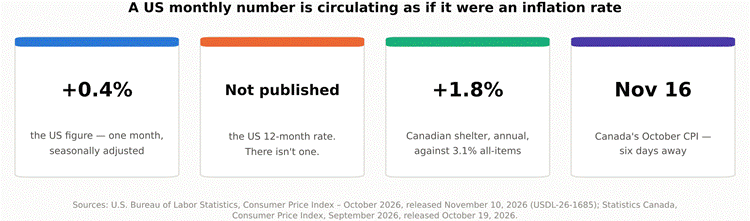
Two countries, two measurement periods, one of them with a hole in it.
First, what this number is
The headline is a US figure. It comes from the Bureau of Labor Statistics release for October 2026, published at 8:30 a.m. Eastern on November 10. Canada’s October CPI is not out until Monday, November 16.
The 0.4% is the monthly, seasonally adjusted change in all items, from September to October, after a 0.6% rise in September. Unadjusted, the monthly change was 0.2%. Shelter rose 0.3% on the month, which the BLS says accounted for “over thirty percent of the monthly all items increase.” Owners’ equivalent rent rose 0.3%, rent of primary residence 0.2%, food 0.5%, and core 0.3% — the same as September and August.
None of that is an inflation rate. It is one month’s change in a price index.

BLS, October 2026. Every figure is a one-month, seasonally adjusted change.
And there is no US annual rate this month
This is the part worth knowing before anyone quotes a US-versus-Canada comparison.
The BLS release states that “BLS did not collect survey data for October 2025 because of a lapse in appropriations.” As a consequence, “for most CPI series, BLS could not publish October 2025 indexes,” and the agency “cannot publish 12-month percent changes for October 2026 for indexes where October 2025 data are unavailable.”
In the release’s own table, the only 12-month figures that survive are unadjusted gasoline at 37.4%, new vehicles at 0.7%, and used cars and trucks at −3.3%. All items shows a dash. So does shelter, so does core.
Separately, BLS notes that “in summer 2025” it announced reductions to CPI data collection across the country and suspended collection entirely in Lincoln, Nebraska; Provo, Utah; and Buffalo, New York. These are two distinct problems: a missing month and a thinner sample.
If someone puts “US inflation 0.4%” next to “Canada 3.1%,” they have compared a month to a year. The gap is roughly twelvefold. Compounded, 0.4% a month would be about 4.9% annually — but that is arithmetic, not a published number, and nobody should quote it as one.
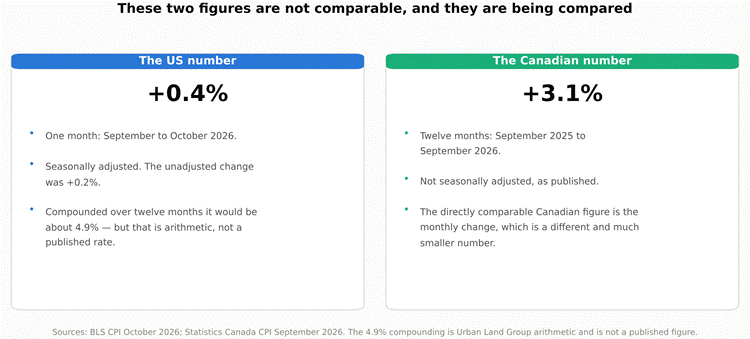
Sources as noted. The compounding is illustrative only.
Quoted from the BLS release and the BLS CPI home page.
The more useful contrast is what shelter is doing
In the US, shelter is pushing inflation up — over 30% of October’s monthly increase, with owners’ equivalent rent rising faster than rent.
In Canada, shelter is doing the reverse. In the September release, all-items inflation was 3.1% while shelter rose only 1.8% — 1.3 points below headline. Mortgage interest cost fell 0.2%. Rent rose 2.8%, and Ontario’s all-items rate was 2.5%, below the national figure.
Shelter is the largest single component of the Canadian CPI basket, so a shelter rate running well below headline is actively dragging measured inflation down. Strip it out and the rest of the basket is running hotter than 3.1% suggests. That is the opposite of the American problem.

Statistics Canada, September 2026. Twelve-month changes.
Why that matters for the next move
The Bank of Canada raised the policy rate to 2.50% on October 28, and said “there could be a need to increase the policy rate further, but given uncertainties, Governing Council agreed to proceed carefully.” It did that while shelter was subtracting from headline inflation — which tells you the pressure the Bank is responding to is coming from somewhere other than housing.
There is a mechanical wrinkle worth holding in mind. Mortgage interest cost is a component of the Canadian CPI, and it moves with the policy rate as mortgages renew. It has been negative, pulling shelter and headline down, because it reflects the earlier easing cycle washing through renewals. If the Bank continues raising, that component eventually turns positive again and shelter starts adding to measured inflation rather than subtracting from it — a feature of the basket’s construction, not a change in housing costs themselves. It is the kind of thing that makes a headline inflation print look worse without any underlying deterioration.
None of which is a forecast. It is a note on what to read in the November 16 release.
| THE ULG VIEW Do not repeat the 0.4% as an inflation rate, and do not set it against a Canadian annual number. It is a US monthly figure. Anyone who stacks it against Canada’s 3.1% has made a twelvefold error, and it is the sort of mistake that gets noticed in a client meeting. The absence of a US annual rate is itself the news. For as long as the October 2025 gap sits in the series, year-over-year US comparisons are unavailable for most components. Anyone quoting a US annual inflation figure this month is either using a different vintage or estimating. Ask which. On the Canadian side, read shelter before headline. Shelter at 1.8% against all-items at 3.1% means housing is currently holding the index down. That is a materially different market story from the American one, and it is the correct answer when someone says “inflation is being driven by housing.” In Canada right now, it is not. Watch mortgage interest cost on November 16. It was −0.2% in September. If it turns positive, shelter stops subtracting and headline inflation rises for reasons that have nothing to do with rents or house prices. That is a basket-construction effect, and it will be reported as though it were a housing story. For underwriting, the practical read is unchanged. The Bank raised on October 28 while shelter was disinflating, and signalled it may raise again. The next decision is December 9. Nothing in the US October print changes a Canadian rate assumption, and it should not be cited as though it does. |
| WHAT IS CONFIRMED AND WHAT IS NOT Confirmed from the BLS. The 0.4% monthly seasonally adjusted all-items increase for October 2026 and the 0.6% for September; the 0.2% unadjusted monthly change and the 337.511 index level; shelter +0.3% and the “over thirty percent of the monthly all items increase” wording; owners’ equivalent rent +0.3%, rent +0.2%, food +0.5%, core +0.3%; the three surviving 12-month figures; the shutdown and data-collection quotations; and the December 10, 2026 next release. Source: Consumer Price Index – October 2026, USDL-26-1685, released November 10, 2026. Confirmed from Statistics Canada. All-items 3.1%, rent 2.8%, shelter 1.8%, mortgage interest cost −0.2% and Ontario all-items 2.5%, all twelve-month changes from the Consumer Price Index for September 2026, released October 19, 2026, Table 18-10-0004-01. The October release date of November 16, 2026. Confirmed from the Bank of Canada. The October 28, 2026 increase to 2.50%, the quoted guidance, and the December 9, 2026 next decision date. ULG’s own. The 4.9% compounding illustration, the 1.3-point shelter-to-headline gap, and the observation about mortgage interest cost turning positive as rates rise. That last point describes how the Canadian basket is constructed; it is not a forecast of what the November 16 release will show. Not verified. No Ontario-specific shelter, rent or mortgage interest cost figure is published in the Statistics Canada release reviewed — those components are national, and the Ontario line shown is all-items. A BLS notice refers to an error in published energy indexes for the Baltimore area between June and September 2026; that notice was not read and does not affect the figures used here. This is market commentary prepared for discussion. Not investment advice, and not an Opinion of Value for any property. |
Sources
OFFICIAL AND PRIMARY SOURCES
· U.S. Bureau of Labor Statistics — Consumer Price Index, October 2026 (USDL-26-1685). Released November 10, 2026. Source of every US figure and of the shutdown quotations. https://www.bls.gov/news.release/cpi.nr0.htm
· U.S. Bureau of Labor Statistics — CPI home page. Source of the 2025 data-collection reduction notice. https://www.bls.gov/cpi/
· U.S. Bureau of Labor Statistics — CPI release schedule. Next release December 10, 2026. https://www.bls.gov/schedule/news_release/cpi.htm
· Statistics Canada — Consumer Price Index, September 2026. Released October 19, 2026. Source of all Canadian figures. https://www150.statcan.gc.ca/n1/daily-quotidien/261019/dq261019a-eng.htm
· Statistics Canada — Table 18-10-0004-01, Consumer Price Index, monthly, not seasonally adjusted. https://www150.statcan.gc.ca/t1/tbl1/en/tv.action?pid=1810000401
· Statistics Canada — Release schedule. October CPI is scheduled for Monday, November 16, 2026. https://www150.statcan.gc.ca/n1/dai-quo/cal2-eng.htm
· Bank of Canada — Policy rate decision, October 28, 2026. Next decision December 9, 2026. https://www.bankofcanada.ca/2026/10/fad-press-release-2026-10-28/
Urban Land Group · Land development advisory and commercial real estate · 30 Eglinton Avenue West, Mississauga, Ontario
Sunny Gawri is a registered real estate sales representative with Royal LePage Signature. Market commentary prepared for discussion. Not investment advice, and not an Opinion of Value for any specific property.