
Budget 2026: Real Estate Is Excluded From the Headline Measure, and the Important Changes Are Not in the Tax Annex

The $15 million capital gains exemption does not apply to this industry. The measures that do matter are four mortgage insurance changes that a tax summary will not mention.
November 9, 2026 · Sunny Gawri, Urban Land Group
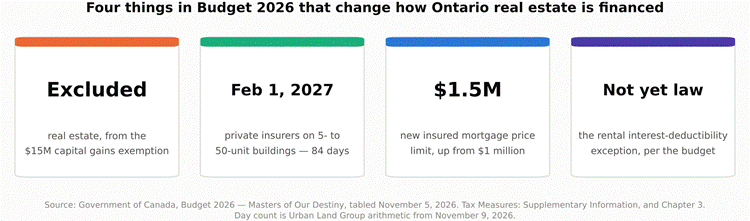
Four items from Budget 2026 that change how Ontario property gets financed.
Start with the exclusion
The Canada Growth Incentive’s $15 million capital gains exemption is the headline personal measure in Budget 2026, and it will be repeated widely over the next few weeks as though it applies to anyone selling a private company. It does not apply here.
The budget defines a qualifying business as “an active business other than” a list of exclusions, and that list includes a business operating in the real estate sector. It also excludes consulting services, the professional practices of accountants, lawyers, notaries, physicians, engineers and architects, any business whose principal asset is the reputation or skill of one or more employees, and any business operating under a licensing or franchising agreement.
Read together, that catches development corporations, brokerage, advisory and most of the professional service firms around a land transaction. The exemption applies to shares issued on or after Budget Day and before 2037, and the budget costs it at nil through 2028-29, $80 million in 2029-30 and $485 million in 2030-31. That cost profile is itself a tell: Ottawa does not expect meaningful claims for three years.
If a client or a partner raises this measure in the context of a development company, the short answer is that the sector is named in the exclusion list.
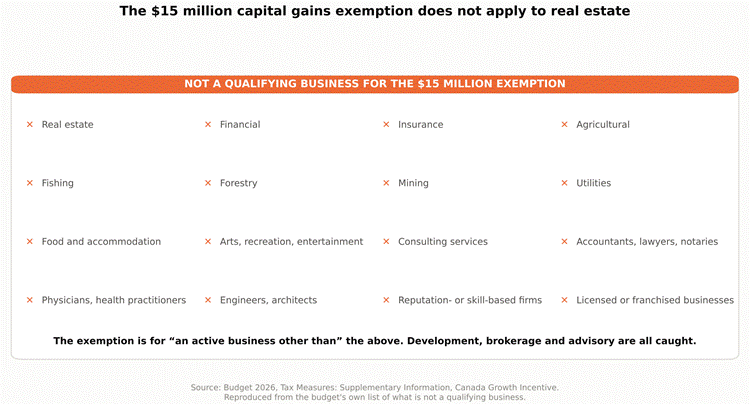
Reproduced from the budget’s own list of what is not a qualifying business.
The measures that actually matter are not tax measures
Because they sit in Chapter 3 rather than the tax annex, an accounting firm’s budget commentary will not carry them. Four are worth knowing.
Private mortgage insurers will be permitted to insure five- to fifty-unit residential properties, effective February 1, 2027 — 84 days away. That band is currently CMHC’s alone. A second source of insurance under the missing middle changes the financing conversation for exactly the project size that has been hardest to fund.
Insured construction financing is being expanded to newly built three- and four-unit housing, with no maximum property value, no requirement to occupy one of the units, and amortisation of up to 30 years. The removal of owner-occupancy is what makes this a builder tool rather than a homeowner tool.
The price limit for optional mortgage insurance rises from $1 million to $1.5 million, with 30-year amortisations, where at least one borrower is a first-time buyer or the home is newly built. In the GTA the old ceiling excluded most detached product.
Neither of the last two carries a stated effective date in the budget.
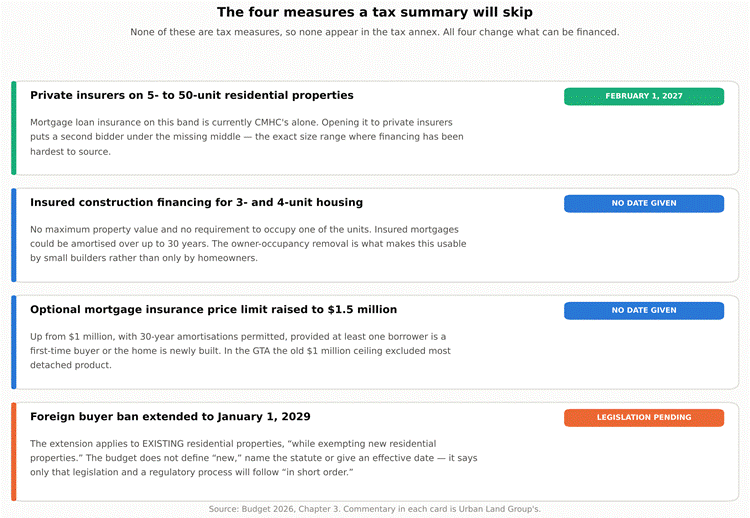
Budget 2026, Chapter 3. Commentary is ULG’s.
The foreign buyer change needs care
Budget 2026 proposes to “extend the ban on foreign purchases of existing residential properties for two years, to January 1, 2029” while “exempting new residential properties.” That carve-out is the consequential part — it would reopen non-resident demand for pre-construction and newly completed product at a moment when GTA pre-construction condo sales are close to nil.
But the budget does not define “new,” does not name the statute being amended and gives no effective date. It says only that the government “will propose legislation and launch a regulatory process on this change in short order.” Until that lands, nobody can structure around it, and nobody should be told that non-resident buyers can now purchase new builds. The announcement is real; the rule does not yet exist.
Two items that reduce friction on cross-border deals
For dispositions on or after January 1, 2027, purchaser withholding on specified taxable Canadian property falls from 50% to 30%, and on other capital property from 25% to 15%. The vendor’s clearance-certificate remittance on other capital property falls from 25% to 15% of the capital gain.
The budget also proposes to exempt vendors and purchasers from withholding entirely on fully tax-deferred section 85 rollovers of taxable Canadian property, provided the election form is filed within 30 days of the disposition and the purchaser notifies CRA with details of the transaction and the vendor. Against that, the anti-avoidance period on such rollovers extends from three years to five, and now reaches a subsequent disposition of property that principally derives its value from the transferred property.
One caution: the pasted commentary describes the rate reduction as applying to “non-resident corporations.” The budget’s rationale does discuss corporate vendors, but the published rate table is not expressly limited to them. Confirm against the legislation before advising anyone that the lower rate is or is not available.
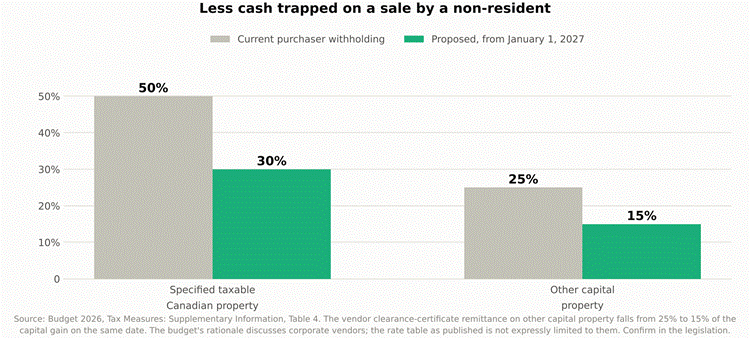
Budget 2026, Tax Measures: Supplementary Information, Table 4.
The rental interest exception still is not law
The excessive interest and financing expenses limitation carries an exception for interest incurred before 2036 on borrowings used to acquire, build or convert purpose-built rental housing in Canada. Budget 2026 expands it to cover borrowings used for eligible activities carried on by another corporation, trust or partnership within the same affiliated group, and to partnerships in which the borrower and affiliates hold at least a 40% interest — which fixes a real problem for anyone holding rental assets through a standard multi-entity structure.
The detail worth noticing is in the budget’s own description of the status quo: of the exceptions announced in Budget 2024, “neither exception has been enacted into law.” Two and a half years on, the relief that rental underwriting has been assuming is still a proposal.
The expansion would apply to taxation years that begin on or after October 1, 2023 — retroactive to the start of the EIFEL regime, not to Budget Day. That is unusually generous drafting and, if enacted, opens the question of amended returns for affected years.
Where the money goes, and when
Budget 2026 commits substantial housing funding, but almost none of it arrives soon. Build Canada Homes gets an additional $13 billion over ten years starting 2028-29 against a stated total capitalisation of $45 billion. Homelessness and rental supports get $11.2 billion over four years from 2027-28. The Canada Housing Benefit is renewed for ten years with $1.7 billion over three years from 2028-29 and $3.9 billion in future years. Federal lands enabling infrastructure gets $1.5 billion over four years from 2027-28, and municipal e-permitting $100 million from 2027-28.
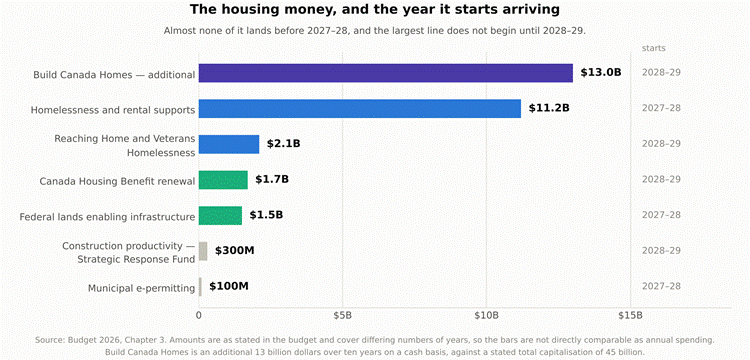
Amounts cover differing numbers of years and are not comparable as annual spending.
| THE ULG VIEW The headline measure is not for us. Real estate is named in the exclusion list for the $15 million exemption, and so are consulting and reputation- or skill-based businesses. Expect to have this conversation several times; the useful answer is the exclusion list itself, not an opinion. February 1, 2027 is the date to put in the calendar. Private insurers entering the five- to fifty-unit band is the single most consequential item in this budget for small and mid-sized residential development. It introduces competition into a product line that has had one provider, and it lands in under three months. Worth a conversation with mortgage contacts now, before the market has priced what a second insurer does to terms. Do not structure anything around the foreign-buyer carve-out yet. A new-build exemption from the non-resident purchase ban would be a genuine demand-side change for pre-construction. But the budget gives no definition, no statute and no date. Treat it as an intention, and watch for the legislation. The EIFEL line is the one to raise with tax counsel. If rental interest deductibility has been assumed in a structure since 2023, the budget says plainly that the exception was never enacted. The proposed expansion is retroactive to taxation years beginning on or after October 1, 2023, which is the right window to be asking about. On the housing spending, manage expectations. The largest commitments begin in 2027-28 and 2028-29. Nothing in this budget changes what gets serviced or approved in 2027. Where federal money does bite sooner is through the mortgage insurance rules, which cost nothing and start in February. Two gaps in the commentary circulating. The version I was sent describes the Volunteer Firefighters credit and the Northern Residents Deduction without saying what changed — both paragraphs set out current law and then stop. If either matters to a client, go to the source rather than the summary. |
| WHAT IS CONFIRMED AND WHAT IS NOT Confirmed from Budget 2026. The Canada Growth Incentive exclusion list including real estate, consulting and reputation- or skill-based businesses; the $15 million limit, the Budget Day to 2037 window and the $80 million and $485 million cost estimates. The EIFEL expansion, the 40% partnership threshold, the October 1, 2023 effective date and the statement that neither Budget 2024 exception has been enacted. The TCP rate reductions, the section 85 exemption and 30-day filing, and the three- to five-year anti-avoidance extension, effective January 1, 2027. The foreign-buyer extension to January 1, 2029 with the new-build exemption. All mortgage insurance changes and the February 1, 2027 date. All housing funding figures and start years. Announced but not yet defined. The foreign-buyer new-build exemption has no definition of “new,” no named statute and no effective date — the budget commits only to legislation and a regulatory process. Neither the three- and four-unit construction financing expansion nor the $1.5 million insurance limit carries a stated effective date. Flagged for confirmation. The published TCP rate table is not expressly limited to corporate vendors, although the budget’s rationale discusses them. The commentary circulating describes the measure as applying to non-resident corporations; that narrowing should be checked against the legislation. Not verified here. The projected 2026-27 deficit could not be located in the budget pages reviewed; the overview reports only that the deficit is expected to be $27.5 billion lower in 2025-26 than at the Spring Economic Update. The Notices of Ways and Means Motions, which carry the legislative text for several of these measures, were not reviewed. Not reviewed at all. The personal tax measures in the circulating commentary — filing deadlines, flat-amount deductions, medical expense credit changes, pension and registered plan measures — are outside the scope of this note and were not checked against the budget. This is market commentary prepared for discussion. It is not tax, legal or accounting advice, and no measure here is law until the enacting legislation receives Royal Assent. Confirm anything that affects a transaction with your own tax advisor. |
Sources
OFFICIAL AND PRIMARY SOURCES
· Government of Canada — Budget 2026: Masters of Our Destiny. Tabled November 5, 2026. https://budget.canada.ca/2026/home-accueil-en.html
· Budget 2026 — Tax Measures: Supplementary Information. Source of the Canada Growth Incentive exclusions, the EIFEL expansion and the taxable Canadian property rate table. https://budget.canada.ca/2026/report-rapport/tm-mf-en.html
· Budget 2026 — Chapter 3. Source of the mortgage insurance changes, the foreign buyer ban extension and all housing funding figures. https://budget.canada.ca/2026/report-rapport/chap3-en.html
· Budget 2026 — Overview and Budget in Brief. https://budget.canada.ca/2026/report-rapport/overview-apercu-en.html
· Department of Finance Canada — Government of Canada Releases Budget 2026: Masters of Our Destiny, November 5, 2026. https://www.canada.ca/en/department-finance/news/2026/11/government-of-canada-releases-budget-2026-masters-of-our-destiny.html
· Budget 2026 — Notices of Ways and Means Motions. The legislative text for several measures; not reviewed for this note. https://budget.canada.ca/2026/report-rapport/nwmm-amvm-1-en.html
Urban Land Group · Land development advisory and commercial real estate · 30 Eglinton Avenue West, Mississauga, Ontario
Sunny Gawri is a registered real estate sales representative with Royal LePage Signature. Market commentary prepared for discussion. Not tax, legal or accounting advice, and not an Opinion of Value for any specific property.