
Why Builders Bought Vaughan: It Is a Foundation Deadline, Not a Development Charge Cut.
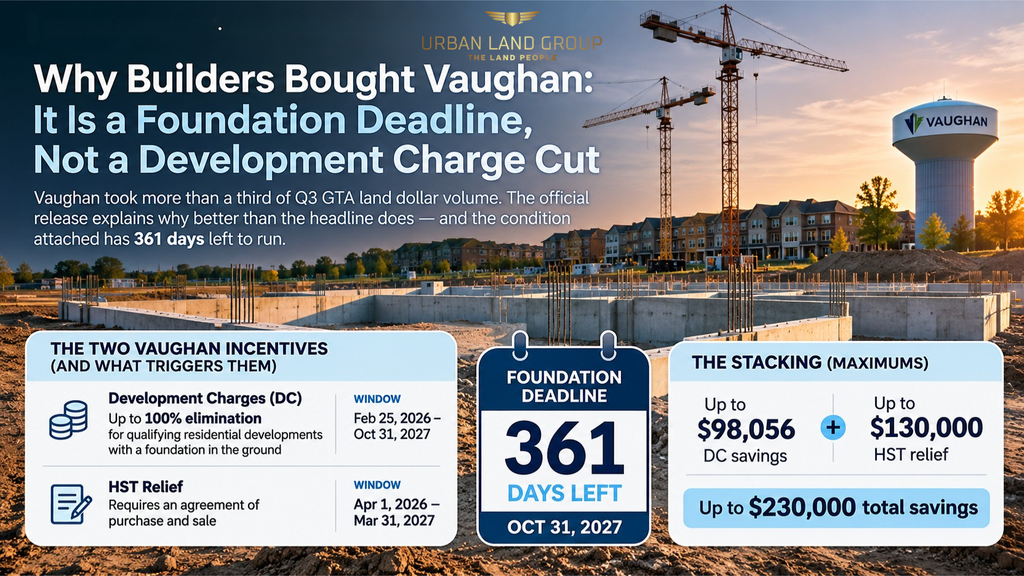
Vaughan took more than a third of Q3 GTA land dollar volume. The official release explains why better than the headline does — and the condition attached has 361 days left to run.
November 4, 2026 · Sunny Gawri, Urban Land Group
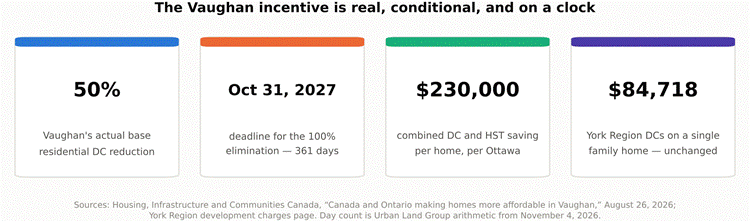
The incentive driving Vaughan land demand, as the federal release actually describes it.
The correction that changes the story
The quarterly land commentary describes Vaughan as “cutting residential charges by 100%.” The joint Canada-Ontario release of August 26, 2026 says something more specific, and the specifics are the reason builders moved.
Vaughan’s base commitment is a 50% reduction for residential developments, from March 30, 2026 to March 31, 2029. That is what earns the city up to $697.2 million under the Development Charge Reduction Program.
The 100% figure is real but conditional. The release says that “for qualifying residential developments that meet specified construction milestones, Vaughan is eliminating development charges altogether from February 25, 2026, to October 31, 2027.” The milestone is physical: a CMHC-prescribed foundation — at-grade for low-rise, lowest-level for mid- and high-rise.
That is not a planning test. It is a concrete test. A builder has to have a foundation in the ground by October 31, 2027 — 361 days from today. Which is precisely why the land that traded was serviced, approvals-advanced and execution-ready. Nothing else can hit the date.
Two incentives, two clocks, two different triggers
The note bundles the HST relief and the DC relief together. They behave very differently.
HST relief needs a signature. The Ontario enhanced new housing rebate and the Ontario New Home Affordability Payment require an agreement of purchase and sale entered into on or after April 1, 2026 and on or before March 31, 2027. The note gives the end date but not the start — and the start matters, because an agreement signed in, say, February 2026 does not qualify at all.
DC elimination needs concrete. February 25, 2026 to October 31, 2027, and only with the foundation milestone met.
So a builder buying serviced Vaughan land this quarter is running two races at once: sell product under agreement before March 31, 2027, and get foundations down before October 31, 2027. Both are achievable on a serviced parcel. Neither is achievable on raw land. That is the entire explanation for where the money went.
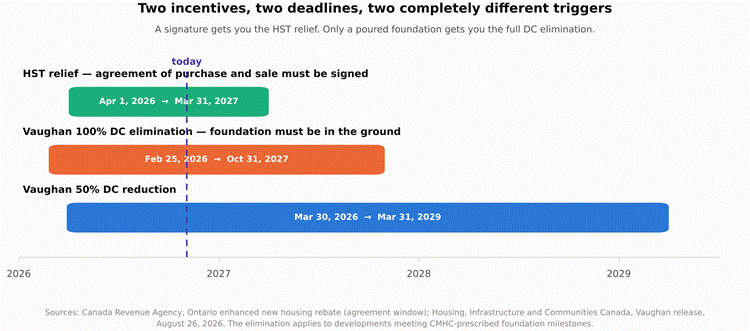
Windows as stated in the official sources.
Three other claims worth checking before you circulate it
York Region at 50% could not be verified. The Vaughan release does not mention York Region, and Vaughan’s 50% is a lower-tier city figure. York Region’s own development charges page shows single-family charges of $55,479 payable at the regional DC agreement plus $29,239 at building permit — $84,718 in total, with no reduction noted. The regional charge is the larger of the two layers. If it has not moved, the saving on a Vaughan single-family lot is materially smaller than a reader would infer.
Toronto at 40 to 60 per cent could not be verified either. No Toronto release was located. The only program-level figure in the material reviewed is the prioritization criterion: funding goes to municipalities that reduce charges “for all residential types by 30 to 50 per cent or greater” and maintain the reduction for at least three years.
The HST window’s start date is missing, as above.
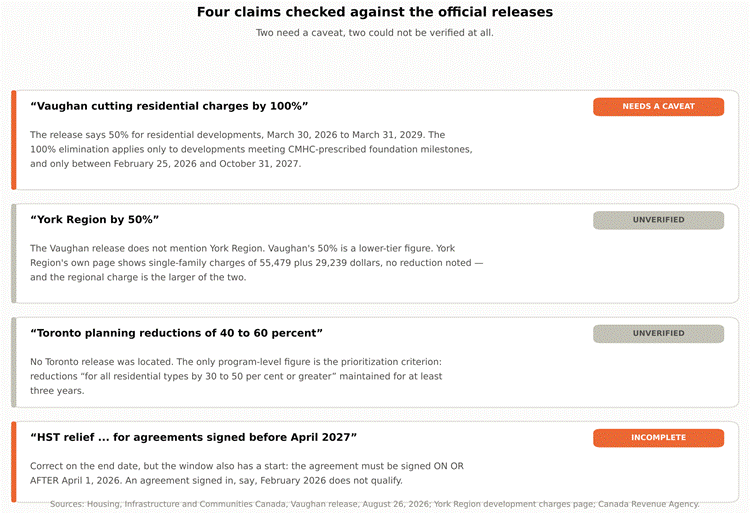
Each claim checked against the primary source.
What the stacking actually adds up to
Ottawa puts a number on it. Vaughan’s DC changes are “estimated to reduce the cost of building new homes by up to $98,056,” and combined with HST relief of up to $130,000 the release says the two “could save Vaughan families up to $230,000.”
Read those as maximums, not entitlements. The $98,056 assumes the full elimination, which assumes the foundation milestone. The $130,000 assumes a home priced at $1 million or more — below that, relief is 13% of price, so an $800,000 home attracts about $104,000, not $130,000. And the city’s own estimate that the savings “would unlock over 120,000 new housing units” is a municipal projection, attributed as such in the release.
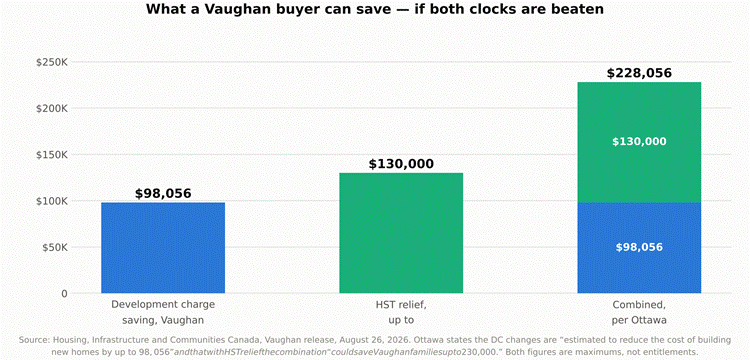
Figures as stated by Housing, Infrastructure and Communities Canada.
What the note gets right
Most of it, and the parts that matter structurally. GTHA condo units under construction are at 35,920, down 38% and the lowest since early 2012. Purpose-built rental absorption is a record 5,092 units year to date, 72% above the ten-year average, with Q3 rental starts of 5,067 units, up 172%. New condo sales are overwhelmingly in completed buildings — a record 85% share in Q3, with bulk purchases at 45% of sales. The Bank of Canada did raise to 2.50% on October 28.
And the note is right on the point most commentary gets wrong: the HST relief is available to all eligible buyers, not only first-time buyers. That is correct and worth repeating.
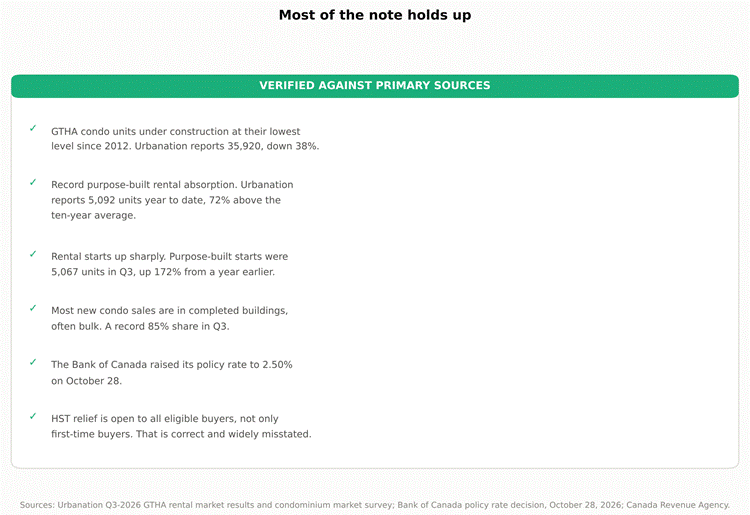
Sources as noted.
| THE ULG VIEW The Bullpen read — that the market is rewarding certainty — is right, but the mechanism is sharper than “certainty.” It is a dated construction milestone. Vaughan’s 100% DC elimination requires a foundation by October 31, 2027, and that single date sorts every parcel in the GTA into two piles: land that can physically get there, and land that cannot. The first pile is bid up. The second is not. That is why ten deals took 58% of volume. Price the window, not the percentage. If a vendor is marketing a Vaughan or York site on “100% DC relief,” the correct question is whether the buyer can realistically pour by October 31, 2027 — site plan approved, permit obtainable, servicing in. If not, the applicable number is 50%, and only until March 31, 2029. Those are different land values. Check the regional layer before you underwrite the saving. York Region’s single-family charges total $84,718 on its own published page with no reduction noted. A 50% cut to the Vaughan lower-tier charge does not touch that. Confirm both layers per site before putting a DC saving into a residual land value. The window closes before the supply gap opens. Condo completions fall to 12,065 units in 2028 and 4,213 in 2029, and the starts that would have filled 2029 have not happened. The incentives expire in 2027 and 2029; the shortage arrives after. A site that cannot hit the 2027 milestones is not disqualified — it is aimed at a different and arguably better window. Underwrite it that way rather than chasing a deadline it cannot meet. One number to confirm before anything is circulated externally: whether York Region and Toronto have in fact committed to reductions. Both claims failed verification here. If a client acts on a regional DC saving that does not exist, that is our problem, not the newsletter’s. |
| WHAT IS CONFIRMED AND WHAT IS NOT Confirmed from the federal release. Vaughan’s 50% residential reduction and its March 30, 2026 to March 31, 2029 term; the 100% elimination for developments meeting CMHC-prescribed foundation milestones from February 25, 2026 to October 31, 2027; the $697.2 million; the prioritization criterion of 30 to 50 per cent or greater maintained at least three years; the $98,056 and $230,000 figures; and the $8.8 billion Canada-Ontario commitment over ten years. Source: Housing, Infrastructure and Communities Canada, August 26, 2026. Confirmed from other primary sources. The HST agreement window of April 1, 2026 to March 31, 2027 and the relief bands, from the Canada Revenue Agency and the Government of Ontario. The Urbanation construction, absorption, starts and sales figures from its Q3-2026 releases. The Bank of Canada’s October 28 move to 2.50%. York Region’s $55,479 and $29,239 single-family charges from its own page. Not verified. York Region’s 50% reduction — the region is upper-tier and is not named in the Vaughan release. Toronto’s 40 to 60 per cent reductions — no release located. The total DCRP funding envelope and the full participating-municipality list were not published in the pages reviewed. Not verifiable here at all. The land transaction figures — $793 million, 61 deals, the distress share, the 58% top-ten concentration, Vaughan’s share of dollar volume and the $226 million six-site acquisition — are from a private research report that was not obtained. They are reported in good faith and cannot be independently checked. The Altus pre-construction count and the BILD September figure were likewise not verified against those organisations’ own releases. ULG’s own. The 361-day and 147-day counts, the $84,718 York Region total, the observation that the foundation milestone rather than the percentage is what sorts the land market, and the read on our own files. Market commentary, not legal or investment advice. |
Sources
OFFICIAL AND PRIMARY SOURCES
· Housing, Infrastructure and Communities Canada — Canada and Ontario making homes more affordable in Vaughan, August 26, 2026. Source of every Vaughan development charge figure, the $697.2 million, and the $98,056 and $230,000 savings estimates. https://www.canada.ca/en/housing-infrastructure-communities/news/2026/08/canada-and-ontario-making-homes-more-affordable-in-vaughan.html
· York Region — Development charges. Source of the $55,479 and $29,239 single-family charges and Bylaw No. 2026-20. https://www.york.ca/business/economic-and-development-services/land-development/development-charges
· Canada Revenue Agency — Who can apply for the Ontario enhanced new housing rebate. Source of the April 1, 2026 to March 31, 2027 agreement window. https://www.canada.ca/en/revenue-agency/services/tax/businesses/topics/gst-hst-businesses/gst-hst-rebates/housing-rebates/ontario-enhanced-new-housing/who-can-apply.html
· Government of Ontario — The Ontario New Home Affordability Payment. Source of the relief bands and the $130,000 combined figure. https://www.ontario.ca/page/ontario-new-home-affordability-payment
· Bank of Canada — Policy rate decision, October 28, 2026. Overnight rate raised to 2.50%; next decision December 9, 2026. https://www.bankofcanada.ca/2026/10/fad-press-release-2026-10-28/
· Toronto Regional Real Estate Board — Market Watch, September 2026. https://trreb.ca/wp-content/files/market-stats/market-watch/mw2609.pdf
PRIVATE RESEARCH — NOT OFFICIAL
· Urbanation Inc. — Q3-2026 GTHA condominium market survey, October 19, 2026. Source of the units-under-construction, completion and new-sales figures. https://www.urbanation.ca/news/gtha-new-condo-sales-double-year-ago-q3
· Urbanation Inc. — Q3-2026 GTHA rental market results, October 27, 2026. Source of the absorption and rental starts figures. https://www.urbanation.ca/news/rental-recovery-begins-gtha-vacancy-and-incentives-fall
· Bullpen Research & Consulting — GTA and GGH land report. The land transaction figures quoted in the originating note come from this series; the Q3-2026 edition was not obtained for this review. https://bullpenconsulting.ca/
Urban Land Group · Land development advisory and commercial real estate · 30 Eglinton Avenue West, Mississauga, Ontario
Sunny Gawri is a registered real estate sales representative with Royal LePage Signature. Market commentary prepared for discussion. Not legal, tax or investment advice, and not an Opinion of Value for any specific property.