
Thirty Buyers Called, Nobody Bid: The Credit Bid Comes To Ontario

A British Columbia court approved a $127.1 million credit bid last week after a full sale process produced no competing offer. The mechanism matters here because a Markham condominium entered receivership six days earlier, and the same question is about to be asked.
Urban Land Group · October 20, 2026
Start with the disclosure: this is not an Ontario transaction. Portwood is a 23-acre redevelopment in Port Moody, British Columbia, originally conceived by Edgar Development, and the Supreme Court of British Columbia approved the transaction on October 13. Connect CRE files the story under B.C. We are writing it up because the mechanism it demonstrates is the one that will determine the outcome of several Ontario files now in front of the courts.
Woodbourne-affiliated lenders will take phases three to five under a $127.1 million credit bid. Woodbourne already held a second mortgage and a 50% equity interest in the affected phases, and its affiliates acquired the matured first mortgage from QuadReal in March. Phase three is a planned rental and retail component; phases four and five contemplate a further 1,376 condominium units, for which development permits have not been issued. The transaction involves secured debt rather than a cash payment.

Reported terms. The project and the court are both in British Columbia.
The number that matters is zero
PricewaterhouseCoopers, as court-appointed monitor, approached 30 parties described as having experience in multi-phase development and the financial capacity to complete a transaction of this size. Six engaged with the monitor. Three signed confidentiality agreements. By the bid deadline of September 24, none had submitted a bid. Woodbourne’s credit bid had been set up as a stalking-horse — a court-approved floor the market was invited to beat — and the market declined.
That is the pattern worth carrying into every conversation about a stalled development site. A credit bid is not a lender outbidding competitors. It is what remains when a properly run, court-supervised process establishes that no qualified buyer exists above the level of the senior debt.
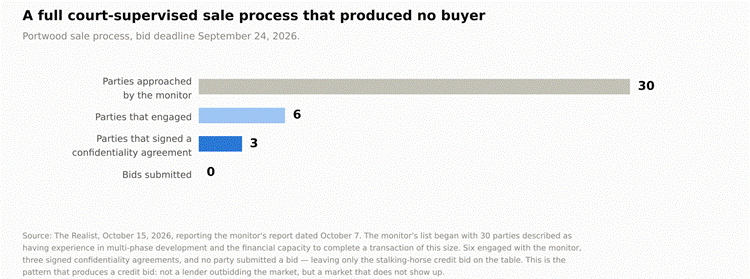
Thirty to zero, through a full court-supervised process with a public bid deadline.
How the mechanism works
A credit bid lets a secured creditor bid the debt it is already owed instead of writing a cheque. Because it is a set-off rather than new money, nothing arrives to distribute down the capital stack. Everyone ranking behind the bidding lender — junior mortgagees, unsecured trade creditors, equity — is extinguished at that price. In Ontario the live question is usually where construction lien claimants sit, and that is answered by statute and by the registration history, not by the size of the bid.
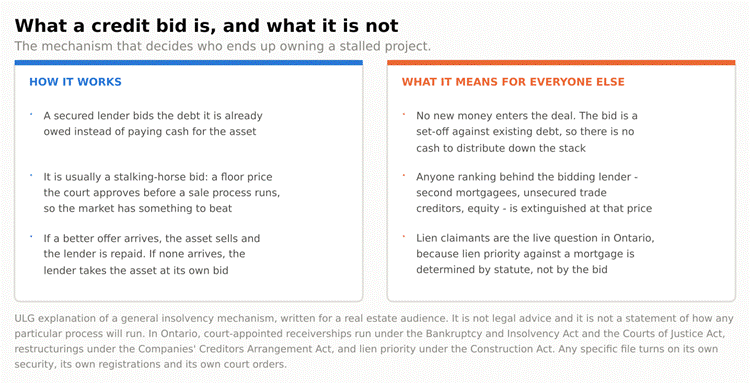
A general description of the mechanism, written for a real estate audience. Not legal advice.
Why this lands in Markham
On October 14 — the day after the Portwood approval — Sher Markham Inc. and Sher Holdings Inc. were placed into receivership by the Ontario Superior Court of Justice, with Grant Thornton appointed receiver, manager and construction lien trustee on the application of Meridian Credit Union, owed approximately $57.7 million. The project, Everhome at 9704 McCowan Road, is approximately 86% complete with 103 of 131 residential units pre-sold. Twenty-one construction lien claims totalling about $11.4 million were registered by October 7, and completing construction was estimated to cost more than $17.3 million.
If a sale process runs and produces what Portwood’s produced, Meridian is in a position to bid its debt. Whether that leaves anything for the lien claimants depends on priority, which is a Construction Act question and not a bidding question. Whether it leaves anything for the 103 purchasers is a separate question again, and one we addressed in yesterday’s note on deposit protection.

Reported figures. The $86.4 million total is ULG addition; priority between the mortgage and the liens is not established here.
| THE ULG VIEW First, this one is not Ontario. Portwood is in Port Moody, British Columbia, and the Supreme Court of British Columbia approved the bid. The Connect CRE item is filed under B.C. It is worth reading anyway, because the mechanism it demonstrates is about to decide the outcome of several Ontario files, including one that went into receivership six days earlier in Markham. The headline number is not the story. The number zero is. The monitor approached 30 parties with multi-phase development experience and the financial capacity to close. Six engaged. Three signed confidentiality agreements. None bid. A credit bid is not a lender outbidding the market — it is what is left when a court-supervised process finds the market does not exist at any price above the debt. That is the test to apply to every stalled Ontario condominium right now. Not what the project is worth on a residual land value calculation, but whether a qualified buyer would actually show up at a court-run sale. Portwood is 23 acres with a development agreement in place, two phases already selling and a rental and retail component. If that drew nothing, the bar is higher than most owners of entitled GTA density currently believe. Everhome is the Ontario version of this question and it is already in play. Meridian is owed approximately $57.7 million and has a receiver appointed. If Grant Thornton runs a sale process and the result looks like Portwood’s, Meridian can bid its debt. The practical question for everyone else is where the 21 registered lien claims totalling $11.4 million sit relative to that mortgage, and that is determined by the Construction Act and the registration history — not by the size of anyone’s bid. For a brokerage file, the operational consequence is about who you call. If a receiver or monitor is running a process on a GTA development site, the buyer list is short and getting shorter, and the parties on it are not the ones who were bidding in 2021. Knowing which groups can actually close a multi-phase development transaction today — and being on a monitor’s initial list of thirty rather than hearing about it afterward — is worth more than any marketing package. And for a vendor still holding entitled density, it reframes the timing question. A credit bid outcome sets a visible market reference point: a court approved a transfer at the level of the senior debt because nothing better existed. Every one of those that gets approved makes it harder to argue that an entitled site is worth a number materially above its debt. If you are advising on a sale, the comparable set now includes insolvency outcomes, not just arm’s-length trades. One caution on reading across. Portwood’s phases were described by the monitor as interdependent, with no building on the later lands occupiable until below-grade work on the earlier phase was substantially complete. That interdependency is a specific reason a partial sale was unattractive and may explain part of the empty room. Not every stalled project carries that constraint, and the Portwood result should not be treated as a general verdict on development land. |
| WHAT IS CONFIRMED AND WHAT IS NOT This is a British Columbia transaction, reported by trade press. Connect CRE Canada on October 19, 2026 and The Realist on October 15, 2026 report that the Supreme Court of British Columbia approved a $127.1 million credit bid on October 13 from Woodbourne-affiliated lenders, with PricewaterhouseCoopers as court-appointed monitor. We have not read the court file or the monitor’s report. The two sources disagree on one detail and leave several open. Connect CRE describes the site as 23 acres; The Realist’s metadata says 24. Neither names the governing statute, gives a total debt figure, states the acreage of the phases being transferred, or says what happens to purchasers in the phases not included in the transaction. The Realist article is partly paywalled and its account of the BC Housing litigation was not readable. The 1,376-unit figure is Connect CRE’s. It is described as contemplated for phases four and five, for which development permits have not been issued. It is not an approved entitlement. The Ontario material is carried from our October 19 note on Everhome and rests on Insolvency Insider’s reporting of October 18, 2026. We were unable to locate a public receiver case website for that matter. The explanation of how a credit bid works is ULG’s, written for a real estate audience. It is a general description of a common insolvency mechanism, not legal advice, and not a statement of how any particular process will run. We could not verify two legal authorities directly. The Ontario Court of Appeal’s framework for approving a receiver’s sale and the Construction Act’s lien priority provisions are both cited here by name only. The CanLII page for the leading authority and the e-Laws page for the statute could not be retrieved by automated fetch, so no section numbers, tests or wording are quoted. Anyone relying on either should read the source or take advice. Nothing here is legal advice. Priority between a mortgage and construction liens, the treatment of purchase agreements, and the effect of any court order are all file-specific questions for counsel. |
SOURCES
Statutes and authorities (cited by name; see the note above)
· Canada — Bankruptcy and Insolvency Act (court-appointed receivers) https://laws-lois.justice.gc.ca/eng/acts/b-3/
· Canada — Companies’ Creditors Arrangement Act https://laws-lois.justice.gc.ca/eng/acts/c-36/
· Ontario — Construction Act (lien priority, holdback and trust provisions) https://www.ontario.ca/laws/statute/90c30
· Ontario — Courts of Justice Act https://www.ontario.ca/laws/statute/90c43
· Royal Bank of Canada v. Soundair Corp., 1991 CanLII 2727 (ON CA) — the leading Ontario authority on approving a receiver’s sale https://www.canlii.org/en/on/onca/doc/1991/1991canlii2727/1991canlii2727.html
· Ontario Superior Court of Justice — Commercial List https://www.ontariocourts.ca/scj/practice/practice-directions/toronto/commercial-list/
· Tarion — Bankruptcies, insolvencies and receiverships (purchaser deposit position) https://www.tarion.com/bankruptcies-insolvencies-receiverships
Trade press (not official)
· Connect CRE Canada — Woodbourne to take Portwood development with $127.1M credit bid, October 19, 2026 https://www.connectcre.ca/stories/woodbourne-to-take-portwood-development-with-127-1m-credit-bid/
· The Realist — BC Housing sues Portwood developers as court approves Woodbourne’s $127.1M bid, October 15, 2026 https://howardchai.substack.com/p/port-moody-portwood-woodbourne-purchase-edgar-bc-housing-lawsuit
· Insolvency Insider — Ontario court orders receivership of stalled Markham condo project owing $57.7 million to Meridian, October 18, 2026 https://insolvencyinsider.ca/p/ontario-court-orders-receivership-of-stalled-markham-condo-project-owing-57-7-million-to-meridian
Prepared by Urban Land Group. Sunny Gawri is a registered sales representative with Royal LePage Signature Realty, Brokerage. This document is market commentary prepared for discussion purposes. All arithmetic identified as ULG calculation is our own. Nothing here is an appraisal, an Opinion of Value, or investment, legal or tax advice, and nothing here is a statement of priority, entitlement or outcome in any insolvency proceeding.