
The $2 Billion Heat Pump Rebate, Read From An Ontario Rate Sheet
Ottawa announced a national heat pump rebate on October 8. In Ontario, where most homes run on cheap natural gas, the operating case fails for the majority of the target market. The part of the announcement that matters to anyone underwriting rental is a single line about CMHC mortgage insurance.
Urban Land Group · October 9, 2026
On October 8 the Prime Minister announced a $2 billion investment to deliver one million home retrofits, built around a National Heat Pump Rebate. Below-median-income households can receive up to $10,000 toward an electric heat pump. Every other eligible household receives $2,000. Both stack with existing provincial programs. Applications run through an online portal with no energy audit before or after installation, and approvals are promised within 24 hours.
The program targets up to 820,000 households. A separate set of measures targets 280,000 apartment units over eight years. The release claims over 25 megatonnes of emissions reductions and quotes average savings of $1,400 a year — for households heating with oil or electric baseboards.
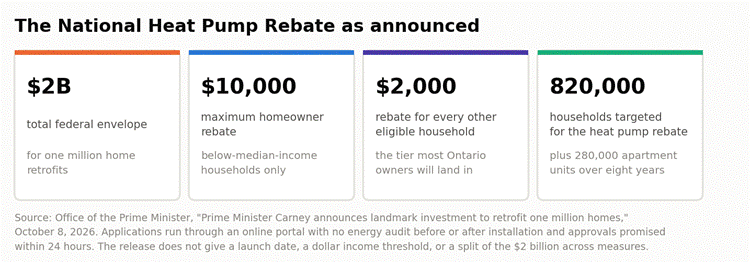
Terms as published by the Office of the Prime Minister on October 8, 2026.
The sentence that is doing the most work is the one about oil and baseboards
The $1,400 figure is not a general claim. It is quoted specifically for households heating with oil or electric baseboards, and the release offers no savings figure for natural gas. That omission is the whole Ontario story, because natural gas is the main household energy source in Ontario.
Run the arithmetic from the published rates. Enbridge Gas EGD Rate 1, effective October 1, 2026, prices gas supply at 9.1080 cents per cubic metre, transportation at 5.4818 cents, and tiered delivery that averages 13.11 cents at a consumption of 200 cubic metres a month — 27.70 cents per cubic metre in total. A cubic metre carries about 10.42 kilowatt-hours; at 95% furnace efficiency that is 9.90 kilowatt-hours of delivered heat, or 2.8 cents per kilowatt-hour.
Now the heat pump. The Ontario Energy Board’s tiered Regulated Price Plan prices Tier 2 electricity at 14.2 cents per kilowatt-hour, and a household running a heat pump through an Ontario winter will be in Tier 2. At a seasonal coefficient of performance of 2.75, delivered heat costs 5.2 cents per kilowatt-hour. That is roughly 1.8 times the gas number — and it excludes electricity distribution and regulatory charges, which would widen the gap. The federal consumer carbon charge was removed in 2025, so there is no longer a carbon price working in the heat pump’s favour either.
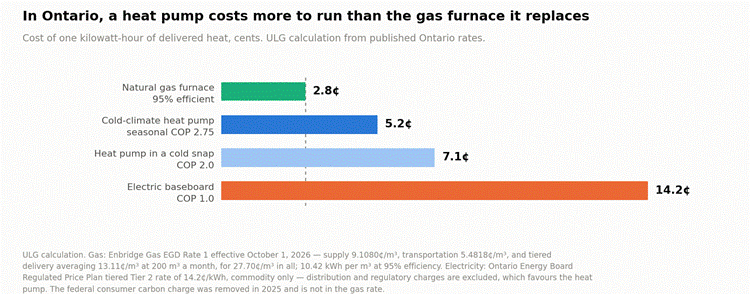
The comparison is deliberately generous to the heat pump: gas delivery charges are included, electricity delivery charges are not.
The same arithmetic explains why the government’s $1,400 figure is defensible where it is claimed. Against electric baseboard at 14.2 cents, a heat pump at 5.2 cents saves about 9 cents per kilowatt-hour of heat. On a home needing roughly 15,000 kilowatt-hours of heat a year, that is about $1,350 — within rounding of the figure in the release.
The envelope will not cover the headline rebate
Two billion dollars across 820,000 households is $2,439 each. Solve for how many households can receive the maximum: if the balance receive $2,000, only about 45,000 households — roughly 5.5% of the target — can be paid $10,000 before the money is gone. That calculation also assumes the entire $2 billion goes to the homeowner rebate, with nothing left for the apartment measures or program administration.
Against that, the Ontario stack is genuinely large. The provincial Home Renovation Savings Program, delivered by Save on Energy and Enbridge Gas, pays up to $7,500 for a cold-climate air source heat pump and up to $12,000 for a ground source system, with the amount varying by equipment size. Stacked with the federal tiers, an Ontario homeowner is looking at $9,500 in the common case and up to $22,000 at the ground-source maximum.
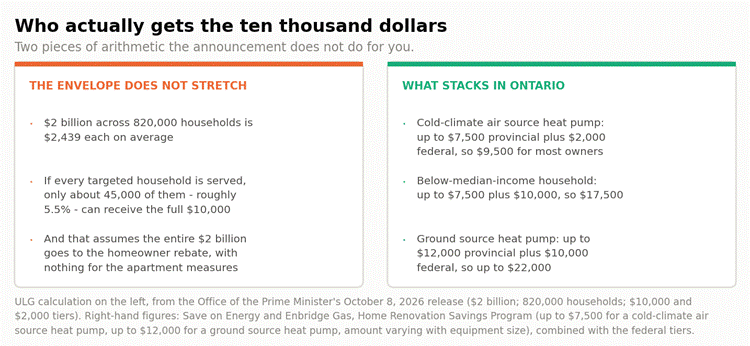
Left-hand figures are ULG arithmetic on the published totals; right-hand figures combine the provincial and federal programs as published.
What this actually changes for a rental or development file
The apartment side of the announcement is 280,000 units over eight years, and 250,000 of those come from CMHC Multi-Unit Mortgage Loan Insurance — the MLI Select product. The release notes that the same product has already supported over 140,000 energy-efficient units. No new grant capital for apartment retrofits was announced. What was announced is a target applied to a program that was already operating.
That does not make it irrelevant. Under MLI Select, an existing property that reduces energy consumption by at least 15% against its current baseline earns 20 points, 25% earns 35 points, and 40% earns 50 points. Fifty points unlocks 85% loan-to-cost and a 40-year amortization on an existing building; seventy points lifts that to 95% and 45 years; one hundred points reaches a 50-year amortization. On an electrically heated building, a heat pump retrofit is the most direct path to the first tranche of those points, and the provincial rebate now offsets part of the equipment cost.
| THE ULG VIEW Read the apartment line, not the headline. Of the 280,000 apartment units in this announcement, 250,000 come from CMHC Multi-Unit Mortgage Loan Insurance — MLI Select. That is mortgage insurance, not a grant, and it already exists; the release itself notes the product has supported over 140,000 energy-efficient units to date. The federal government is counting a program that is already running toward a new target. For anyone underwriting rental, that is the operative fact: no new capital subsidy for apartment retrofits was announced, and the $2 billion is overwhelmingly a homeowner cheque. On an MLI Select file the energy points are still the cheapest points on the board. For an existing property, a 15% reduction against the current baseline earns 20 points, 25% earns 35, and 40% earns 50. Fifty points total gets 85% loan-to-cost and a 40-year amortization; seventy gets 95% and 45 years; one hundred gets 50 years. On an electrically heated existing building, a heat pump retrofit is the most direct route to the first 20 or 35 of those points, and the provincial rebate now carries part of the capital cost. In Ontario the homeowner rebate largely does not pay for itself, and the government’s own release says so by omission. The $1,400 average annual saving is quoted for households heating with oil or electric baseboards. It is not quoted for gas, and our arithmetic from published Ontario rates shows why: a heat pump at a seasonal coefficient of performance of 2.75 costs roughly 5.2 cents per kilowatt-hour of delivered heat against 2.8 cents for a 95% gas furnace, and that comparison already excludes electricity distribution charges. Natural gas is the main household energy source in Ontario. For most Ontario homes this is a capital subsidy to raise an operating bill. The subsidy stack is real even where the operating case is not. Up to $7,500 provincially plus $2,000 federally is $9,500 against the installed cost of a cold-climate air source heat pump. That is enough to change the capital decision on a system replacement at end of life, particularly in a rental where the owner pays the equipment and the tenant pays the hydro. Note that split-incentive carefully before you assume a landlord will do this voluntarily. Where it changes a land file: electrically heated stock and off-gas sites. The cohort where the math genuinely works is oil, propane and baseboard — rural and small-town Ontario, older walk-up apartment buildings, and sites with no gas service at all. On an unserviced or partly serviced parcel, the cost of bringing gas to the site has always been a line in the pro forma. An all-electric building with a heat pump plant, an MLI Select energy point score behind it and two layers of rebate against the equipment is now a more defensible base case than it was a week ago. That is a scenario worth re-running, not a conclusion. |
| WHAT IS CONFIRMED AND WHAT IS NOT There is no launch date. The Prime Minister’s release says the program is launching but gives no opening date for the portal. Reporting has suggested early next year; that is not in the release. There is no published income threshold. Eligibility for the $10,000 tier is stated only as below-median-income. No dollar figure, household-size adjustment or income-test mechanism has been published. The $2 billion has not been split. The release does not say how much goes to the homeowner rebate versus the apartment measures or administration. Every allocation figure in this document is ULG arithmetic on the published totals and is labelled as such. The operating cost comparison is our calculation, not a government or utility figure. It uses Enbridge Gas EGD Rate 1 effective October 1, 2026 and the Ontario Energy Board Regulated Price Plan tiered rates effective November 1, 2025. Electricity distribution, regulatory charges and the Ontario Electricity Rebate are excluded, which flatters the heat pump. Coefficient of performance assumptions are ours. Actual results turn on the building envelope, the equipment selected and the rate plan. Landlord and rental eligibility for the homeowner rebate is not addressed. The release speaks to homeowners and separately to apartment building owners. Whether a single-family or small rental property qualifies for the $2,000 or $10,000 tier is not stated. Enbridge’s tiered delivery rate varies with consumption. Our 13.11 cents per cubic metre is the blended delivery rate at 200 cubic metres a month. A lower-use household pays a higher average rate, which narrows the gap modestly. |
SOURCES
Official and primary sources
· Office of the Prime Minister — Prime Minister Carney announces landmark investment to retrofit one million homes, October 8, 2026 https://www.pm.gc.ca/en/news/news-releases/2026/10/08/prime-minister-carney-announces-landmark-investment-retrofit-one
· Government of Canada, Housing, Infrastructure and Communities — same announcement with quick facts https://www.canada.ca/en/housing-infrastructure-communities/news/2026/10/prime-minister-carney-announces-landmark-investment-to-retrofit-one-million-homes-cutting-energy-costs-and-emissions.html
· Ontario Energy Board — Regulated Price Plan electricity rates, effective November 1, 2025 https://www.oeb.ca/consumer-information-and-protection/electricity-rates
· Enbridge Gas — EGD Rate 1 residential rate notice, effective October 1, 2026 https://www.enbridgegas.com/-/media/Extranet-Pages/ontario/residential/myaccount/rates/EGD—Rate-1—System-Notice.pdf
· Save on Energy and Enbridge Gas — Home Renovation Savings Program rebate amounts https://saveonenergy.ca/For-Your-Home/Home-Renovation-Savings
· CMHC — MLI Select product sheet, point tiers and energy efficiency criteria https://assets.cmhc-schl.gc.ca/sites/cmhc/professional/project-funding-and-mortgage-financing/mortgage-loan-insurance/multi-unit-insurance/mliselect/mli-select.pdf
· Statistics Canada — The price on heat, and how it is generated (natural gas as Ontario’s main household energy source) https://www.statcan.gc.ca/o1/en/plus/8614-price-heat-and-how-its-generated
Press coverage (not official)
· CBC News — What we know about Ottawa’s $2B rebate plan for heat pumps https://www.cbc.ca/news/canada/canada-heat-pump-retrofit-faq-9.7374613
· CTV News — $2B heat pump rebate program unveiled by federal government https://www.ctvnews.ca/politics/article/in-the-market-for-a-new-heating-system-federal-government-unveils-2b-heat-pump-rebate-program/
· Canadian Mortgage Trends — Ottawa unveils $2-billion home retrofit plan https://www.canadianmortgagetrends.com/2026/10/ottawa-unveils-2-billion-home-retrofit-plan/
Prepared by Urban Land Group. Sunny Gawri is a registered sales representative with Royal LePage Signature Realty, Brokerage. This document is market commentary prepared for discussion purposes. All arithmetic identified as ULG calculation is our own and is not sourced from any government, utility or agency. Nothing here is an appraisal, an Opinion of Value, or investment, legal, tax or energy engineering advice.