
Three Implementation Deadlines That Change Land Diligence: December 2, January 1, and March 2031.
A $1-billion infrastructure stream for municipalities that charge no development charges, a Tribunal clearing more cases than it receives, and the end of the Municipal Class EA. The Tribunal’s own numbers also correct a figure now circulating.
Urban Land Group · October 7, 2026
The funding stream, and who is locked out of it
Ontario and Canada have committed $1 billion — $500 million each, through the Municipal Housing Infrastructure Program and the federal Build Communities Strong Fund — to municipalities that do not levy residential development charges and had no active residential DC by-law as of March 30, 2026. Applications open October 29 and close December 2, 2026 at 4:59 p.m.
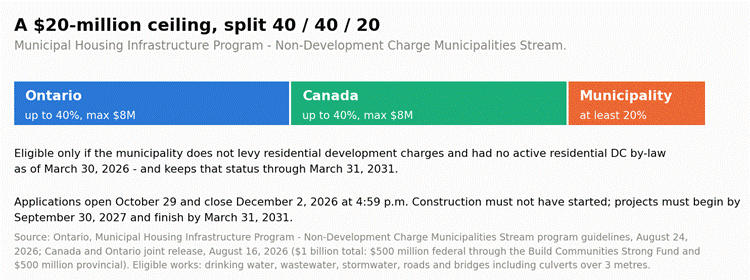
Figure 1 — The cost-sharing structure and the conditions attached.
Eligible works are drinking water, wastewater, stormwater, roads and bridges, including culverts spanning more than three metres. Two conditions matter more than the dollars: construction cannot already have started, and a recipient must remain free of residential development charges through March 31, 2031.
What the Tribunal’s own report says
The Ontario Land Tribunal’s 2025-26 Annual Report, released September 25, covers the year ended March 31, 2026. A figure now circulating has the two headline numbers reversed.
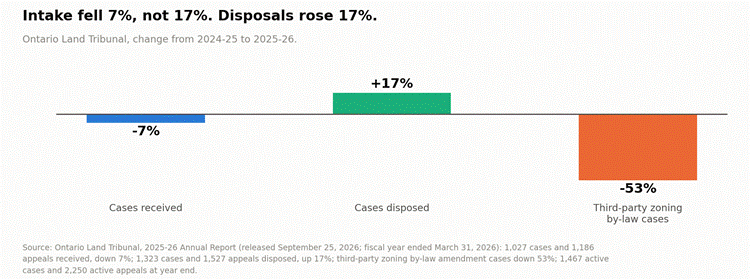
Figure 2 — The Tribunal’s year, as reported.
The Tribunal received 1,027 cases and 1,186 appeals, down 7%, and disposed of 1,323 cases and 1,527 appeals, up 17%. Third-party zoning by-law amendment cases fell 53%. On mediation: 83 of 86 formal mediations resolved — 98% — plus 28 of 32 simplified mediations. Service standards were met on acknowledgements (95% within ten days) but missed on first hearings (77% within 120 days against an 85% target).
The Class EA ends on January 1
Ontario Regulation 258/26, with the decision posted August 6, 2026, replaces the Municipal Class Environmental Assessment on January 1, 2027. “Schedule B” and “Schedule C” stop being the right vocabulary.
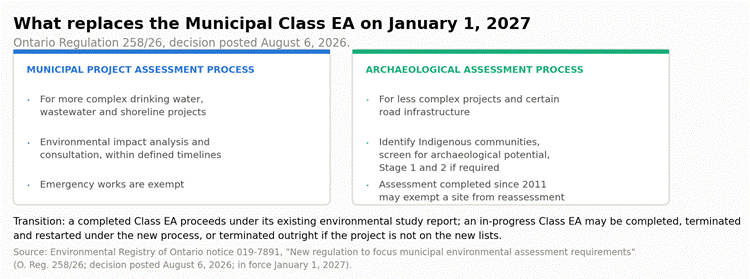
Figure 3 — The two new pathways.
| WHAT WE CHECKED Every figure here was verified against the primary document. The funding structure, eligibility date and deadlines are from Ontario’s own program guidelines dated August 24, 2026 and the federal-provincial release of August 16, 2026. The Tribunal statistics are from its 2025-26 Annual Report, released September 25, 2026, for the year ended March 31, 2026 — which is where the 7% and 17% figures come from, in the opposite arrangement to the post that prompted this note. The environmental assessment framework is Environmental Registry notice 019-7891 and Ontario Regulation 258/26. The Whitchurch-Stouffville decision is Environmental Registry notice 019-8976. One nuance the summaries miss: the Minister refused the withheld employment-area policies on September 18, 2026, but the Town had already adopted its own official plan amendment on July 13, 2026 to address them, and that amendment is in effect with no appeals filed. The refusal is not a gap in the Town’s policy framework — it is the Province declining to approve provisions the municipality had already replaced. Statutory interpretation here is for planning and legal counsel; this note is not legal advice. |
| THE ULG VIEW One correction first, because it runs the wrong way. The Tribunal’s intake fell 7%, not 17% — it was disposals that rose 17%. The post has the figures transposed. The direction of travel is the same, and arguably better than reported: the Tribunal received 1,027 cases and cleared 1,323, so it is working down the backlog rather than merely receiving less work. Third-party zoning by-law cases really are down 53%, and 1,467 cases were still active at year end. The mediation number deserves the attention it is getting: 83 of 86 formal mediations resolved, a 98% rate, plus 28 of 32 simplified mediations. Read that beside the Erin Mills settlement — 3,162 units kept, seven storeys given up — and the pattern is clear. At the Tribunal, the contested merits hearing is now the exception; the negotiated order is the norm. Budget for a settlement position with the engineering and planning evidence behind it, not only for a hearing. The funding stream is not a GTA story, and that is exactly why it matters to land buyers. Toronto, Mississauga, Oakville, Burlington and Hamilton all levy development charges and are ineligible. The money is for rural, small and northern municipalities that charge no residential DCs — and a recipient must stay DC-free until March 31, 2031. For anyone underwriting land in those townships, that is a five-year guarantee of no residential development charges on a serviced lot, with up to $16 million of senior-government money paying for the water, wastewater or road capacity that unlocks it. Check the DC status of the municipality before you check the zoning. And the January 1, 2027 date is a live diligence item now, not a 2027 one. Where a servicing project gates a plan of subdivision — a trunk sewer, a water main, a bridge — the Class EA it is riding on may be completed, restarted under the new Municipal Project Assessment Process, or abandoned. Ask the municipality which path it is taking before you condition a purchase on servicing timing, and on any employment-land acquisition, confirm the municipality has actually brought its employment-area mapping into conformity with the 2024 Provincial Planning Statement — Whitchurch-Stouffville had its employment policies refused outright in September. |
Sources
· Ontario — Municipal Housing Infrastructure Program, Non-Development Charge Municipalities Stream, application guide and program guidelines (Central Forms Repository, form ON00964). https://forms.mgcs.gov.on.ca/en/dataset/on00964
· Government of Canada and Ontario — “The Government of Canada and Ontario investing $1 billion to help Non-Development Charge Municipalities build more homes,” August 16, 2026. https://www.canada.ca/en/housing-infrastructure-communities/news/2026/08/the-government-of-canada-and-ontario-investing-1-billion-to-help-non-development-charge-municipalities-build-more-homes.html
· Ontario Land Tribunal — 2025-26 Annual Report (year ended March 31, 2026). https://olt.gov.on.ca/wp-content/uploads/2025-26_OLT_Annual_Report_EN.pdf
· Ontario Land Tribunal — “OLT Releases 2025-26 Annual Report,” September 25, 2026. https://olt.gov.on.ca/blog/news/olt-releases-2025-26-annual-report/
· Environmental Registry of Ontario — notice 019-7891, “New regulation to focus municipal environmental assessment requirements” (O. Reg. 258/26, in force January 1, 2027). https://ero.ontario.ca/notice/019-7891
· Environmental Registry of Ontario — notice 019-8976, Town of Whitchurch-Stouffville official plan decision (employment area policies refused September 18, 2026). https://ero.ontario.ca/notice/019-8976
· Ministry of Municipal Affairs and Housing — Notice of Decision, Whitchurch-Stouffville Official Plan. https://ero.ontario.ca/public/2025-09/Notice%20of%20Decision%20-%20Whitchurch-Stouffville%20Official%20Plan_0.pdf
Charts by Urban Land Group from Ontario, federal, Tribunal and Environmental Registry documents. Figures are as published in those documents. General market commentary; not legal, planning, engineering or financial advice — confirm program eligibility and environmental assessment pathways with the relevant ministry and qualified advisors before relying on them.