
$18,475 on a $1.1-Million Home: What Scrapping Toronto’s Land Transfer Tax Would and Would Not Do.
A mayoral campaign has proposed exempting principal residences from the municipal land transfer tax below the city’s average price. The municipal tax is real money — and the provincial one, which is the same size, stays exactly where it is.
Urban Land Group · October 1, 2026
A campaign release dated September 29, 2026 proposes eliminating Toronto’s Municipal Land Transfer Tax on the value of an eligible principal residence below the previous year’s average Toronto sale price — $1.1 million on the campaign’s figure — with the threshold indexed annually. Two parts: the first-time buyer rebate, fixed at $400,000 since 2008, would be re-based to that average; and a new Principal Residence Rebate would extend the same relief to existing Toronto owners who sell one home and buy another in the city within six months. Investors, multi-property owners, corporations and commercial purchasers would be excluded, and the graduated rates on homes above $3 million would remain.
What the tax actually costs at that price
Toronto’s brackets run 0.5% to $55,000, 1.0% to $250,000, 1.5% to $400,000 and 2.0% to $2 million. On $1.1 million that is $18,475. The existing first-time buyer rebate is capped at $4,475 — which fully covers a $400,000 purchase and nothing more.
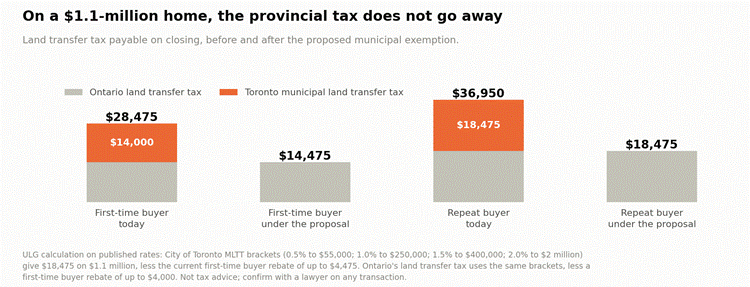
Figure 1 — Land transfer tax on a $1.1-million purchase, today and under the proposal.
So the saving is about $18,475 for a repeat buyer and about $14,000 of new saving for a first-time buyer, who already receives the existing rebate. In both cases Ontario’s land transfer tax — roughly the same amount again — continues to apply.
The money, and where it would come from
The City’s 2026 Budget books $850 million of MLTT revenue, 4.5% of an $18.9-billion operating budget. The campaign puts the cost of the exemption at approximately $300 million a year, to be funded by amortising capital projects over their useful life rather than paying from the operating budget, and by dividends from a proposed municipally owned water utility.
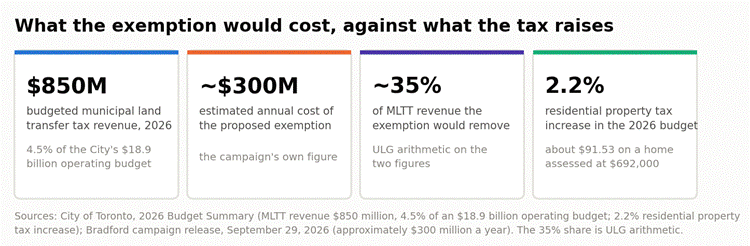
Figure 2 — The cost against the revenue line.
The brackets this touches, and the ones it does not
Council adopted graduated rates on higher-value homes on December 17, 2025, effective April 1, 2026: 4.40% between $3 and $4 million, rising to 8.60% above $20 million. Those stay. At the same meeting, a motion to raise the first-time buyer rebate threshold to $800,000 was defeated 4 votes to 19.
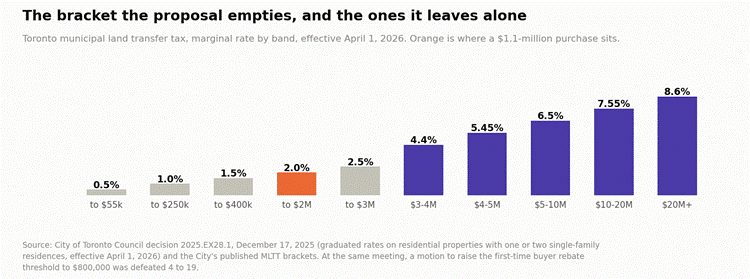
Figure 3 — The municipal rate ladder.
| WHAT IS OFFICIAL, AND WHAT IS CAMPAIGN MATERIAL The document behind this note is a campaign release issued during a municipal election campaign; the election is October 26, 2026. Claims in it about an opponent’s record, property tax increases, water rates and food bank use are political assertions and are not reproduced or assessed here. We take no position on any candidate. The “2.6% of homes” and “two thirds of homes” coverage figures are the campaign’s, drawn from board data, and we have not verified them. Official and verifiable: the MLTT rate brackets, including the graduated rates on homes above $3 million adopted by Council on December 17, 2025 and effective April 1, 2026; the defeat of the motion to raise the first-time buyer rebate threshold to $800,000 by 4 votes to 19 at that meeting; the first-time buyer rebate maximum of $4,475; and the 2026 Budget’s $850 million of budgeted MLTT revenue within an $18.9 billion operating budget. Tax figures in Figure 1 are ULG calculations on published rates, not tax advice. |
| THE ULG VIEW Take the arithmetic first, because the headline number is right for one buyer and wrong for another. On a $1.1-million purchase the Toronto tax is $18,475. A repeat buyer saves all of it. A first-time buyer already receives up to $4,475 today, so the incremental saving is about $14,000 — still large, but not the figure in the release. And in every case Ontario’s land transfer tax is untouched: roughly $18,475 more, less up to $4,000 for a first-time buyer. Nobody is closing tax-free. The move-up and downsize provision is the part that would actually change transaction volumes. A tax that is charged on moving suppresses moving; removing it on principal residences, both ends, is aimed squarely at the chain — the downsizer who frees a house, the condo owner moving to a house. If it passes, expect listing supply in the 416 to improve before prices do. That is the mechanism a brokerage should care about, more than the slogan. Now the two things the release does not say. First, a buyer-side tax cut into fixed supply is partly capitalised into price — the vendor captures some of it. Treat the $18,475 as shared between buyer and seller, not banked by the buyer. Second, the threshold is indexed to the previous year’s average price, so the cost grows automatically with the market: roughly $300 million today, against $850 million of budgeted MLTT revenue — about 35% of the line, funded by amortising capital costs (that is, more debt) and dividends from a municipal water utility. Both are structural changes that Council, not a mayor, decides. What to tell a client this week: nothing has changed yet. The proposal applies to agreements dated on or after September 29, 2026 subject to Council approval, by a candidate in an election being held October 26. Do not restructure a closing, a condition or a possession date around it, and do not let a buyer underwrite affordability on $18,000 that does not yet exist. If it is enacted later with that retroactive date, the rebate is claimed after the fact — which is an administrative question for the client’s lawyer, not a reason to change a deal today. |
Sources
· City of Toronto — Municipal Land Transfer Tax (rates, rebates, and the December 17, 2025 amendment effective April 1, 2026). https://www.toronto.ca/services-payments/property-taxes-utilities/municipal-land-transfer-tax-mltt/
· City of Toronto — Council agenda item 2025.EX28.1, December 17, 2025 (graduated rates above $3 million; motion 5b to raise the first-time buyer rebate threshold to $800,000 defeated 4-19). https://secure.toronto.ca/council/agenda-item.do?item=2025.EX28.1
· City of Toronto — 2026 Budget Summary ($850 million budgeted MLTT revenue, 4.5% of an $18.9 billion operating budget; 2.2% residential property tax increase). https://www.toronto.ca/wp-content/uploads/2026/05/8f04-2026-City-of-Toronto-Budget-Summary.pdf
· City of Toronto — 2026 Budget (City budget centre). https://www.toronto.ca/city-government/budget-finances/city-budget/
· TRREB — 2025 year-end market release (GTA average selling price $1,067,968 in 2025, 62,433 sales) — board data. https://trreb.ca/2025-ends-with-more-affordable-market-and-paves-the-way-for-year-of-recovery/
· Bradford campaign — “Brad Bradford will eliminate Toronto’s land transfer tax for the average homebuyer,” September 29, 2026 (campaign material). https://bradford26.ca/news/brad-bradford-toronto-mayor-will-eliminate-torontos-land-transfer-tax-for-the-average-homebuyer
Charts by Urban Land Group. Tax calculations are ULG arithmetic on published City of Toronto and Ontario rates and are illustrative only — not tax or legal advice. This note describes a campaign proposal during an election period and does not endorse or oppose any candidate. General market commentary; not investment or financial advice.