
Single-Family Sales Tripled. Condo Sales Are 78% Below Average. Both Are the Same Policy.
RESCON’s Housing Summit heard that reform is working but not fast enough. The official numbers say the supply gap is wider than the figure quoted from the podium, and the HST rebate did exactly what its eligibility rules were written to do.
Urban Land Group · September 29, 2026
RESCON’s Housing Summit 6.0, held September 23, produced a consistent message: things are improving, and it is nowhere near enough. Carleton’s Ian Lee put Canadian production at roughly 250,000 homes a year against a need he cited as 400,000 to 470,000. TRREB’s Jason Mercer said the income needed to buy a $1-million GTA home has fallen from above $200,000 to roughly $140,000–$150,000. Minister Rob Flack pointed to development charges now payable at occupancy, streamlined site plans, and the HST relief on new homes. Abacus Data’s David Coletto reported 79% of Canadians think the housing system is broken, and just 16% of Ontarians think the province is heading in the right direction.
The gap is wider than the number quoted
CMHC’s published estimate is 430,000 to 480,000 units a year to 2035 to return to 2019 affordability — not 400,000 to 470,000. CMHC’s own description is that this is “an approximate doubling of the current pace.” And the pace is easing, not accelerating: 229,046 units annualised in August 2026, with the six-month trend down 1.3% and actual starts in centres over 10,000 people down 4% year to date.
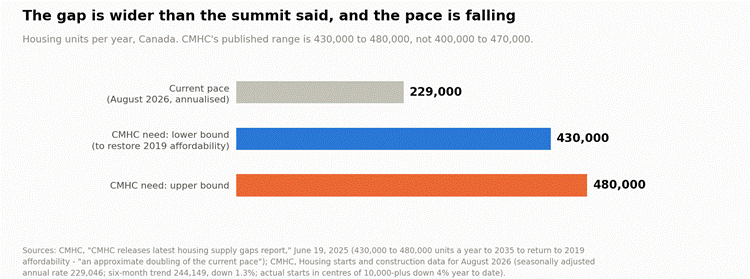
Figure 1 — What is being built against what CMHC says is required.
What the rebate actually moved
The minister’s claim is defensible on its own terms. Independently published BILD and Altus data for August show 692 single-family sales in the GTA, 47% above the ten-year August average — the fifth consecutive month low-rise beat that average.
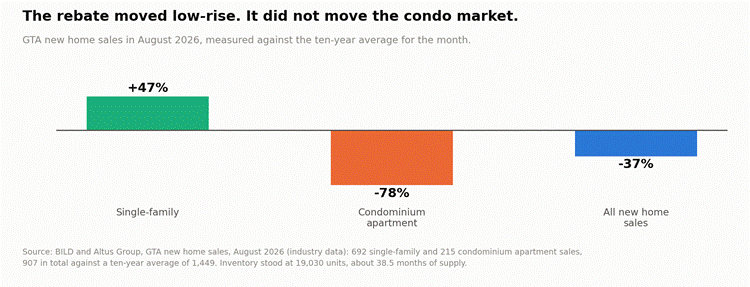
Figure 2 — GTA new home sales versus the ten-year average, August 2026.
The rest of the picture is unchanged. Total new home sales were 907 against a ten-year average of 1,449, condominium apartment sales were 78% below average, and 19,030 units of inventory sat on the market — roughly 38.5 months of supply.
The eligibility rules are the explanation
This is not a surprise; it is the design. Per the Canada Revenue Agency, the enhanced rebate goes to a purchaser buying a new home as a primary residence — theirs or a relation’s — with full relief to $1.5 million, phasing out to $1.85 million, on agreements signed between April 1, 2026 and March 31, 2027. Investors are outside it. Condominiums already under construction cannot satisfy the construction-start rule, a point BILD itself makes.
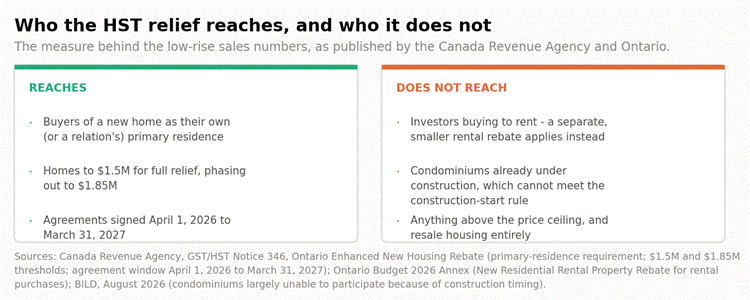
Figure 3 — The rebate’s reach, as published.
| WHAT IS OFFICIAL, AND WHAT IS INDUSTRY DATA The summit account is RESCON’s own write-up of its September 23 event; we did not attend and have not seen the presentations. The sales figures attributed to the minister — GTA single-family sales tripling in July and August, province-wide new home sales up about 130% in the second quarter — are as reported there and we could not verify them from a primary release. The independently published BILD and Altus figures for August are in Figure 2 and are industry data, not government statistics. The Abacus Data polling is private research. Official: CMHC’s supply-gap range and the August starts data; the Canada Revenue Agency’s rebate conditions; Ontario’s 2026 Budget annex; and Bill 17, which received royal assent on June 5, 2025 and moved residential development charge payment to occupancy. TRREB’s affordability figures are board data. The conclusions in the ULG View are ours. |
| THE ULG VIEW Start with the correction, because the number matters. CMHC’s published requirement is 430,000 to 480,000 homes a year to 2035 — its own words, “an approximate doubling of the current pace.” The summit used 400,000 to 470,000. The gap is bigger than the room was told, and the pace is going the wrong way: starts were at a 229,046 annualised rate in August, with actual starts in larger centres down 4% year to date. The rebate is working, precisely and narrowly. Single-family new home sales in the GTA ran 47% above their ten-year August average. That is real, and the minister is entitled to claim it. But total new home sales were 37% below average and condominium apartment sales 78% below, on 19,030 units of standing inventory — about 38.5 months of supply. “Tripled” is true and beside the point when the base was a record low and the other half of the market is inert. The design explains the split. The relief runs to buyers of a principal residence, up to $1.5 million with a phase-out to $1.85 million, on agreements signed between April 1, 2026 and March 31, 2027. Investors are excluded. Condominiums already under construction cannot meet the construction-start rule. A policy aimed at end-user low-rise produced end-user low-rise. Nothing about it was ever going to clear standing condo inventory — which is why a provincially backed fund is buying that inventory in blocks instead. What this means for files on our desk. The bid is in low-rise, end-user, sub-$1.5-million product in the 905 — and there is a deadline on it, March 31, 2027, which will pull sales forward and leave a hole after. Price the deadline into absorption. For condominium sites, 38.5 months of supply means no new starts and no recovery in site values on a condo pro forma; test rental, or test a bulk exit. And with development charges now payable at occupancy under Bill 17, the carry on a DC deferral is worth real money on a low-rise cash-flow model — run it. |
Sources
· CMHC — “CMHC releases latest housing supply gaps report,” June 19, 2025 (430,000 to 480,000 units a year to 2035; “an approximate doubling of the current pace”). https://www.cmhc-schl.gc.ca/media-newsroom/news-releases/2025/cmhc-releases-latest-housing-supply-gaps-report
· CMHC — Housing starts and construction data for August 2026 (229,046 SAAR; six-month trend 244,149, down 1.3%; actual starts down 4% year to date). https://www.cmhc-schl.gc.ca/media-newsroom/news-releases/2026/housing-starts-construction-data-august-2026
· BILD and Altus Group — GTA new home sales, August 2026 (692 single-family, 215 condominium apartments, 907 total; 19,030 units of inventory) — industry data. https://www.globenewswire.com/news-release/2026/09/22/3366097/0/en/new-home-sales-in-the-gta-continue-their-positive-momentum-throughout-august.html
· Canada Revenue Agency — GST/HST Notice 346, Ontario Enhanced New Housing Rebate (primary-residence condition; thresholds; agreement window). https://www.canada.ca/en/revenue-agency/services/forms-publications/publications/notice346/ontario-enhanced-new-housing-rebate.html
· Government of Ontario — 2026 Budget, Annex (enhanced New Residential Rental Property Rebate for rental purchases). https://budget.ontario.ca/2026/annex.html
· Legislative Assembly of Ontario — Bill 17, Protect Ontario by Building Faster and Smarter Act, 2025 (royal assent June 5, 2025; residential development charges payable at occupancy). https://www.ola.org/en/legislative-business/bills/parliament-44/session-1/bill-17
· CMHC — Fall 2026 Housing Supply Report (City of Toronto condominium and rental starts). https://www.cmhc-schl.gc.ca/professionals/housing-markets-data-and-research/market-reports/housing-market/housing-supply-report
· RESCON — Housing Summit 6.0 account by Grant Cameron, September 28, 2026 (the summit quotes and figures). https://www.rescon.com/
Charts by Urban Land Group. CMHC and CRA figures are official; BILD, Altus, TRREB and Abacus figures are industry or private research. Summit statements are as reported by RESCON. General market commentary; not investment, financial, tax or legal advice.