
Thin Buffers, Rising Arrears: What the Paycheque Survey Does and Doesn’t Tell You About Ontario Property.
A payroll-industry survey is not a housing indicator. But Ontario’s mortgage delinquency rate has passed the national rate for the first time in over a decade, and the Bank of Canada is clear about what drives it next.
Urban Land Group · September 24, 2026
The National Payroll Institute’s 2026 research, picked up this week by the Financial Post, reports that 28% of working Canadians could not absorb a one-week delay in pay, 50% spend all of their net pay or more, and 44% call themselves financially stressed — with an estimated $74.3 billion in annual lost productivity. Groceries were the top stressor at 55%, personal debt second at 46%.
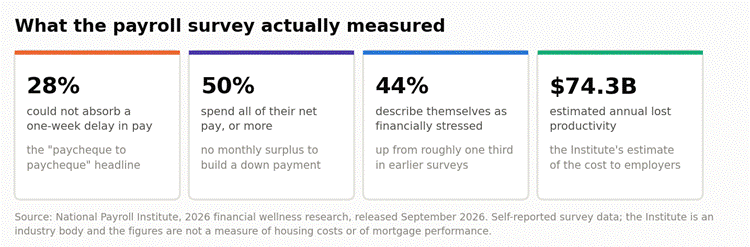
Figure 1 — The survey’s headline numbers.
Before anyone builds a market call on that: it is a self-reported workplace survey from an industry association, it measures groceries and debt rather than shelter, and the partisan captions attached to it online are commentary, not data. The useful signal is narrower — household buffers are thin — and there are official series that tell us what thin buffers do to property.
The arrears data is where it becomes real
CMHC’s Spring 2026 Residential Mortgage Industry Report has Ontario’s 90+ day mortgage delinquency rate at 0.27% in Q4 2025, up from 0.20% a year earlier — a 35% increase, and above the national rate of 0.24% for the first time in more than a decade. Toronto ran hotter still at 0.29%, up 45% year over year.
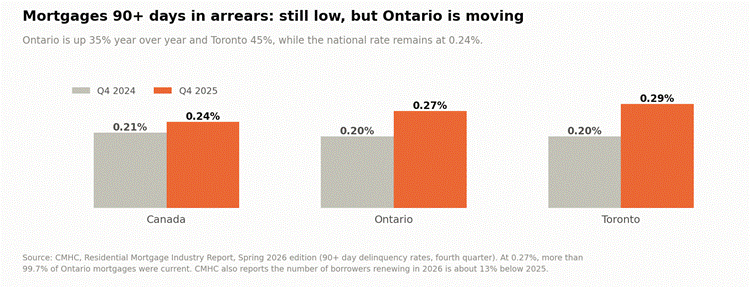
Figure 2 — Mortgage delinquency, Q4 2024 versus Q4 2025.
Keep the scale in mind. At 0.27%, 99.7% of Ontario mortgages are current, and the rate is elevated only against a decade of near-record lows. CMHC also reports the number of borrowers renewing in 2026 is roughly 13% below 2025, which means the renewal-shock story is now fading rather than building.
What actually drives the next move
The Bank of Canada’s staff work on the macro drivers of arrears is blunt about the mechanism: a one percentage point increase in unemployment raises the mortgage arrears rate by about 0.1 percentage points after roughly a year, with interest rates a distant second. Statistics Canada had Ontario employment down 18,000 in August 2026 and the unemployment rate at 6.9%.
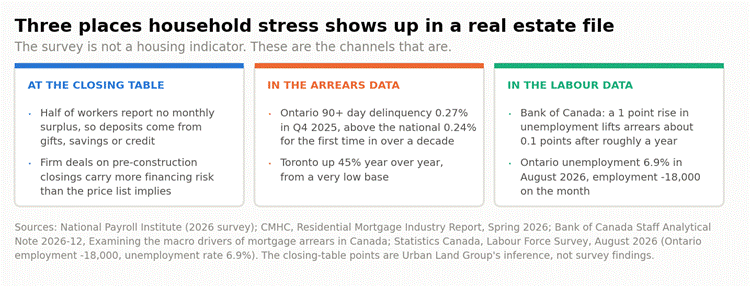
Figure 3 — Where this lands in a transaction.
| WHAT IS MEASURED, AND WHAT IS NOT The survey figures are the National Payroll Institute’s, as reported in its September 2026 release; the sample size and method are not stated in the material we reviewed, the responses are self-reported, and the Institute is an industry association with an interest in employer financial-wellness programmes. The 28% “paycheque to paycheque” figure and the 44% “financially stressed” figure measure different things and should not be used interchangeably. The arrears, renewal and labour figures are from CMHC, the Bank of Canada and Statistics Canada. The closing-table points in Figure 3 are Urban Land Group’s inference from the survey, not survey findings. Nothing here is an opinion on any political party’s economic record, and none of it is financial, mortgage or investment advice. |
| THE ULG VIEW This is a workplace-wellness survey, not a housing indicator — and the version circulating on social media is doing political work the data does not support. Self-reported stress, from an industry body, measured against groceries and debt. It says nothing about house prices, rents, mortgage performance or transaction volumes, and the partisan framing attached to it on Instagram is a claim, not a finding. Use the survey for what it is: a read on household buffers. The buffer is the part that matters to us. If half of workers have no monthly surplus and 28% cannot absorb a one-week delay in pay, first-time buyer formation stays slow no matter what happens to rates, and the deposit on a pre-construction purchase is more likely to be gifted, borrowed or drawn from credit than saved. On any firm deal, verify the deposit source and keep the financing condition realistic. That is the practical translation. The hard data says stress, not crisis. Ontario’s 90+ day delinquency rate is 0.27% — a 35% jump, and above the national rate for the first time in more than a decade, but still meaning 99.7% of mortgages are current. Toronto is up 45% from a very low base. Anyone selling either “everything is fine” or “a wave of defaults” is ignoring one half of that sentence. CMHC also has 2026 renewals running about 13% below 2025, so the renewal-wall story is past its peak. Watch employment, not the survey. The Bank of Canada’s own work puts the transmission plainly: a one-point rise in unemployment lifts arrears roughly 0.1 points about a year later. Ontario sat at 6.9% in August with employment down 18,000 on the month. That is the number that would turn thin household buffers into distressed listings in 2027 — and it is the one to track for acquisitions timing, not the paycheque-to-paycheque headline. |
Sources
· National Payroll Institute — “Canadians are on a Financial Crash Course,” September 2026 release (28% one-week pay delay; 50% spending all or more of net pay; 44% financially stressed; $74.3 billion). https://www.newswire.ca/news-releases/canadians-are-on-a-financial-crash-course-808837328.html
· CMHC — Residential Mortgage Industry Report, Spring 2026 edition (Ontario 0.27%, Toronto 0.29%, Canada 0.24% in Q4 2025; 2026 renewals about 13% below 2025). https://www.cmhc-schl.gc.ca/professionals/housing-markets-data-and-research/housing-research/research-reports/housing-finance/residential-mortgage-industry-report
· CMHC — “National delinquency rate drops but continues to rise in Ontario and BC” (Ontario first exceeded the national rate in Q2 2025). https://www.cmhc-schl.gc.ca/media-newsroom/news-releases/2025/national-delinquency-rate-drops-continues-rise-ontario-bc
· Bank of Canada — Staff Analytical Note 2026-12, “Examining the macro drivers of mortgage arrears in Canada” (1 point of unemployment to about 0.1 points of arrears after roughly a year). https://www.banqueducanada.ca/wp-content/uploads/2026/03/sap2026-12.pdf
· Statistics Canada — The Daily, Labour Force Survey, August 2026 (national employment -42,000, unemployment 6.4%; Ontario -18,000, 6.9%). https://www150.statcan.gc.ca/n1/daily-quotidien/260904/dq260904a-eng.htm
· Financial Post — “Nearly a third of working Canadians are living paycheque to paycheque, a new payroll institute survey says” (news coverage that prompted this note). https://financialpost.com/
Charts by Urban Land Group. Survey figures are self-reported and are the National Payroll Institute’s; arrears, renewal and labour figures are from CMHC, the Bank of Canada and Statistics Canada. General market commentary; not investment, financial, mortgage or legal advice, and not a political statement.