
Toronto Started 156 Condo Units. The Backlog Fell 50% Anyway.
CMHC’s Fall report puts first-half condominium starts in the City of Toronto at 156 units, against a decade average near 7,000 a year. The permitted-but-unstarted inventory is down half from its 2023 peak — and at 156 starts, almost none of that decline became a building.
Urban Land Group · September 15, 2026
CMHC’s semi-annual Housing Supply Report is out. The number that matters for anyone holding Ontario land is this: in the first half of 2026, the City of Toronto started 156 condominium apartment units. The average over the previous decade was roughly 7,000 a year.
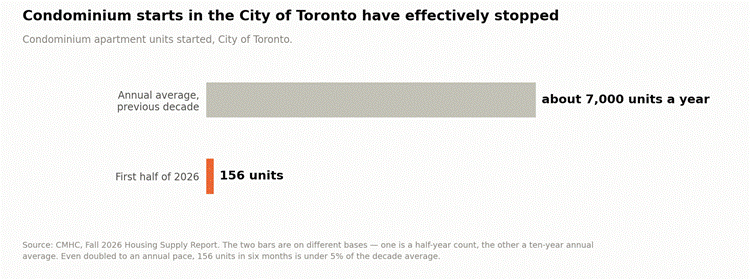
Figure 1 — Condominium apartment starts, City of Toronto.
Even doubled to an annual pace, that is under 5% of the decade average. This is not a downturn in a tenure. It is the tenure switching off.
One category is growing
Purpose-built rental starts rose 82% against the first half of 2025 — the only housing category in which starts grew at all. Rental apartment starts have now passed condominium starts for the first time since 1994. Freehold ground-oriented starts, meanwhile, are at record lows after more than two decades of decline.
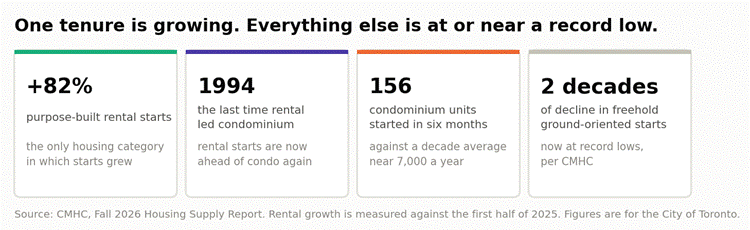
Figure 2 — City of Toronto starts by category, first half of 2026.
The backlog is draining, and that is worse news than it sounds
The inventory of permitted units awaiting construction in Toronto has fallen 50% from its 2023 peak. Read quickly, that sounds like progress — a pipeline converting into buildings.
Set it against 156 condominium starts and it reads the other way. Very little of that decline became a building. Permits lapse. Projects are cancelled. The pipeline is not converting; it is disappearing — and CMHC names the reasons plainly: weak presales, high construction costs, poor investor demand, financing constraints and economic uncertainty.
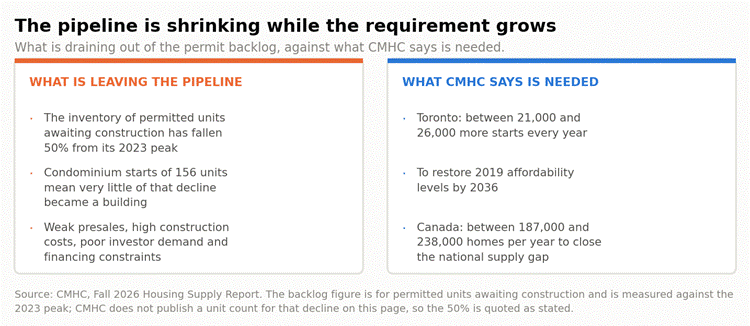
Figure 3 — What is leaving the pipeline, against what CMHC says is required.
The scale of what is being asked
CMHC’s own requirement for Toronto is between 21,000 and 26,000 more starts every year to restore 2019 affordability levels by 2036. Nationally the figure is 187,000 to 238,000 homes a year. Set the Toronto number against 156 condominium units in six months and the gap is not a policy shortfall to be narrowed. On the current trajectory it is arithmetic that does not work — and it certainly will not be closed by the condominium tenure.
| THE ULG VIEW Entitlement depreciates, and this is the report that proves it. For twenty years the working assumption on GTA land was that an approval is a durable asset — that the worst case is waiting for the cycle to turn. Toronto has now demonstrated approvals lapsing at scale. An approval has a shelf life, set by permit validity, by the pro forma that justified it, and by the market it was underwritten to. None of those three is indefinite. Model the decay rather than assuming a floor. On a Toronto condominium-approved site the question is no longer when it builds. It is whether it ever builds as approved. One hundred and fifty-six units in six months is not a slow market; it is a stopped one. The live options are a re-cut to rental, a re-cut to larger end-user product, or a sale to somebody who will do one of those. Holding for a condominium recovery is a position, not a plan. Rental is the only tenure growing, and it grew 82%. It has passed condominium starts for the first time since 1994. That is where the financing sits, where CMHC MLI Select points, and now where the shovels are. If you are underwriting an Ontario land file this autumn and rental is not the base case, you should be able to say precisely why in one sentence. And it changes the vendor conversation. A condominium approval in the City of Toronto is a document the market has just shown may not convert. That is not an argument for a punitive discount — it is an argument for structure. Tie the price to the tenure that actually gets financed, put re-entitlement risk into an earn-out, and let the vendor carry the conversion risk rather than charge a certainty premium for certainty that is not there. |
| A CORRECTION TO OUR NOTE OF SEPTEMBER 4 On September 4 we published a note arguing that Ontario had an approvals surplus and a starts deficit — that the approved-but-unstarted backlog was rising, and that entitlement had stopped being the binding constraint on supply. That rising figure was CMHC’s national count for centres of 50,000 or more, and it was right on that basis. CMHC’s Fall report measures something narrower and more consequential: the City of Toronto’s permitted-but-unstarted inventory, down 50% from its 2023 peak. The two are not arithmetically contradictory — different geography, different period, different definition. But the conclusion has to change, and it changes for the worse. A backlog that drains while starts run at 156 units is not a backlog being built. It is a backlog being abandoned. |
Sources
· CMHC — Fall 2026 Housing Supply Report. https://www.cmhc-schl.gc.ca/professionals/housing-markets-data-and-research/market-reports/housing-market/housing-supply-report
· CMHC — Spring 2026 Housing Supply Report (prior tenure-mix and cancellation findings). https://www.cmhc-schl.gc.ca/media-newsroom/news-releases/2026/spring-2026-housing-supply-report
· CMHC — Housing starts and construction data for July 2026 (the national approved-but-unstarted count referenced in the correction). https://www.cmhc-schl.gc.ca/media-newsroom/news-releases/2026/housing-starts-construction-data-july-2026
Charts by Urban Land Group from CMHC’s Fall 2026 Housing Supply Report. Figures are as published by CMHC and are subject to revision; the half-year and annual-average figures in Figure 1 are on different bases and are labelled as such. General market commentary; not investment, financial or planning advice.