
Ontario Commercial Real Estate: Rates Hold, Inflation Sticks, and the Land Play Shifts to the Fee Window
A September 2026 state-of-market read for Ontario land and development, built entirely on primary sources — Bank of Canada, Statistics Canada, CMHC, and federal/municipal releases.
Prepared by Urban Land Group | Monday, September 14, 2026 | Ontario-only
| THE 30-SECOND READ The Bank of Canada held its policy rate at 2.25% on September 2 — the seventh straight hold — and August inflation, released this morning, stuck at 3.0% nationally. But Ontario’s own inflation is the lowest in the country at 2.4%, and the province’s real story for developers is no longer the rate: it’s the development-charge relief window that is open right now in Mississauga, Hamilton and Toronto and closing on a deadline. Cost of capital has stopped falling; the cost of building is where the value is moving. Bottom line: underwrite to a flat 2.25%–plus rate, chase the fee relief while it lasts, and price employment land to its operating use — not to a conversion dream. |
1. Rates: the easing cycle is over — plan around a hold, not a cut
On September 2, 2026 the Bank of Canada left its target overnight rate at 2.25%, the seventh consecutive meeting without a change. That caps an easing cycle that took the rate down from a 5.00% peak through ten cuts between June 2024 and October 2025. The market view — and the Bank’s own posture, with above-target inflation still in the data — is that the next move is as likely to be a hike as a cut. For anyone funding or refinancing inside twelve months, the planning assumption is a rate that stays put, not one that bails you out.
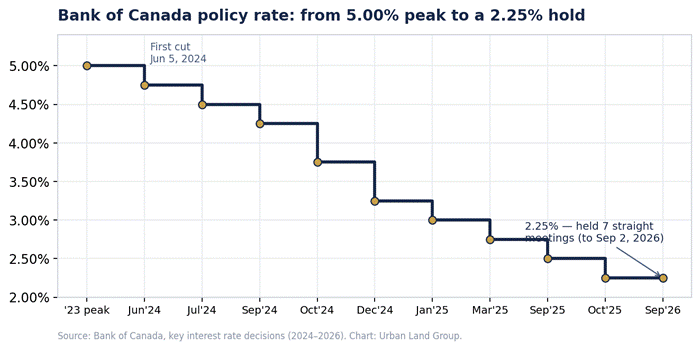
Figure 1 — Bank of Canada target overnight rate, 2024–2026. Source: Bank of Canada.
Why it matters for land: the “wait for cheaper debt” thesis that carried a lot of 2024–25 underwriting has run out of road. Deals that only pencil on a further 50–75 bps of cuts are, on today’s signal, deals that don’t pencil. The takeout assumption has to be honest.
| THE ULG VIEW Carry a 2.50%–2.75% take-out rate as your stress case on anything closing or refinancing inside 12 months. If the pro forma only works at a lower rate than the Bank is currently holding, the land is priced wrong — not the debt. |
2. Inflation: 3.0% nationally, but Ontario is the softest market in the country
Statistics Canada reported August CPI this morning: 3.0% year-over-year nationally, unchanged from July, with prices actually down 0.1% month-over-month. Stripping out gasoline — which is still up 22.8% year-over-year on Middle East supply pressure — inflation runs at 2.4%. Grocery inflation eased to 2.8%. The headline is stuck at 3% mostly because of fuel, not because the broad economy is overheating.
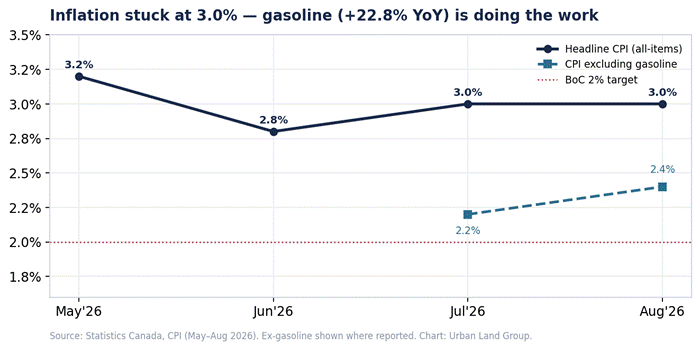
Figure 2 — Canada headline CPI vs. CPI excluding gasoline, May–August 2026. Source: Statistics Canada.
The Ontario angle is the one that matters for this business. Ontario posted the lowest inflation of any province in August at 2.4% — below the national 3.0% and far below Atlantic Canada (Nova Scotia 5.1%). It’s a persistent gap: the cost pressure your Ontario buyers and tenants actually feel is milder than the national headline suggests, which supports the case that Ontario real incomes — and absorption — hold up better than a “3% inflation” story implies.
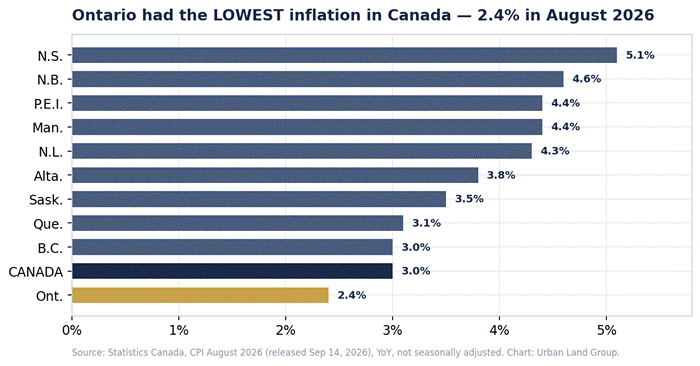
Figure 3 — Inflation by province, August 2026. Ontario lowest at 2.4%. Source: Statistics Canada.
| THE ULG VIEW Don’t let a national “3% inflation” headline discount your Ontario absorption assumptions. Ontario is running 2.4%. The real risk to demand is jobs and mortgage rates, not a broad cost-of-living spiral — Ontario’s own price data doesn’t support the pessimistic case. |
3. Development charges: the real value lever is open — and time-boxed
With rates flat, the biggest swing factor on a GTA/Halton pro forma right now is not debt — it’s municipal fees. 2026 has produced the largest development-charge relief in a generation, but it is uneven across the seven core municipalities and, critically, some of it expires. This is where feasibility is won or lost this year.
| Municipality | 2026 residential DC posture | Practical read for feasibility |
| Hamilton | Residential DCs ELIMINATED Mar 30 2026 – Mar 31 2029 (~$100,442/home removed) | Most developer-favourable core market; largest single per-unit cost swing available today |
| Mississauga | 50% cut on residential + FULL elimination on qualifying 1BD-den / 2BD / 3BD rental; funded to Mar 2029 | Permit deadline Nov 13, 2026 — the live clock. Time-boxed; pull permits inside the window |
| Toronto | DC index frozen + $1.5B Canada–Ontario deal cutting residential DCs ~40–60% | Materially cheaper than 2025, but layered rules — model the specific unit mix |
| Oakville | Opted OUT — full DC load; new bylaw expected ~early 2027 | The core-market outlier. Underwrite the full charge; no relief priced in |
| Halton Region | Full load — By-Law 25-22 (~$64K single / ~$31K apartment) | Regional charge sits on top of the local charge; no cut |
Sources: Government of Canada / Housing, Infrastructure and Communities (Mississauga agreement, Sept 2026); City of Toronto; City of Hamilton; Town of Oakville; Halton Region By-Law 25-22. Figures verified against primary releases; confirm the exact charge for your unit mix at permit stage.
| THE ULG VIEW The Mississauga rental DC elimination on a Nov 13, 2026 permit deadline is the single most bankable near-term lever in the core — roughly nine weeks out at time of writing. Where a rental deal is close, the fee relief can be the difference between infeasible and fundable, but only if the permit lands inside the window. Model the permit timeline as hard as the pro forma. |
4. Supply: starts are cooling nationally, but Toronto multi-family is still moving
CMHC’s most recent data (June 2026) put national housing starts at a 238,971-unit seasonally adjusted annual rate, down 6% from May, with the agency flagging “rising uncertainty, higher development costs, weaker demand and more unsold homes” and warning that full-year 2026 starts will likely land below 2025. The national trend line is softening.
Ontario is the nuance. Toronto starts rose 25% year-over-year in June on higher multi-unit activity (per CMHC deputy chief economist Kevin Hughes), and the Ontario pipeline remains deep: over 151,000 units under construction and nearly 30,000 permitted units waiting to break ground. The pipeline that will complete over the next 24–36 months is already committed; what’s at risk is the next cohort of starts, which is exactly where DC relief and takeout financing decide go/no-go.
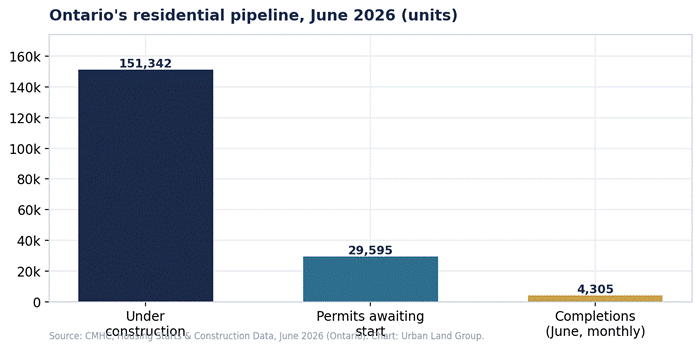
Figure 4 — Ontario residential pipeline, June 2026 (units under construction, permitted-awaiting-start, and monthly completions). Source: CMHC.
| THE ULG VIEW The overhang of unsold product and cooling national starts is precisely why the condo-to-rental re-cut remains ULG’s working pattern on entitled GTA land: underwrite the rental pro forma as the realistic highest-and-best-use, treat the condo approval as optionality, and lean on DC relief plus CMHC-insured takeout to make the rental math close. |
5. Capital markets: patient private money is setting the floor
Two recent Ontario transactions show where the bid actually is. CPP Investments and Dream Industrial sold two fully-leased Vaughan warehouse buildings (346,035 sq. ft.) to the private Zzen Group for $115M — about $332 per square foot — a rare hard comp for stabilized GTA infill industrial, and one the institutional seller called “full value.” The marginal buyer of stabilized industrial is patient private capital, not spec developers.
Separately, Stellantis signed a preliminary agreement to sell its idle 269-acre, 2.95-million-sq.-ft. Brampton assembly plant to armoured-vehicle maker Roshel, and Brampton council is moving to protect the site for employment use. The read across both: large-format GTA employment land is being defended as employment land, and the “buy it cheap, flip the zoning to residential later” playbook is narrowing.
| THE ULG VIEW Use the ~$332/sf Vaughan trade as a mark-to-market anchor when you back-solve residual land value on GTA employment sites. And price employment land to a credible operating end-user — the conversion-OPA upside is being fenced off, most visibly in Brampton. |
6. What to watch next
Building permits (July) — Wed, Sept 16: the next hard Ontario development-intentions datapoint from Statistics Canada; watch the residential-vs-ICI split for where capital is actually committing.
BoC summary of deliberations — Wed, Sept 16: how close the September 2 hold-vs-hike split was tells you the odds on October.
Mississauga DC permit deadline — Nov 13, 2026: the live clock on the rental fee elimination. Everything eligible should be racing the calendar.
Ontario municipal elections — October 2026: Toronto, Halton and Hamilton councils turn over the same month as the Oct 28 BoC decision. Council composition is the biggest swing factor on 2027 DC bylaws — including whether Oakville’s opt-out and Halton’s full-load positions hold.