
The OLT Allowed 90% of Development Appeals. The Cost Is the Queue, Not the Odds.
Ontario’s Auditor General found the Tribunal let about 90% of the 116 development appeals before it proceed, and that roughly half had settled before adjudication. Active files now stand at 1,860 cases. Appealing is a carry decision before it is a planning one.
Urban Land Group · September 11, 2026
A planner’s post circulating this week — TJ Cieciura’s “To Appeal or Not to Appeal” — makes the practitioner’s case well: appeal when a file is genuinely deadlocked, keep working with the municipality when the application has momentum, and expect most matters to resolve short of a contested decision. It is a sound argument, and it is built almost entirely from experience.
The numbers exist. They sharpen the argument in places and complicate it in others.
What the Auditor General found
Ontario’s Auditor General audited the Ontario Land Tribunal in 2024. In fiscal 2023/24 the Tribunal allowed about 90% of the 116 proposed developments appealed to it to proceed, on the basis that they were consistent with the provincial land-use planning framework. In an audit sample of twenty development-related decisions between June 2021 and March 2024, the Tribunal overturned the municipality’s decision, or went against the municipality’s position, in eleven.
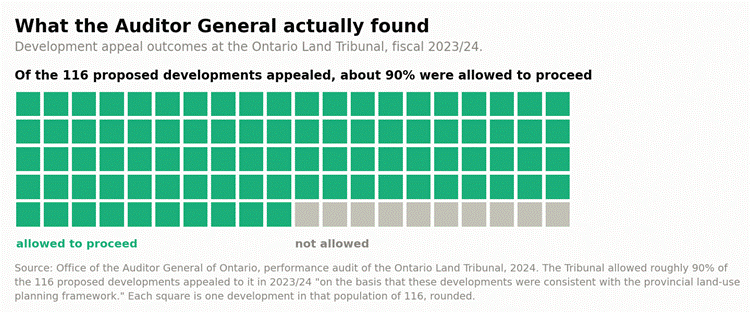
Figure 1 — Development appeal outcomes, fiscal 2023/24.
The selection argument is probably right, and it is not provable
The industry’s answer to that 90% is that it is a selection effect: nobody spends six figures on studies, counsel and expert witnesses unless the file is strong, so what arrives at the Tribunal is pre-filtered. That is a serious argument and it is probably largely correct.
It is also unfalsifiable from this data. The applications that were never filed, and the refusals that were never appealed, leave no record — which is precisely why they cannot be counted. So the honest position is this: the approval rate is 90%, and the published data cannot separate how much of that is merit from how much is the Tribunal’s disposition. What the data can tell you is what happens to files that get there.
Most of them never reach a contested decision
In about half of those 116 cases, the parties had largely agreed a settlement before adjudication. Separately, the Tribunal reports 68 of 71 mediations succeeded in 2024/25 — a 96% rate — saving an estimated 913 hearing days.
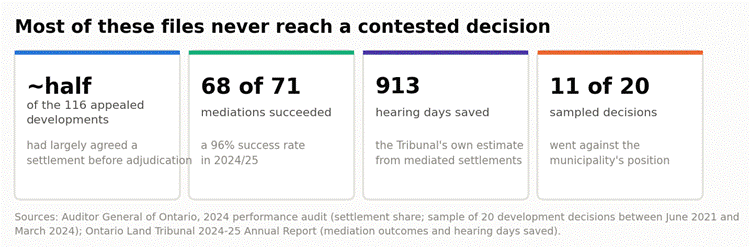
Figure 2 — How appealed development files actually resolve.
That confirms the practitioner’s instinct and puts a number on it. Settlement is not the consolation prize for a weak appeal; it is the ordinary outcome, and the formal mediation channel has a hit rate most litigation would envy.
The cost is the queue
Here is where the anecdote and the data part company. Filing the day after the statutory non-decision period expires is a common reflex. The Tribunal’s own numbers are the reason to think harder about it.
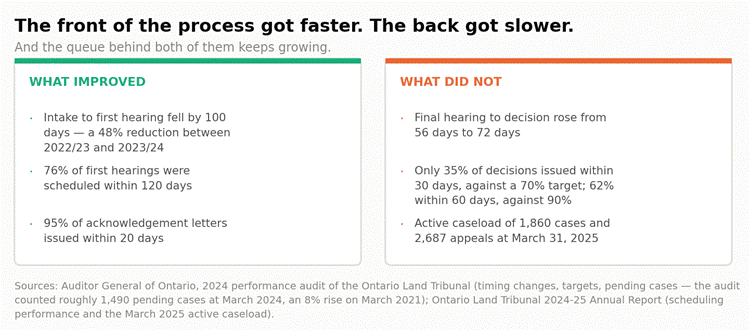
Figure 3 — Tribunal performance, by stage.
Between 2022/23 and 2023/24 the Tribunal cut the average time from intake to first hearing by 100 days, a 48% reduction — a real achievement. Over the same period, the time from final hearing to issuing a decision rose from 56 days to 72, and the Tribunal hit only 35% of its target to issue decisions within 30 days, against a goal of 70%. The Auditor General counted roughly 1,490 pending cases at March 2024, up 8% on 2021 despite additional funding and staff. By March 31, 2025 the Tribunal’s own report shows 1,860 active cases and 2,687 active appeals.
The process got faster at the front and slower at the end. For a developer paying carry, only the total matters.
| THE ULG VIEW An appeal is a carry calculation before it is a planning one. Months in the queue multiplied by the carry on land that is producing nothing, plus counsel and expert witnesses, set against the expected uplift in entitlement value. If the uplift does not clear that number, the appeal loses money even when it wins. With the policy rate held at 2.25% and the Tribunal’s caseload rising, that arithmetic is materially worse than it was in 2021. Take the mediation. Sixty-eight of seventy-one mediations succeeded in 2024/25 — a 96% hit rate, and 913 hearing days saved on the Tribunal’s own estimate. On the published numbers it is the cheapest instrument on the board, and it is used at nowhere near the rate that success would justify. The day-after-the-deadline appeal is a scheduling decision dressed as a strategy. Filing the moment the statutory non-decision period expires does not start a decision; it starts a queue. Only 76% of first hearings were scheduled within 120 days, and active files stood at 1,860 cases and 2,687 appeals at March 31, 2025. And for anyone pricing a site with a live appeal — this is where the money is. A property under appeal is not approved and it is not refused. It is an option with a knowable carry cost and a historical base rate near 90% on the merits. Price it as an option: discount for the months it will sit, credit the probability, and make the vendor carry the timeline risk if they want to be paid the entitled price today. Most vendors in this position are asking for the certainty premium without having delivered the certainty. |
| WHAT THESE NUMBERS CAN AND CANNOT TELL YOU The 90% is one fiscal year and 116 cases. The eleven-of-twenty finding comes from an audit sample of twenty decisions between June 2021 and March 2024 — small, and chosen by the auditor rather than drawn at random. The audit reports on 2023/24; the Tribunal’s annual report covers 2024/25. Different periods, pointing the same way, but not directly comparable. The selection effect is the important caveat, and it cuts against reading 90% as your odds. Applications that were never filed, and refusals that were never appealed, leave no trace in this data — which is exactly why they cannot be counted. The base rate describes files that reached the Tribunal, not files like yours. On the statutory clock: the Planning Act’s non-decision appeal periods have been amended repeatedly, including by Bill 109 and Bill 185. Confirm the period that applies to your application type with counsel rather than working from a remembered number. The 120 days referred to in Figure 3 is the Tribunal’s own scheduling standard for first hearings, which is a different thing entirely. |
Sources
· Office of the Auditor General of Ontario — performance audit, Ontario Land Tribunal, 2024 Annual Report. https://www.auditor.on.ca/en/content/annualreports/arreports/en24/pa_ONlandtribunal_en24.pdf
· Ontario Land Tribunal — 2024-25 Annual Report. https://olt.gov.on.ca/wp-content/uploads/2024-25-OLT-Annual-Report-EN.html
· Ontario Land Tribunal — annual report announcement and tribunal home page. https://olt.gov.on.ca/blog/news/2024-25-annual-report/
· Ontario Land Tribunal — decisions database. https://olt.gov.on.ca/decisions/
Commentary reference: TJ Cieciura, “To Appeal or Not to Appeal,” published September 10, 2026. That article prompted this note; it is not a source for any figure here, and no part of it is reproduced. Charts by Urban Land Group from the Auditor General and Tribunal sources listed above. This is general market commentary and is not legal, planning, investment or financial advice — appeal decisions should be taken on the advice of counsel and a qualified planner.