
Statistics Canada attributes rising metal and steel prices directly to retaliatory tariffs. Toronto residential construction costs still fell 0.8% last quarter — one of only three metropolitan areas to decline. That gap is not good news, and it will not hold.
Urban Land Group · September 6, 2026
The Town of Oakville is directing tariff-affected businesses to a resource page through Invest Oakville. It is a useful page for a manufacturer or a supplier. It is a directory of federal programmes rather than municipal money, and it says nothing about construction — which leaves the question every developer in the region is actually asking unanswered: what are tariffs doing to the cost of building in Ontario?
That question has a published answer, and it is not the one circulating in industry newsletters.
What the tariffs are doing
Statistics Canada’s Building Construction Price Indexes for the second quarter of 2026 are unambiguous about direction and cause. In residential construction, metal fabrications rose 2.1% and structural steel framing rose 1.8% in a single quarter. The agency’s own explanation is direct:
“Metal and steel products continued to lead cost increases due to the upward price pressure associated with implemented retaliatory tariffs and the related supply chain disruptions.” — Statistics Canada, Q2 2026
The first-quarter release said the same thing, noting retaliatory tariffs on steel implemented in March 2025 and expanded in December, with metal fabrications up 2.3% and structural steel up 1.9% on the non-residential side. The material effect is real, it is measured, and it is attributed.
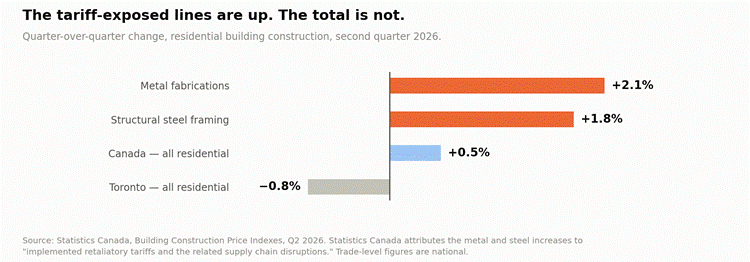
Figure 1 — Residential building construction, quarter-over-quarter change, Q2 2026.
What they are not doing
And yet the aggregate has not followed. Nationally, residential construction costs rose just 0.5% in the second quarter and 2.3% year over year. In Toronto they went the other way: down 0.8%, after a flat +0.1% in the first quarter. Toronto was one of only three census metropolitan areas to record a residential decline.
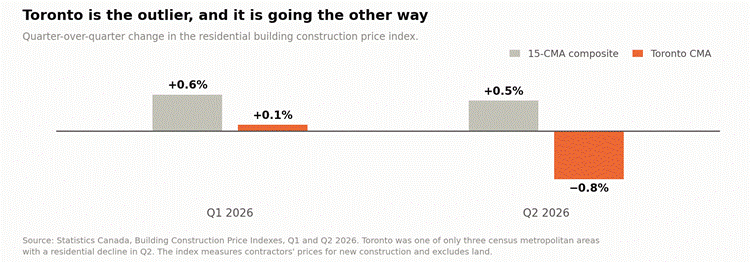
Figure 2 — Toronto against the 15-CMA composite, residential building construction.
The explanation is not that Toronto escaped the tariffs. It is that Toronto stopped building. Starts fell to their lowest level since 2009 in 2025 — below Calgary, Montréal and Vancouver for the first time — condominium apartments dropped to roughly a tenth of starts, and July starts were down another 10% year over year. When a market stops building, contractors bid for work instead of choosing between jobs. That labour and margin discount is currently larger than the tariff premium on steel.
Why this is a trap, not a saving
The relief in Toronto’s numbers is the price of the downturn. It is not a structural improvement in the cost of building, and it reverses on recovery — which is the same event that makes a land purchase work. When starts return, the trade discount goes first and the tariff line does not come back down with it. A developer who buys land this autumn on Q2 trade pricing, for a project breaking ground in 2028, is underwriting a discount that expires exactly when it is needed.
What is actually on offer
The federal package the Oakville page points to was announced on August 25, 2026 and totals $7.5 billion. None of it is a construction or development programme. Two components are realistically reachable by a building-products manufacturer or a modular supplier: the Regional Tariff Response Initiative, with non-repayable contributions now up to $3 million and liquidity support to $2 million, effective this month; and BDC’s Pivot to Grow, offering loans of $250,000 to $5 million with interest-only payments for 36 months, for companies with $1 million or more in annual revenue.
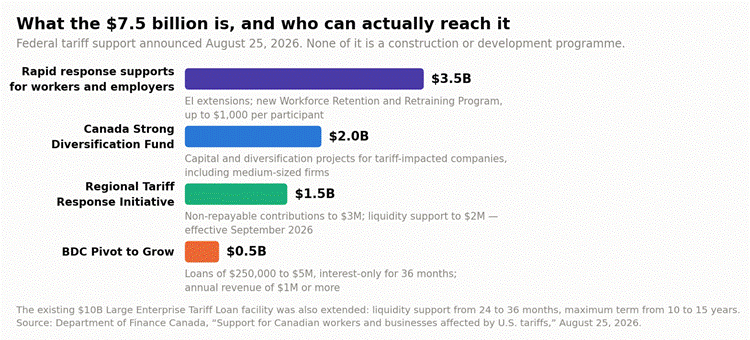
Figure 3 — The August 25, 2026 federal tariff support package.
| THE ULG VIEW Do not capitalise a soft Q2 into a land price you pay this fall for a project that starts in 2028. Toronto’s cost relief exists because almost nobody is building. It disappears at precisely the moment your project does start. Underwriting today’s trade pricing across a four-year horizon is not conservatism; it is buying a discount you will not be able to use. If you are pricing a start inside the next twelve months, the opposite applies. The discount is real, it is measurable, and it is available now — go and get firm trade pricing while contractors are bidding for work rather than choosing between jobs. Price steel separately from the trade market. The two lines are moving in opposite directions and only one of them is demand-driven. On steel-intensive product — structural-steel mid-rise, industrial, parking structures — the tariff premium sits in your budget whether or not the trades are hungry, and it does not unwind when starts recover. For Oakville specifically, note what is absent. The Town is not in the provincial development charge reduction programme, full rates apply, and its next by-law goes to a council elected on October 26. On the cost side of an Oakville pro forma there is currently no relief valve at all — which makes the trade-pricing window the only lever actually available this year. |
| WHAT THE OAKVILLE PAGE ACTUALLY IS Invest Oakville’s tariff page is a directory of federal programmes, not a municipal fund. There is no Oakville-specific money on it, and it contains no reference to construction, building materials or development. That is not a criticism — pointing local businesses at federal capital is a sensible use of an economic development office — but it should not be read as new support for the building industry, because it is not. |
Sources
· Statistics Canada — Building construction price indexes, second quarter 2026. https://www150.statcan.gc.ca/n1/daily-quotidien/260724/dq260724b-eng.htm
· Statistics Canada — Building construction price indexes, first quarter 2026. https://www150.statcan.gc.ca/n1/daily-quotidien/260428/dq260428b-eng.htm
· Department of Finance Canada — Support for Canadian workers and businesses affected by U.S. tariffs, August 25, 2026. https://www.canada.ca/en/department-finance/news/2026/08/support-for-canadian-workers-and-businesses-affected-by-us-tariffs.html
· Invest Oakville — Tariff resources for businesses. https://invest.oakville.ca/grow-your-business/tariff-resources-for-businesses/
· CMHC — Housing starts and construction data for July 2026. https://www.cmhc-schl.gc.ca/media-newsroom/news-releases/2026/housing-starts-construction-data-july-2026
· CMHC — Spring 2026 Housing Supply Report (Toronto starts and tenure mix, 2025). https://www.cmhc-schl.gc.ca/professionals/housing-markets-data-and-research/market-reports/housing-market/housing-supply-report
· Town of Oakville — development charges (programme position and 2027 by-law timeline). https://www.oakville.ca/town-hall/budget-finances/growth-infrastructure-financing-tools/development-charges/
Charts by Urban Land Group from the Statistics Canada, Department of Finance Canada and CMHC sources listed above. The building construction price index measures contractors’ prices for new construction and excludes land. General market commentary; not investment, financial or planning advice.