
Hamilton is cheapest for for-sale housing. Mississauga may be cheaper for purpose-built rental. Oakville has opted out entirely — and is letting an incoming council write its next by-law.
Urban Land Group · September 2, 2026
Development charges used to be a number you looked up. For the next eighteen months they are a strategy variable, and the municipalities of the GTA core have taken visibly different positions. Read across them and the useful conclusion is not that one place is cheap. It is that the cheapest place now depends on what you are building.
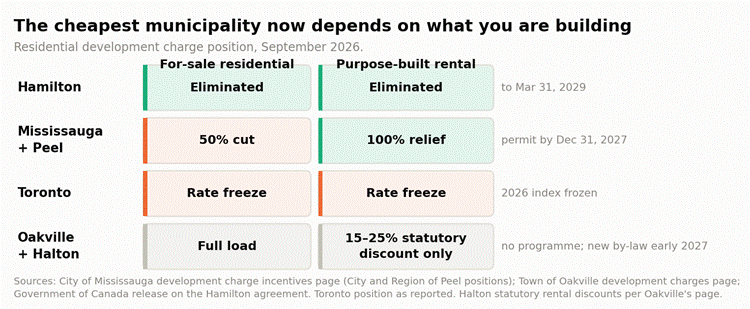
Figure 1 — Residential development charge position across the GTA core, September 2026.
Hamilton: eliminated, for everything
Under the $572 million Canada-Ontario agreement, Hamilton eliminates residential development charges entirely from March 30, 2026 to March 31, 2029. The federal release puts the saving at up to $100,442 per home and the City estimates the measure could unlock more than 31,000 units. It applies to all residential development types, which makes Hamilton the simplest position on the board: cheapest for condo, cheapest for rental, cheapest for ground-related.
Mississauga: deeper than it looks, on the right product
The City of Mississauga’s own incentives page sets out a 50% reduction for all residential unit types and a 100% reduction for purpose-built rental — one-bedroom-plus-den, two-bedroom and three-bedroom units — subject to a 25-year rental tenure agreement. The Region of Peel matches both. Layered on top is a 35% reduction to the municipal tax rate for the new multi-residential subclass, effective January 1, 2026.
The eligibility condition is a building permit for footings and foundations before December 31, 2027. Note also that Mississauga’s community benefits charge programme has been repealed — a second cost line gone that rarely gets counted alongside the charge relief.
Oakville: opted out, on the record
The Town of Oakville’s development charges page is unambiguous: “The Town of Oakville is not applying to participate in the program and there will be no changes to development charges at this time.” By-law 2022-068 continues. A background study is underway, with consultation in Fall 2026 and a proposed by-law before Council in early 2027.
Statutory rental discounts of 15 to 25 per cent by bedroom count still apply, as they do everywhere under the Development Charges Act, and education development charges add $12,021.25 per dwelling unit as of June 1, 2026. But there is no local reduction programme, and none is coming before the new council sits.
The clocks that actually matter
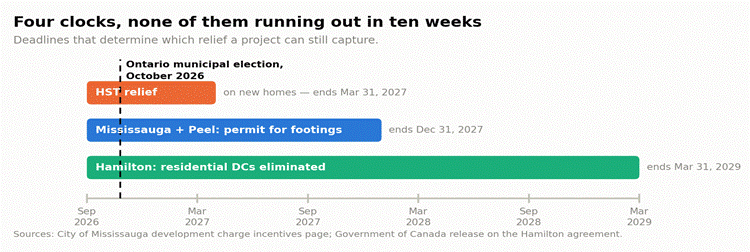
Figure 2 — The deadlines governing which relief a project can still capture.
Three windows, three end dates, and a municipal election sitting near the front of all of them. A project only captures what is still open on the day it starts — and the shortest window, HST relief, closes at the end of March 2027.
On the October rate call
It is worth being precise about the monetary side, because the internal read has been running ahead of the evidence. Ahead of today’s decision, all 35 economists in the Reuters survey expected a hold at 2.25%. Four of Canada’s six largest banks — BMO, CIBC, RBC and TD — forecast that hold continuing through December 2026. Two, National Bank and Scotiabank, forecast an increase to 2.50% in October. The Bank’s own July Market Participants Survey put the first hike at Q3 2027.
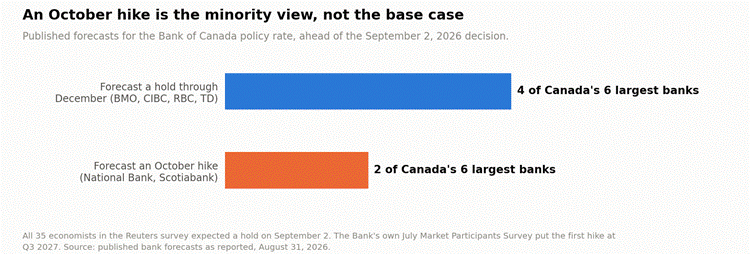
Figure 3 — The published forecast split ahead of the September 2 decision.
An October hike is a real scenario held by serious forecasters. It is not the base case, and describing October as carrying two stacked upside-risk events overstates one of them. The council turnover is the event with a known date and a direct line to development charge policy. The rate path is contested.
| THE ULG VIEW Stop ranking municipalities and start ranking municipality-by-product pairs. On for-sale residential, Hamilton is the cheapest place in the core seven to build and will be until March 2029. On purpose-built rental, Mississauga is arguably cheaper still — City and Region both at full relief, plus a 35% cut to the municipal tax rate on the new multi-residential subclass — provided a footings permit is in hand by the end of 2027. That distinction is worth real money on a residual, and it cuts both ways: a Mississauga site being underwritten as condo may be worth more as rental than the sponsor thinks, purely on the charge treatment. Oakville is the outlier, and it is a deliberate one. The Town’s own page states it is not applying to participate and there will be no changes at this time. A new by-law follows a Fall 2026 consultation and Council review in early 2027 — which means Oakville’s charge position is being set by a council that will be elected in October. That is the single largest known swing factor on Halton land values over the next eighteen months, and it is a local political question, not a monetary one. |
| TWO CORRECTIONS TO THE INTERNAL WATCH NOTE The Mississauga clock is not ten weeks out. The City’s own incentives page requires a building permit for footings and foundations before December 31, 2027 — roughly sixteen months, not ten weeks. Any land priced or marketed on a November 2026 urgency is priced on a date that does not appear in the City’s programme. Mississauga’s relief is deeper than 50%. The City reduces charges 50% for all residential unit types and 100% for purpose-built rental (one-bedroom-plus-den, two- and three-bedroom), subject to a 25-year rental tenure agreement. The Region of Peel matches both. Describing the position as a “50% City residential cut” understates it materially for rental product. |
Sources
· City of Mississauga — development charge incentives (City and Region of Peel). https://www.mississauga.ca/services-and-programs/planning-and-development/growth-charges/development-charges/development-charges-by-laws-and-rates/development-charge-incentives/
· Town of Oakville — development charges. https://www.oakville.ca/town-hall/budget-finances/growth-infrastructure-financing-tools/development-charges/
· Government of Canada — “Canada and Ontario making homes more affordable in Hamilton,” August 2026. https://www.canada.ca/en/housing-infrastructure-communities/news/2026/08/canada-and-ontario-making-homes-more-affordable-in-hamilton.html
· Halton Region — development charges and front-ending recovery payment. https://www.halton.ca/the-region/finance-and-transparency/financing-growth/development-charges-front-ending-recovery-payment
· Association of Municipalities of Ontario — funding development charge reductions. https://www.amo.on.ca/policy/land-use-planning-resources-and-climate-change/funding-development-charge-reductions-under
· Bank of Canada — September 2, 2026 interest rate announcement. https://www.bankofcanada.ca/2026/09/bank-of-canada-interest-rate-announcement-2026-09-2/
Charts by Urban Land Group from the sources above. Halton Region and Toronto positions are summarized from secondary reporting and should be confirmed against each by-law before use. Prepared before the Bank of Canada’s 09:45 ET announcement on September 2, 2026. General commentary; not legal, planning or investment advice.