
Oakville converted employment land to housing. Toronto paid a manufacturer to stay on it. Burlington turned a unit of it into a housing factory. Vaughan traded some at institutional pricing. Same asset class, four different answers.
Urban Land Group · August 31, 2026
Four Ontario stories landed in the trade press in the same week. Read separately they are routine. Read together they are the clearest picture yet of what has happened to GTA employment land: it is being pulled in three directions at once, and the pull is coming from three different kinds of buyer who cannot agree on what the land is for.
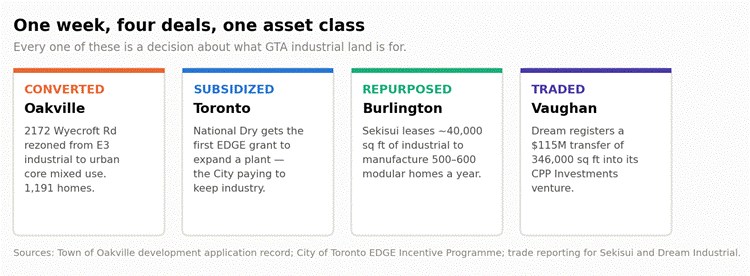
Figure 1 — Four transactions, one asset class.
Oakville: the Official Plan held
On August 10, Oakville council approved a zoning by-law amendment for 2172 Wyecroft Road, on the south side of Wyecroft west of Third Line, beside Bronte GO. The Town’s own record shows the site zoned E3 sp:4 — Industrial, and the applications sought a site-specific Urban Core Mixed Use (MU4) zoning together with an Official Plan amendment to “permit an increase in the building heights on the subject lands from a maximum of 24-storeys to up to 35-storeys.”
The approval is four towers on two six-storey podiums, 1,191 homes, at 21 to 24 storeys. The applicant asked for 35. It got the Official Plan maximum.
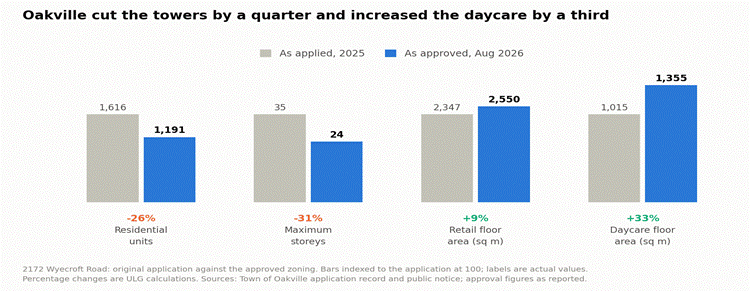
Figure 2 — What the application asked for, and what the by-law delivered.
Note the direction of travel. Units fell by roughly a quarter and maximum height by about a third, while retail floor area rose and the daycare grew by a third. Council did not simply shrink the project; it traded saleable density for community floor space and family-sized units.
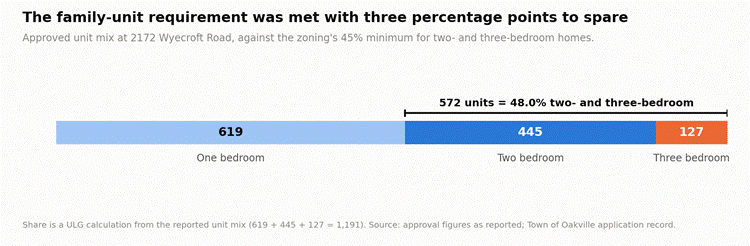
Figure 3 — The approved unit mix against the 45% family-unit requirement.
The approved zoning requires at least 45% of homes to have two or three bedrooms. The approved mix delivers 48%. That is a binding constraint met with almost nothing to spare, and it is a constraint that changes a pro forma — two- and three-bedroom units carry different absorption and different revenue per square foot than the one-bedroom stock that would otherwise fill a tower.
Toronto: paying to keep the industry
Two hundred kilometres of policy away, the City of Toronto marked construction on the first project approved under its EDGE Incentive Program — National Dry Beverages’ $18.1 million, 62,000 sq. ft. expansion on Arrow Road, adding 20 full-time jobs.
EDGE rebates the municipal tax increment created by eligible employment development over five years. The City has temporarily raised the grant from 60% to 100% of the municipal tax increment for applications received by December 31, 2027. Since launching in January 2025 the programme has approved eight projects representing about $220 million of construction, 583 new jobs and 725 retained.
Read that against Oakville. One municipality is permitting employment land out of existence at a transit station; another is writing cheques to keep manufacturing on it. Both are rational. They are simply pricing different things.
Burlington and Vaughan: the other two bids
Sekisui has opened its first Canadian modular factory in just under 40,000 sq. ft. at 955 Maple Avenue in Burlington on a reported $15 million investment, targeting 500 to 600 modular units a year. That is industrial land being consumed to manufacture housing — a use that competes for the same buildings as logistics, and that exists only because housing delivery is slow.
And Dream Industrial registered the transfer of two Vaughan buildings totalling 346,000 sq. ft. into its joint venture with CPP Investments at a reported $115 million — roughly $332 per square foot on a blended basis, by our arithmetic. That is not a land comparable, but it is a marker of what institutional capital will pay for standing, leased industrial in York Region.
| THE ULG VIEW There is no single price for GTA employment land any more, because there is no single buyer. The same acre is worth one number to a logistics investor, a different number to a manufacturer weighing a tax grant against a move, and a much larger number to a residential developer who can get it rezoned. Only the third of those buyers is bidding on a future use. So the underwriting question on any employment-land site is no longer “what are industrial comparables?” It is: which of those three buyers can actually transact on this parcel, and what would have to be true for the residential one to appear? Proximity to a GO station and a permissive MTSA policy are the two conditions that move a site from the first bucket to the third — and that move is where nearly all the value sits. Oakville is the cautionary half of that. The applicant sought 35 storeys and got 24, because the Official Plan height maximum held. Residual land value on a conversion play should be run at the policy ceiling, not at the ask. The difference here was 425 units. |
| A NOTE ON SOURCING Application figures, zoning designations and file numbers are from the Town of Oakville’s own development-application record and public notice; EDGE programme terms and totals are from the City of Toronto. The approved unit counts, storey range, floor areas and density for 2172 Wyecroft are as reported in trade coverage — the Town’s application page still shows the original 2025 submission. Confirm the approved figures against the Aug. 10 council record and the passed by-law before relying on them. The Sekisui and Dream items rest on trade reporting and company statements. Percentage changes and per-square-foot figures are ULG calculations, marked as such. |
Sources
· Town of Oakville — development application record, NBIM 2172 Wyecroft LP (OPA 1627.02, Z.1627.02, 24T-25006/1627). https://www.oakville.ca/business-development/planning-development/active-development-applications/ward-1-development-and-site-plan-applications/nbim-2172-wyecroft-lp-2172-wyecroft-road-opa-1627-02-z-1627-02-and-24t-25006-1627/
· Town of Oakville — public notice, 2172 Wyecroft Road applications. https://www.oakville.ca/town-hall/news-notices/2025-planning-public-notices-archive/complete-application-public-meeting-for-proposed-opa-zba-plan-of-subdivision-2172-wyecroft-road/
· City of Toronto — EDGE Incentive Program. https://www.toronto.ca/business-economy/business-operation-growth/business-incentives/edge-incentive-program/
· City of Toronto — construction milestone for the first EDGE-approved project, August 27, 2026. https://www.toronto.ca/news/city-of-toronto-marks-construction-milestone-for-first-project-approved-under-edge-incentive-program/
· City of Toronto — Community Improvement Plan for the EDGE Incentive Program. https://www.toronto.ca/legdocs/mmis/2024/ph/bgrd/backgroundfile-250855.pdf
· Connect CRE Canada — Oakville approves four towers and 1,191 units near Bronte GO. https://www.connectcre.ca/stories/oakville-approves-four-towers-and-1191-units-near-bronte-go/
· Connect CRE Canada — Sekisui launches modular manufacturing hub in Burlington. https://www.connectcre.ca/stories/sekisui-launches-modular-manufacturing-hub-in-burlington/
· Connect CRE Canada — Dream registers $115M Vaughan transfer to CPP Investments venture. https://www.connectcre.ca/stories/dream-industrial-cppib-create-3b-jv/
Charts by Urban Land Group from the sources above; percentage changes and per-square-foot figures are ULG calculations. General market commentary; not legal, planning or investment advice.