
The registry posting reads “Closed.” An update filed three days ago says the Advisory Body is still taking submissions by email — and will be until its term ends in February.
Urban Land Group · August 24, 2026
On July 15, 2026 the Ministry of Municipal Affairs and Housing posted a consultation on reducing regulatory burden in Ontario’s Building Code (ERO notice 026-0744). The comment period ran thirty days and closed on August 14.
On August 21 the notice was updated. The update says the consultation was “the initial phase of the Building Code Review consultation,” and that the Building Code Advisory Body “continues to welcome additional feedback and comments throughout its review period,” at buildingcode.advisorybody@ontario.ca.
If you looked at the posting and saw “Closed,” you would have moved on. The window is open.
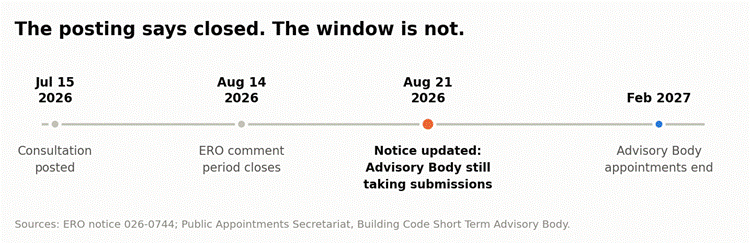
Figure 1 — The consultation’s formal window, and the one that is still running.
Who is actually doing the review
The Minister established the Building Code Short Term Advisory Body — an independent panel described as engineering, construction and Code specialists — by Order in Council. Its mandate is a comprehensive, section-by-section review of the Building Code, with particular emphasis on its twelve main parts, and evidence-based recommendations on reducing construction-related regulatory burden while maintaining health, safety, accessibility and integrity.
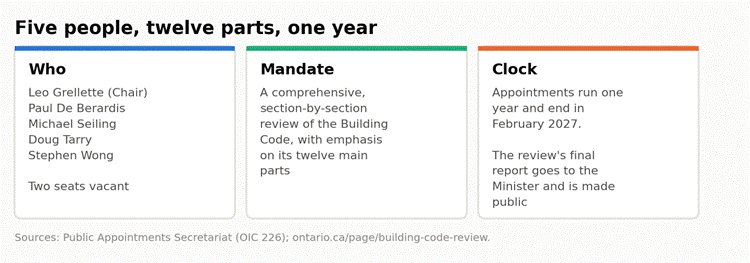
Figure 2 — The Advisory Body’s composition, mandate and term.
Five members, two vacant seats, one year, and the whole Building Code. That is a small group working fast on a very large regulation — which is precisely why targeted, specific submissions from people who build things carry weight.
What “burden” means here
The Advisory Body asked for input on four things: provisions that are outdated, duplicative, overly prescriptive, or no longer proportionate to risk; opportunities to simplify, consolidate or remove requirements without giving up safety and accessibility outcomes; alignment with the National Construction Codes where harmonization reduces burden; and practical, evidence-based ideas that cut compliance cost and improve the Code’s usability.
TRREB’s submission is a useful illustration of what a specific ask looks like in practice. It proposed:
- An annual Building Code review between full editions, rather than waiting for each new edition.
- Permitting single-stair residential buildings up to six storeys, with sprinklers and floorplate limits, citing British Columbia as precedent.
- Allowing elevators within exit enclosures for sprinklered buildings of not more than three storeys.
- Enabling a faster barrier-free passenger elevator for residential buildings of not more than four storeys and 600 square metres.
Three of those four are geometry. That matters more than it sounds.
Nothing has changed yet
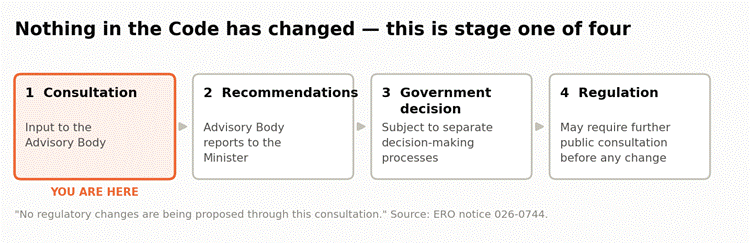
Figure 3 — From consultation to Code change.
The notice is explicit: “No regulatory changes are being proposed through this consultation.” The Advisory Body reports to the Minister; any resulting proposal goes through separate government decision-making and, where required, further public consultation. Treat everything in the submissions as directional.
| THE ULG VIEW The Building Code is normally treated as a construction-cost input. On small and awkward sites it is also a land-value input, and the two are not the same thing. On a narrow infill lot the binding constraint is frequently a Code requirement rather than a zoning one — two exit stairs and a double-loaded corridor inside a shallow envelope, or an elevator core that will not fit the floorplate. A site that cannot carry that geometry is worth less than an identical site that can, at the same zoning. If single-stair to six storeys ever reaches the Ontario Code, a class of narrow lots across the GTA and Hamilton that price today as low-rise would reprice. That is a watch item, not a pro forma assumption. Do not pay for it. Do identify which sites in your portfolio it would move, so that if the recommendation survives to regulation you already know where to look. |
| WHAT THIS NOTE DOES NOT COVER The consultation paper itself — which sets out the Advisory Body’s guiding principles and the specific questions it asked — is a separate document linked from the ERO notice and is not reproduced there. This note covers the process, the people and the stakes. Read the consultation paper before drafting a submission. |
How to submit. The Advisory Body is accepting comments at buildingcode.advisorybody@ontario.ca through its review period. Responses do not need to address every question in the consultation paper — the notice invites comment on “any Building Code issues, opportunities, risks, or practical examples.” A one-page submission naming a single provision, the site condition it blocks, and the cost of the workaround will land better than a general letter about burden.
Sources
· Environmental Registry of Ontario — notice 026-0744, Consultation on Reducing Regulatory Burden in Ontario’s Building Code. https://ero.ontario.ca/notice/026-0744
· Government of Ontario — Building Code review. https://www.ontario.ca/page/building-code-review
· Public Appointments Secretariat — Building Code Short Term Advisory Body (OIC 226). https://www.pas.gov.on.ca/Home/Agency/867
· Toronto Regional Real Estate Board — submission on the Building Code review. https://trreb.ca/trreb-provides-solutions-to-make-ontarios-building-code-clearer-and-more-practical/
· Ontario Building Officials Association — CodeNews Issue 383. https://www.oboa.on.ca/news/ontario-codenews-issue-383-consultation-launched-on-building-code-advisory-body-section-by-section
Diagrams by Urban Land Group from the sources above. General commentary on public policy; not legal, planning, building-code or investment advice.