
By Sunny Gawri, Founder & Principal, Urban Land Group
The headline number for the second quarter looks like a recovery. GTA residential land trading jumped to roughly $810 million in dollar volume, more than double the first quarter. If you stopped reading there, you’d think the market had turned. It has turned, but not in the direction most landowners are hoping for. The doubling wasn’t a rally. It was a small number of large, mostly distressed transactions doing almost all of the lifting while the broad builder market stayed exactly where it has been on the sidelines.
A doubling that wasn’t a rally
Strip the quarter apart, and the concentration is striking. Three distressed development-land acquisitions by a single institutional buyer accounted for roughly 41% of GTA volume on their own. Add the rest of the distress and non-arm’s-length activity, and more than half of the quarter’s dollars sat outside conventional, open-market demand. Deal count, meanwhile, was down sharply year over year. So we have more money moving through fewer hands-on fewer sites the signature of a market being repriced, not a market recovering.
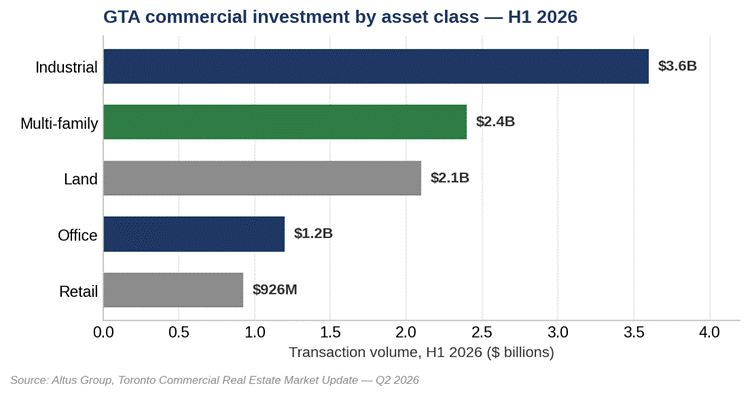
Market context: across all GTA commercial asset classes in the first half of 2026, industrial and multi-family led investment volume, with land at $2.1B. Source: Altus Group, Toronto Commercial Real Estate Market Update — Q2 2026.
Patient capital is setting the price
This is what a reset looks like in real time. Well-funded, patient buyers are using the window to secure land at reset pricing, while the builders who depend on construction financing and pre-sales stay measured. If you own a quality, execution-ready site, the good news is that the right buyer is active and decisive. The hard news is that there are fewer of them, and they are underwriting to today’s numbers — not to what your land was worth in 2022. The bid is real, but it is disciplined.
Core versus fringe has never been wider
The divide between core and fringe land is as clear as I’ve seen it. High-density interest stayed concentrated in prime Old Toronto and established inner-suburban nodes. Ground-oriented demand improved in the stronger submarkets, helped by softer pricing and the new-home HST rebate that took effect April 1. Serviced, low-density parcels with a realistic path to market traded this quarter. But speculative land — long-term holds, non-OP-designated parcels with no known servicing timeline remains very difficult to move, particularly across the broader Greater Golden Horseshoe, where volume fell by more than half year over year. The market is paying for certainty and punishing “someday.”
Where the real demand is: low-rise and rental
Underneath the distress story, genuine end-user demand is finally showing life, and it’s concentrated at two ends. Low-rise led the improvement — single-family new-home sales ran well above their ten-year average in June as buyers responded to tax relief and easing benchmark prices. The condo market is stabilizing off record lows (new sales up more than 50% year over year), but it’s doing so against record standing inventory and a pre-construction pipeline that keeps shrinking, with no new projects launching for a second straight quarter. And purpose-built rental remains the standout, posting a record first half for construction starts, with more than 31,000 units underway across the GTHA. For land suited to rental density and longer-term holds, that momentum continues to support values.
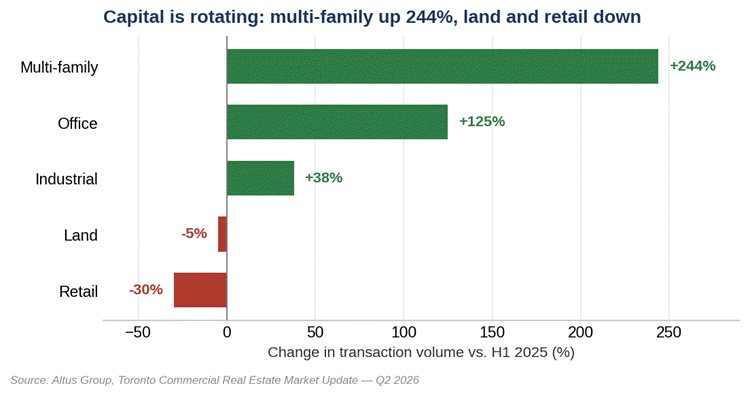
The capital rotation behind the thesis: multi-family investment volume rose 244% year-over-year while land and retail softened capital is concentrating where rental and end-user demand are strongest. Source: Altus Group, Toronto Commercial Real Estate Market Update — Q2 2026.
What this means if you own land
Three things follow directly. First, if your site is serviced with a clear path to market, this is a market where you can transact, but price to the reset, not to the peak, or the active buyer will simply move to the next file. Second, if your land is speculative or lacks a servicing timeline, your job right now is to build the timeline story: entitlement progress, servicing certainty, a credible path, because the market is no longer paying for optionality alone. Third, if your parcel supports rental density, you’re sitting in the one lane where demand and capital are both still leaning in.
The takeaway heading into the second half of 2026 is that the market is selective, not stalled. Policy shifts are helping. Whether that’s enough is still an open question. Land is trading where pricing, servicing, timing, certainty and end-user affordability all line up and both institutional capital and low-rise demand are showing us where confidence is returning first. The owners who read that map correctly will transact this year. The ones still waiting for 2022 to come back will not.
Urban Land Group advises landowners, developers and capital partners on acquisitions, dispositions, highest-and-best-use, and development feasibility across the GTA, Halton, Hamilton, Niagara and Waterloo. If you’re weighing whether to sell, hold, or reposition a site in this market, that’s the conversation we have every day.
Sources & notes
• Residential land dollar-volume figures ($810M, 41% concentration, GGH decline) are drawn from the Residential Land Market Update — Q2 2026, Land & Investment Group (Royal LePage).
• Charts show broader GTA commercial investment context from Altus Group, Toronto Commercial Real Estate Market Update — Q2 2026 (H1 2026 data). Altus reports GTA land at $2.1B for H1 2026, down 5% YoY — a different metric, period and source than the $810M Q2 residential-land figure above; the charts are supporting market context, not the source of the headline number.
• New-home, condo and rental figures reference Altus / BILD and CMHC data. Verify all figures against the underlying reports before publishing.