
Four Units on One Lot: What Budget 2026 Actually Proposes
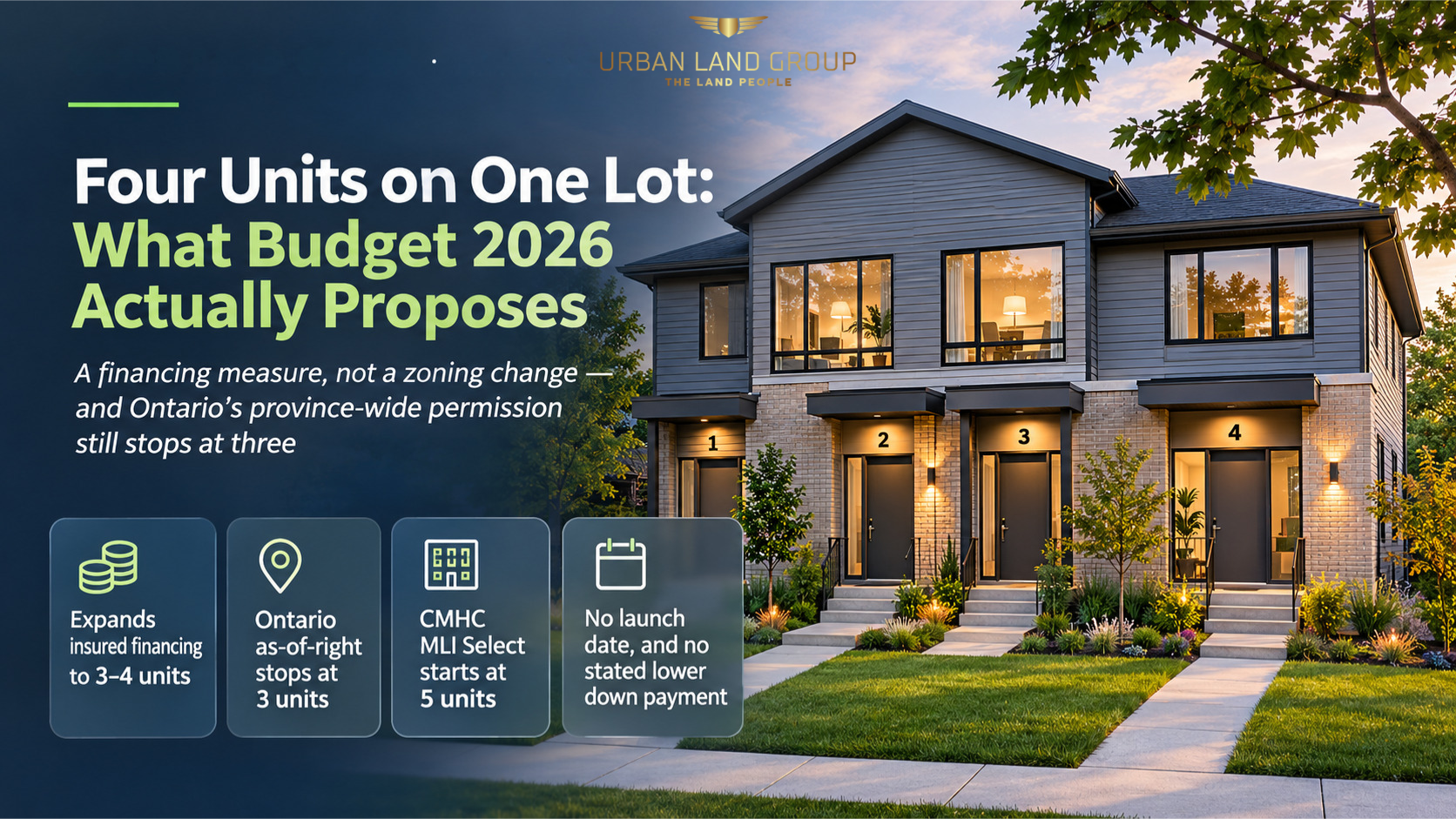
A financing measure, not a zoning change — and Ontario’s province-wide permission still stops at three
November 11, 2026
A post circulating on Facebook says that “early next year” the federal government will introduce “low cost, and low down payment, government insured financing up to 4 units for ONE LOT. AKA a 4-unit on a single family lot.” The direction is right. Budget 2026 does propose to extend insured construction financing down to three- and four-unit housing. Almost every specific around that is wrong, and one of them matters a great deal in Ontario.
The fourth unit is a financing question and a zoning question, and they are answered by different governments. Ottawa can insure a mortgage on a fourpex. It cannot permit one. In Ontario the province-wide as-of-right permission created by the More Homes Built Faster Act, 2022 is three units per lot, not four. The fourth depends entirely on what the local by-law says. And CMHC’s actual multi-unit programme, MLI Select, states a “minimum project size of 5 units.” Between three and five there is, today, nothing.
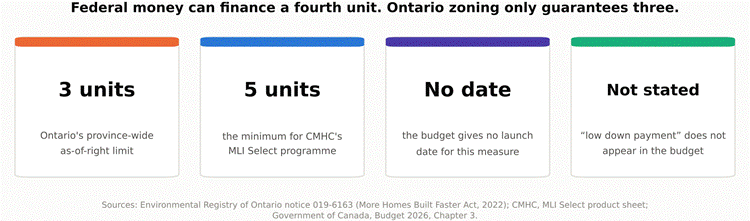
Figure 1. The four numbers that decide whether this helps a given lot.
What Budget 2026 actually says
Chapter 3 of Budget 2026 proposes to “expand access to insured construction financing for newly built three- and four-unit housing.” The stated features are no maximum property value, no requirement to occupy one of the units, and amortisation “over up to 30 years.” That last point is the real substance: a small builder or a homeowner adding units has, until now, generally been pushed toward construction lending priced and amortised as commercial debt. Thirty-year insured amortisation on a four-unit newly built property is a different cost of capital.
Three things the post adds that the budget does not. First, there is no launch date. The passage gives none. The February 1, 2027 date that has been attached to this in social posts belongs to a different measure in the same chapter — allowing private mortgage insurers into the five- to fifty-unit residential band, which is currently CMHC’s alone. Two separate proposals are being run together. Second, “low cost, low down payment” does not appear. No reduced down payment, no subsidised rate, no loan-to-value figure is stated in the measure as described. Third, CMHC is not named as the sole insurer in that passage. Given that the companion measure expressly brings private insurers into the adjacent band, exclusivity should not be assumed.
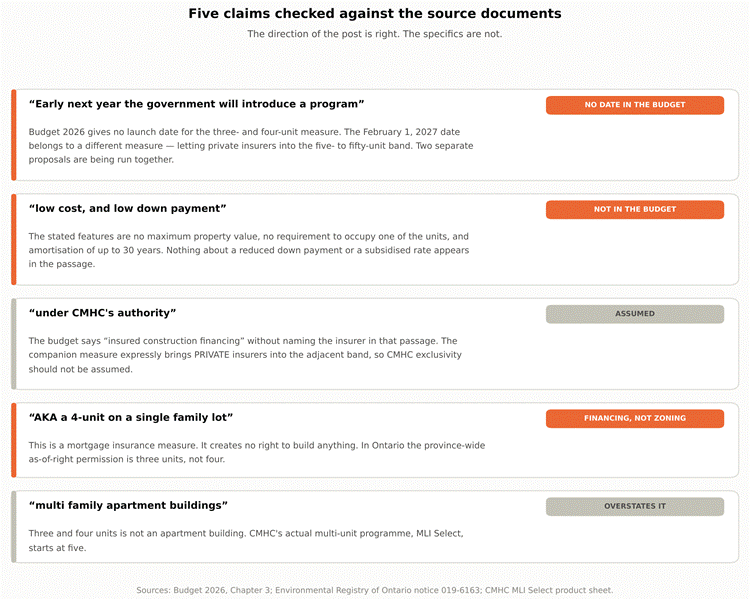
Figure 2. The five claims in the post, checked line by line against the source documents.
Ontario stops at three
This is the part that decides whether a given Ontario lot can use the financing at all. The Environmental Registry decision notice for the More Homes Built Faster Act, 2022 (Royal Assent November 28, 2022) describes the as-of-right permission as up to three units per lot — either three units within the primary building, or two in the primary building plus one in an ancillary building such as a garage. It applies province-wide to any parcel where residential uses are permitted, in settlement areas with full municipal water and sewage services, and it supersedes local official plans and zoning. Development charges, parkland dedication and minimum unit sizes beyond the Building Code do not apply, and no more than one parking space may be required.
What it does not do is permit a fourth unit. Some Ontario municipalities have gone to four in their own by-laws; most have not. So the practical test on any specific property is not “does the federal programme exist” — it is “does this lot’s zoning permit four, and is it on full municipal services inside a settlement area.” On a lot on private septic, or outside a settlement area, or carrying a legal non-conforming use such as an existing house on hazard land, the three-unit permission does not reach it either.
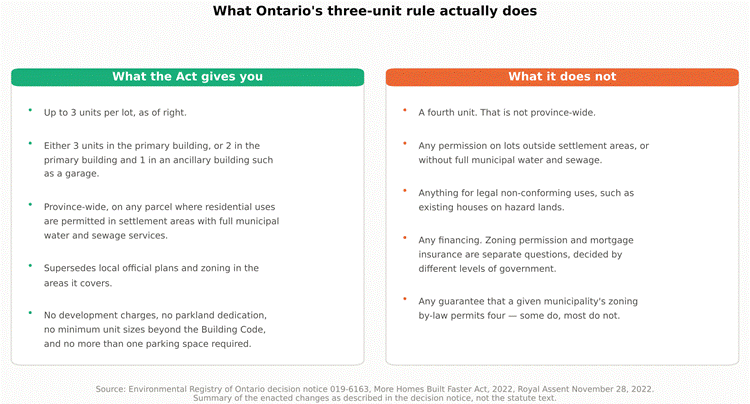
Figure 3. What the Ontario three-unit rule gives, and what it leaves to the municipality.
The gap the measure is reaching into
CMHC’s MLI Select product sheet sets out the programme that small multi-unit borrowers actually ask about, and it is explicit: “Minimum project size of 5 units except retirement homes where a minimum of 50 units/beds is required.” Above that threshold the terms are genuinely strong — a minimum of 50 points qualifies, new construction may advance to 95% of loan-to-cost, existing properties up to 95% loan-to-value (capped at 85% at the 50-point tier), amortisation up to 50 years by points tier, and minimum debt coverage of 1.10 on standard rental. There is no owner-occupancy requirement. CMHC notes that additional conditions may apply and that the information is subject to change at any time.
Below five units, none of that is available. That is the gap Budget 2026 proposes to fill — and it is a real gap, which is why the post resonated. But a measure that fills the four-unit hole in federal financing does nothing for the three-unit ceiling in Ontario zoning, and the two are routinely conflated.
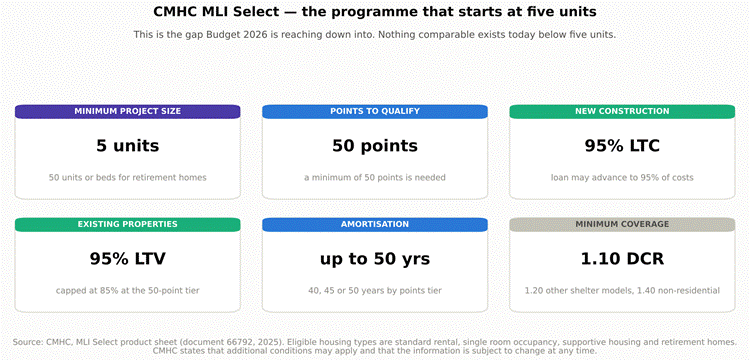
Figure 4. MLI Select terms, from CMHC’s own product sheet. The floor is five units.
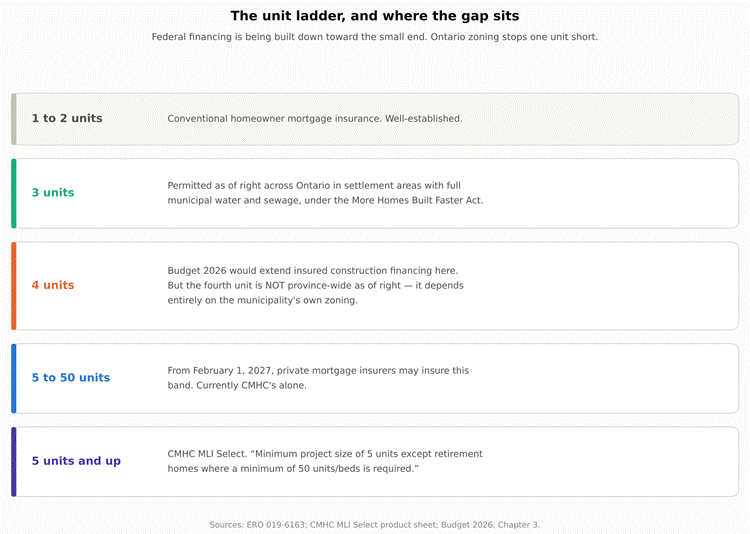
Figure 5. The unit ladder: federal financing building down from above, provincial zoning stopping below.
What this changes for a small infill site
If the measure is enacted as described, the arithmetic on a fourpex changes in one specific way: thirty-year insured amortisation instead of commercial construction terms, with no owner-occupancy requirement and no property value cap. On a small site that is the difference between a project that debt-services and one that does not. It does not change land cost, construction cost, or the time it takes to get through a committee of adjustment for the fourth unit on a lot zoned for three.
The sequence for anyone looking at this is unchanged by the announcement: confirm the by-law permits four; confirm full municipal water and sewage inside a settlement area; confirm the lot is not carrying a legal non-conforming use; then look at financing. A financing programme with no enactment date is the last variable to solve, not the first.
| THE ULG VIEW The measure is real and it addresses a real gap — there is nothing between a two-unit homeowner mortgage and MLI Select’s five-unit floor. But it is being reported as if it were a zoning change, and in Ontario that is the error that costs money. The binding constraint on a four-unit infill in most of this province is the municipal by-law, not the mortgage. Ontario’s province-wide permission is three. Where a municipality has gone to four, the financing measure would matter a great deal. Where it has not, the measure is irrelevant until the zoning changes or a committee of adjustment says yes. Treat every date circulating with this story as unverified. The budget passage carries no launch date; the February 1, 2027 date belongs to the private-insurer measure for five- to fifty-unit properties. A budget proposal is also not law — the EIFEL rental exception from an earlier budget is still, by the government’s own description, not enacted. |
| WHAT IS CONFIRMED AND WHAT IS NOT Confirmed from primary sources. The MLI Select terms above are quoted from CMHC’s own product sheet (document 66792). The Ontario three-unit permission is quoted from the Environmental Registry decision notice for the More Homes Built Faster Act, 2022. Not confirmed. CMHC’s main website could not be reached while preparing this note — every page requested returned a permission error rather than content. So the specific question of whether CMHC itself has published anything about a three- and four-unit programme remains unverified here. The MLI Select figures come from CMHC’s hosted product sheet, which did load. Partially verified. The Budget 2026 Chapter 3 wording is quoted from a reading of the chapter taken earlier; a re-fetch of budget.canada.ca during this note failed on a permission error. Anyone relying on the exact wording should read Chapter 3 directly at the link below. No launch date exists in any source reviewed. Any date you see attached to this measure in social media is either the February 1, 2027 date belonging to the separate private-insurer measure, or an invention. |
Sources
Official and primary sources
· Government of Canada, Budget 2026, Chapter 3 (insured construction financing for three- and four-unit housing; private insurers in the five- to fifty-unit band). https://budget.canada.ca/2026/report-rapport/chap3-en.html
· CMHC, MLI Select product sheet (document 66792). https://assets.cmhc-schl.gc.ca/sites/cmhc/professional/project-funding-and-mortgage-financing/mortgage-loan-insurance/multi-unit-insurance/mli-select.pdf
· CMHC, MLI Select programme page (not reachable at time of writing; listed for the reader). https://www.cmhc-schl.gc.ca/professionals/project-funding-and-mortgage-financing/mortgage-loan-insurance/multi-unit-insurance/mli-select
· Environmental Registry of Ontario, decision notice 019-6163 — More Homes Built Faster Act, 2022 (three units as of right). https://ero.ontario.ca/notice/019-6163
· Ontario, More Homes Built Faster Act, 2022 (Bill 23), e-Laws. https://www.ontario.ca/laws/statute/s22021
Private research and trade press (not official)
· The Facebook post that prompted this note (social media commentary; not a government source). https://www.facebook.com
Sunny Gawri
Urban Land Group — land development advisory and commercial brokerage
Sales Representative, Royal LePage Signature Realty, Brokerage — registered since 2013
30 Eglinton Avenue West, Mississauga, Ontario
This note is general market commentary compiled from public sources. It is not an appraisal, not a legal opinion, and not advice on any specific property. Figures described as ULG calculations are our own arithmetic on the cited public data. Confirm zoning, servicing and financing terms for any site with the municipality and the lender before acting.