
Ontario’s Archaeology Reforms: What Is Law, What Is Live, and What Is Just a Press Release.
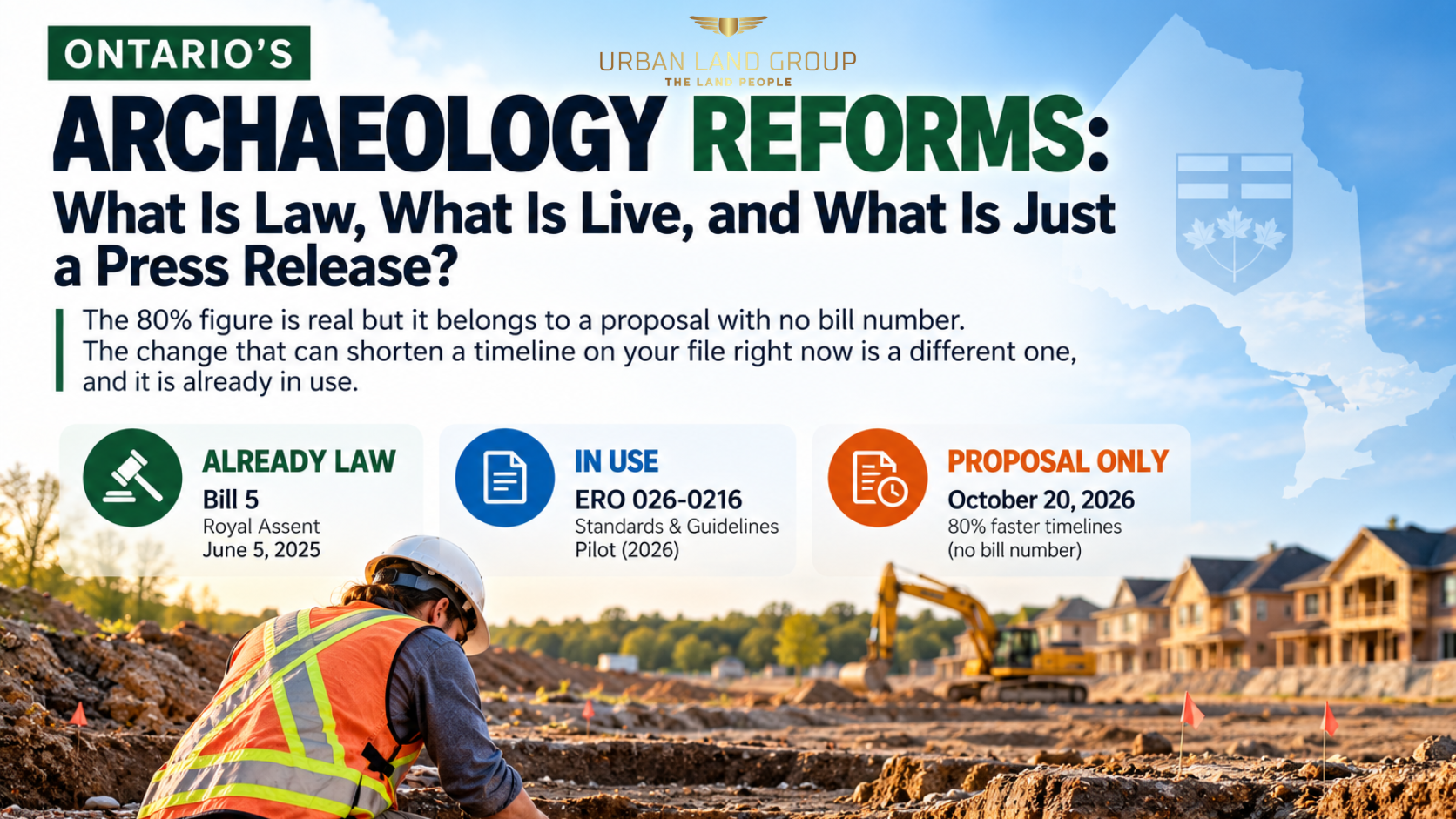
The 80% figure is real but it belongs to a proposal with no bill number. The change that can shorten a timeline on your file right now is a different one, and it is already in use.
October 30, 2026 · Sunny Gawri, Urban Land Group
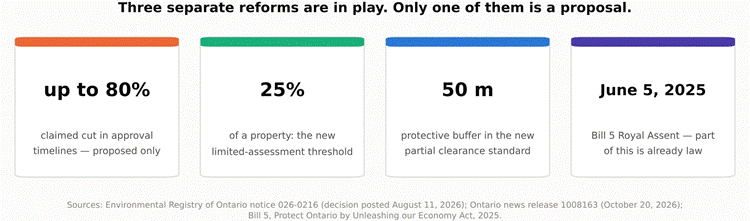
Three reforms, three different legal statuses. Only one of them is a proposal.
Three things are being conflated
“Ontario has proposed cutting archaeological approval times by 80%” is circulating as a single item. It is three, and they are at three completely different stages.
Bill 5, the Protect Ontario by Unleashing our Economy Act, 2025, is already law. It received Royal Assent on June 5, 2025 and added sections 66.1 and 66.2 to the Ontario Heritage Act, allowing Cabinet to exempt properties from Part VI archaeological requirements for listed priorities including transit, housing and health care. Those sections come into force on a day to be named by order, and I could not verify whether that order has been made. The power exists in the statute book regardless.
ERO 026-0216 is decided, not proposed. It was posted March 6, 2026, the 30-day comment period closed April 5, and the decision was posted on August 11, 2026. The Ministry of Citizenship and Multiculturalism received 81 comments through the registry and 12 by email. It is now piloting updated Standards and Guidelines through the 2026 field season, intends to finalize them in late 2026, and would post them in the new year ahead of the 2027 season, coming into force 60 days after posting.
Only the October 20, 2026 announcement is a proposal — and it is a far bigger one than the headline suggests. It would replace the four-stage assessment process with risk tiers and, as reported, eliminate licensing requirements for those who conduct archaeology. No bill number, no tabled text and no effective date could be verified.
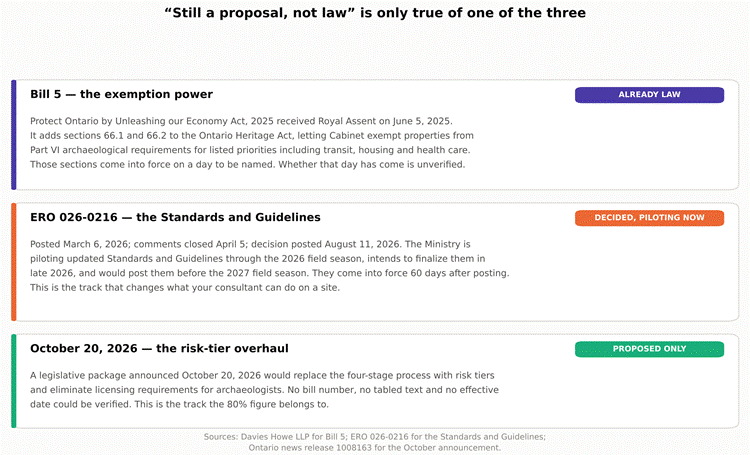
Statuses as at October 30, 2026.
Where the 80% actually comes from
It is not in ERO 026-0216. The notice contains no review time, no service standard and no percentage of any kind — the only time figures in it are the 30-day comment period, the 60-day coming-into-force period and a 50-metre buffer. The two instances of “80%” in the draft standards are unrelated: one is about ploughed ground visibility during pedestrian survey, the other about the occupation span of a site.
The figure comes from the October 20 announcement. An MPP page reproducing it says the reforms “are expected to cut approval timelines by up to 80 per cent and increase sector capacity by 45 per cent,” and that the province “has already eliminated a backlog of more than 3,000 archaeological reports.” Counsel reporting on the same announcement gives the underlying numbers: assessment timelines falling from 29 months to 4–6 months for 80% of projects, and from 64 months to 12–18 months for the remaining 20%.
Two cautions on that. First, there are two different 80s in the same claim — an 80% reduction in time and 80% of projects — and they are easy to conflate. Second, I could not retrieve the official release. Ontario’s newsroom serves release 1008163 only to a JavaScript browser, and the trade coverage is robots-blocked. Every figure in this section is a government claim relayed by an MPP page or by counsel, not a published service standard. Do not put them in a client memo as official.
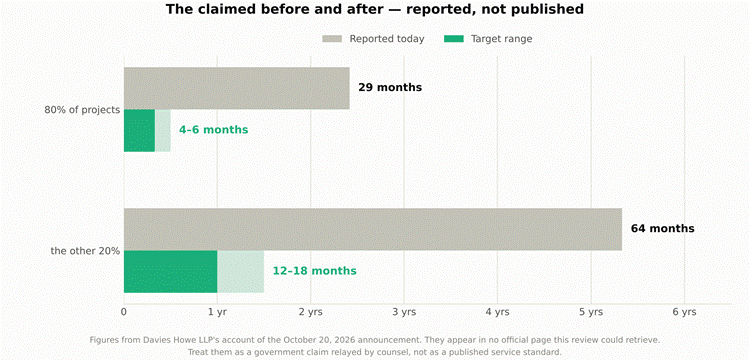
Reported figures, not published ones. Sourced as noted.
The change that is actually usable now
While the headline reform waits for a bill, the Standards and Guidelines pilot is live, and it contains two tools that bear directly on a development schedule. Both sit in Stage 2, which is where archaeological time is usually lost.
Limited assessments. Until now there were no standards for assessing part of a property; the Ministry allowed it case by case as an exception. The new standards would let a licensed consultant archaeologist assess only the affected area where the development impacts plus a 10-metre buffer cover 25 per cent or less of the property, and recommend that the rest requires no further assessment. A Stage 1 background study of the entire property is still required.
Partial clearance. The existing process allowed development on part of a property while sites elsewhere were still being assessed, but the notice says the option “is not consistently used, risking impacts to the archaeological sites.” The new standard recommends a 50-metre protective buffer around any site of further cultural heritage value, with land outside the buffer recommended as cleared once the report is entered in the Ontario Public Register of Archaeological Reports. The catch: the archaeologist must obtain a signed, standardized letter from the proponent or landowner acknowledging the site and committing to avoid impacts within the protected area, submitted to the Ministry with the report package.
That second requirement is a real covenant on title-adjacent conduct, not a formality. It should be read before it is signed.
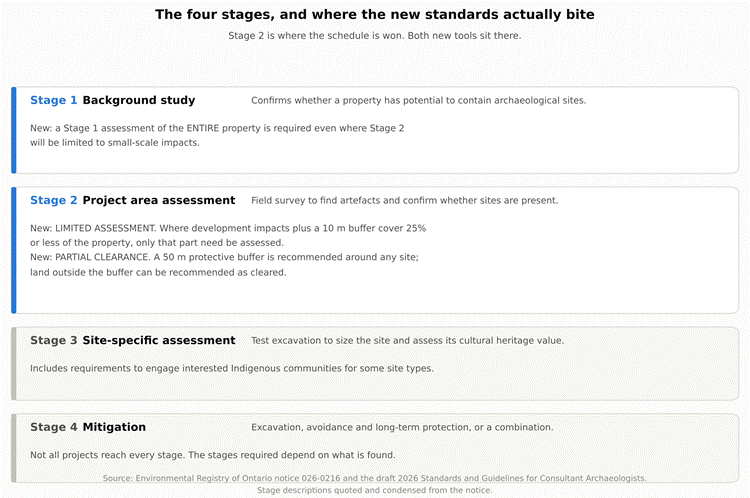
Stage descriptions condensed from ERO 026-0216.
What the proposal would replace it with
The October announcement would scrap the four stages for a three-tier risk model: exemptions for low-risk small-scale and residential projects with no archaeological potential; permit-by-rule registration for medium risk, where work proceeds if mandatory requirements are met; and Ministry authorization for high risk.
The part that has had least attention is the reported elimination of licensing requirements to widen who can conduct archaeology. That is how you get a 45% capacity increase, and it is also where the risk sits for a proponent. Today, a licensed consultant archaeologist carries defined obligations as terms and conditions of a licence issued under the Ontario Heritage Act. If licensing goes, the quality of your consultant becomes a due diligence question rather than a regulatory one.
Worth noting alongside it: the Ministry consulted separately on criteria for evaluating consultant compliance — report resubmission rates, non-compliant reports, licensing actions — and the decision notice records concerns “about reputational damage from making compliance information… public.” Those two workstreams point in opposite directions.
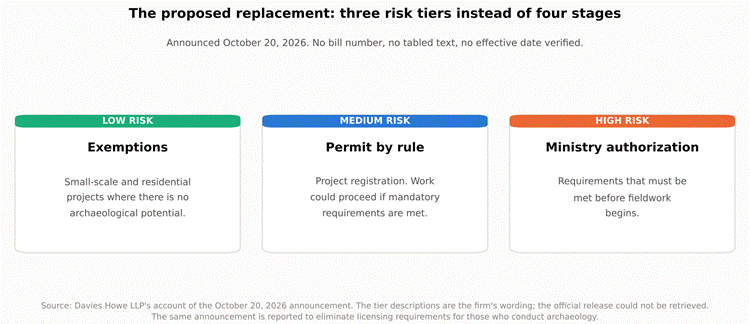
Tier descriptions as reported by counsel; the official release could not be retrieved.
| THE ULG VIEW Do not re-forecast an entitlement schedule off the 80% number. It attaches to a legislative package with no bill, no text and no date, and the only published version of it I could find is an MPP’s paraphrase. If a lender or partner asks where it comes from, “a government press release we could not open” is the honest answer. Do ask your archaeological consultant about limited assessments and partial clearance on every live file, this season. Those standards are being piloted now. On a site where the development footprint plus a 10-metre buffer is a quarter of the property or less, the difference between assessing the whole parcel and assessing the footprint is a field season. That is the real number on a pro forma, and it is available without waiting for any bill. Partial clearance is the more valuable of the two on a phased site. Getting the unaffected portion cleared for approval while a site elsewhere is still being worked lets Phase 1 proceed. But the standardized letter committing the landowner to avoid impacts within a 50-metre buffer runs with the conduct of the project — have counsel read it before signing, and price the buffer as unbuildable area in the yield. Bill 5’s exemption power is the sleeper. If sections 66.1 and 66.2 are proclaimed and housing is a listed priority, a residential file could be exempted from Part VI entirely by order. That is a much bigger lever than any percentage, it is already in the statute, and the criteria regulation that would govern it was consulted on a year ago with no verified outcome. Worth a standing watch rather than a forecast. On the licensing proposal, take the opposite of the obvious position. More capacity is good for schedule. But if the regulatory floor under archaeological consultants is removed, the risk of an inadequate assessment surfacing later — at a Tribunal hearing, on a servicing permit, or when ground is opened — moves from the regulator to you. Keep hiring licensed consultants whether or not the law requires it. And the Indigenous engagement thread is not noise. The decision notice records “concerns that earlier Indigenous engagement requirements were not included in this round of changes” and that Indigenous communities want input reflected in consultant compliance criteria. Reforms that speed approvals while leaving engagement unaddressed tend to produce delay later rather than less of it. |
| WHAT IS CONFIRMED AND WHAT IS NOT Confirmed from the Environmental Registry. ERO 026-0216’s notice type, Act, ministry, posting and decision dates, the closed comment period, the comment counts, the pilot decision and the 60-day coming-into-force period. The four-stage process description, the limited assessment and partial clearance standards, the 25 per cent threshold, the 10-metre and 50-metre buffers, the signed landowner letter requirement, and the regulatory impact wording. Confirmed from Ontario. That the Ministry receives approximately 3,000 archaeological reports a year with over 30,000 on file, that ministry staff and Archaeology Review Officers review reports, and that the Ontario Public Register of Archaeological Reports is provided for by section 65.1 of the Ontario Heritage Act. Not verified — and this matters. The official news release could not be retrieved; Ontario’s newsroom serves it only to a JavaScript browser and the trade coverage is robots-blocked. The 80 per cent claim, the 45 per cent capacity claim and the eliminated backlog come from an MPP’s page reproducing the announcement. The 29-month, 64-month, 4–6 month and 12–18 month figures, the three risk tiers and the licensing elimination all come from Davies Howe LLP’s commentary. No minister quote, bill number or effective date could be confirmed from any source. Also not verified. Whether Ontario Heritage Act sections 66.1 and 66.2 have been proclaimed in force; the outcome of the draft Archaeology Exemption Criteria Regulation consulted on under ERO 025-1081 in late 2025; and a discrepancy in report volumes — ontario.ca says approximately 3,000 a year, counsel reports approximately 3,500. ULG’s own. The observation that the 80 per cent figure appears nowhere in ERO 026-0216, the three-track framing, and the reading that Stage 2 is where the new tools bite. This is market commentary, not legal advice; archaeological obligations are parcel-specific and a licensed consultant archaeologist should advise on any particular site. |
Sources
OFFICIAL AND PRIMARY SOURCES
· Environmental Registry of Ontario — ERO 026-0216, Heritage Framework Transformation: Proposals related to Ontario’s Archaeology Program. Ministry of Citizenship and Multiculturalism. Proposal posted March 6, 2026; decision posted August 11, 2026. https://ero.ontario.ca/notice/026-0216
· Government of Ontario — Archaeology. Source of the report volumes and the description of ministry review. https://www.ontario.ca/page/archaeology
· Government of Ontario — news release 1008163, Ontario Cutting Wait Times for Archaeological Approvals by Up to 80 Per Cent, October 20, 2026. Could not be retrieved; the page is served only to a JavaScript browser. https://news.ontario.ca/en/release/1008163/ontario-cutting-wait-times-for-archaeological-approvals-by-up-to-80-per-cent
· Environmental Registry of Ontario — ERO 025-1081, draft Archaeology Exemption Criteria Regulation, consulted October to November 2025. Outcome unverified. https://ero.ontario.ca/notice/025-1081
SECONDARY — LAW FIRM COMMENTARY AND MPP PAGES, NOT OFFICIAL
· Davies Howe LLP — Ontario Proposes Changes to Archaeological Assessment and Approval Process, October 26, 2026. Source of the 29/64-month figures, the three risk tiers and the licensing elimination. https://davieshowe.com/ontario-proposes-changes-to-archaeological-assessment-and-approval-process/
· Davies Howe LLP — Bill 5 and the Ontario Heritage Act: Understanding the Proposed Archaeological Exemption Framework. Source of the June 5, 2025 Royal Assent date and sections 66.1 and 66.2. https://davieshowe.com/bill-5-and-the-ontario-heritage-act-understanding-the-proposed-archaeological-exemption-framework/
· Davies Howe LLP — Digging into Change: Ontario Proposes Updates to Archaeological Assessment Standards, March 2026. https://davieshowe.com/digging-into-change-ontario-proposes-updates-to-archaeological-assessment-standards/
· Graham McGregor, MPP — Cutting Red Tape to Build More Homes and Infrastructure Faster, October 20, 2026. Source of the 80 per cent and 45 per cent claims and the eliminated backlog. https://grahammcgregormpp.ca/cutting-red-tape-to-build-more-homes-and-infrastructure-faster/
Urban Land Group · Land development advisory and commercial real estate · 30 Eglinton Avenue West, Mississauga, Ontario
Sunny Gawri is a registered real estate sales representative with Royal LePage Signature. Market commentary prepared for discussion. Not legal advice, and not an Opinion of Value for any specific property.