
Ontario’s 36 Conservation Authorities Become 9 on February 1.
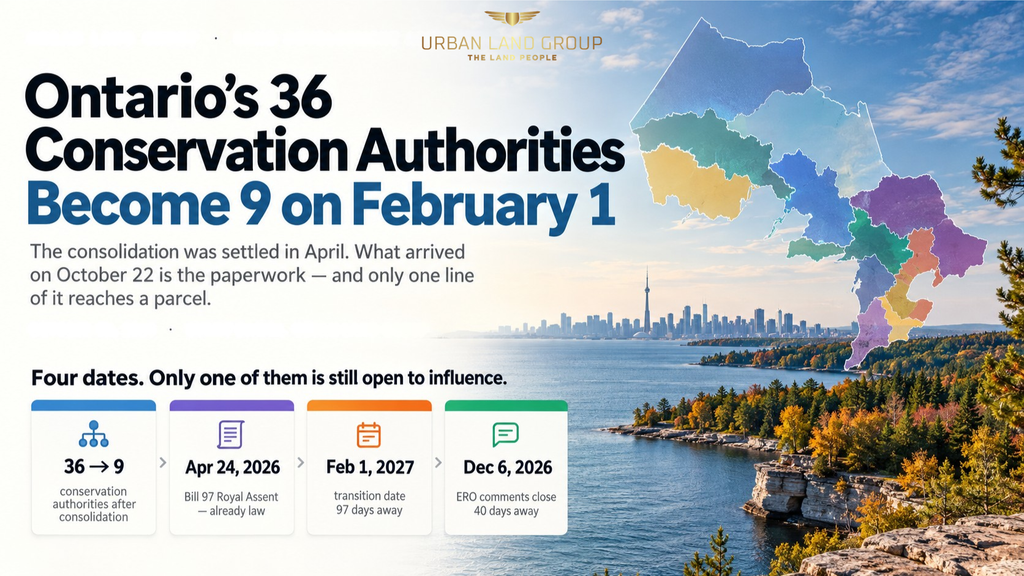
The consolidation was settled in April. What arrived on October 22 is the paperwork — and only one line of it reaches a parcel.
October 27, 2026 · Sunny Gawri, Urban Land Group
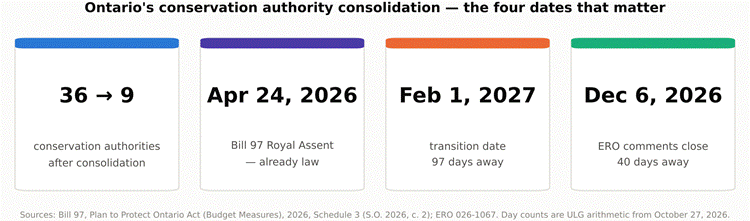
Four dates. Only one of them is still open to influence.
The headline is three months late
The October 22 package is being described as the province “moving to consolidate” Ontario’s conservation authorities. It already did. Bill 97, the Plan to Protect Ontario Act (Budget Measures), 2026, received Royal Assent on April 24, 2026 and is Chapter 2 of the Statutes of Ontario, 2026. Schedule 3 added Part I.1 to the Conservation Authorities Act, in force on assent. The explanatory note: the Act “provides for the amalgamation of 35 conservation authorities into 8 new conservation authorities and continues the Lakehead Region Conservation Authority under the name Northwestern Ontario Regional Conservation Authority.” Thirty-six becomes nine. The transition date is February 1, 2027 “or such later date as may be prescribed” — 97 days out.
ERO 026-1067, posted October 22, is implementation detail. Comments close at 11:59 p.m. on December 6. Commenting will not change whether the merger happens. It can change five regulatory mechanics: OPCA cost recovery from the authorities; apportionment and budget timing under O. Reg. 402/22 and 401/22; amendments to O. Reg. 41/24; the Lake Simcoe renaming; and consequential changes tied to ERO 026-1069.
Who merges into whom
The mapping is in the Table to section 1.3 of Schedule 3 — the most useful page in the package, and the part most coverage has skipped. Credit Valley, Halton Region, Hamilton Region and Niagara Peninsula amalgamate into Western Lake Ontario Regional. Toronto and Region and Central Lake Ontario become Central Lake Ontario Regional. Grand River does not join either — it goes to Eastern Lake Erie, with Catfish Creek, Kettle Creek and Long Point Region.
The statute writes “Halton Region” and “Hamilton Region”, not Conservation Halton or Hamilton Conservation Authority. Use the enacted names. And Lake Simcoe Region going into Lake Huron Regional is not an error in the notice — Lake Simcoe drains through the Severn into Georgian Bay, which is Lake Huron.
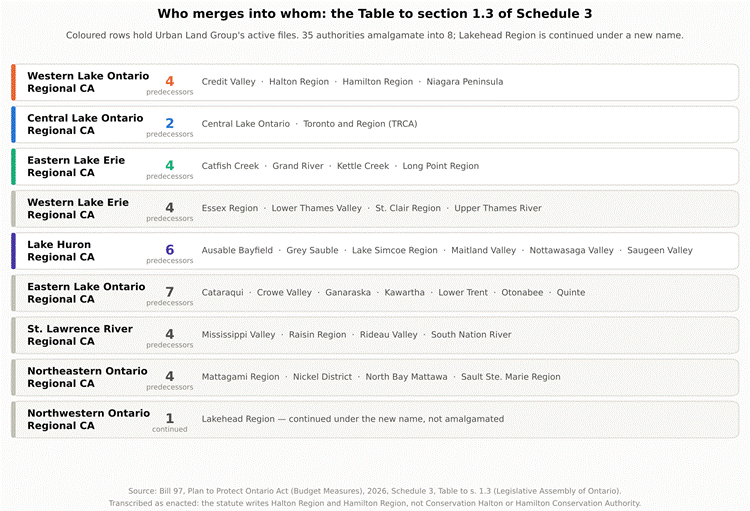
Transcribed from the Table to s. 1.3 of Schedule 3. Coloured rows carry ULG files.
The one item that reaches a parcel — and its limit
Item 3 amends O. Reg. 41/24: existing technical standards continue in the appropriate watersheds, clause 7(1)(h) is reworded, the municipal drain maintenance and repair exception no longer applies within a wetland, and shoreline hazard allowances are corrected — no buffer for Niagara Peninsula and Lake Simcoe Region; 15 metres for Saugeen Valley unless a dynamic beach is present.
The Niagara line is being over-read. A shoreline hazard allowance regulates Great Lakes shoreline. A site on the Welland River, the canal corridor or inland Niagara Falls is regulated through riverine flood and erosion hazards, wetlands and watercourse setbacks — none of which this touches. If you hold Lake Erie or Lake Ontario frontage, read item 3 before December 6. If not, it is a footnote.
Continuity is written into the statute
Section 1.3(3) provides that a new authority “shall stand in the place of its predecessor authorities for all purposes.” Paragraph 20 continues any permit application filed before the transition date and not yet decided. Paragraph 21 continues hearing requests and commenced hearings; paragraph 22 deems the new authority the party. Paragraph 14 provides the amalgamation does not breach, terminate, repudiate or frustrate any permit. Paragraph 1 transfers all rights, obligations, assets and liabilities. Employment is continuous. Nobody refiles.
Two provisions cut the other way: the transition date can be pushed by regulation, and s. 1.14(1)(a) lets the Minister direct an authority to stop making decisions under any of its powers.
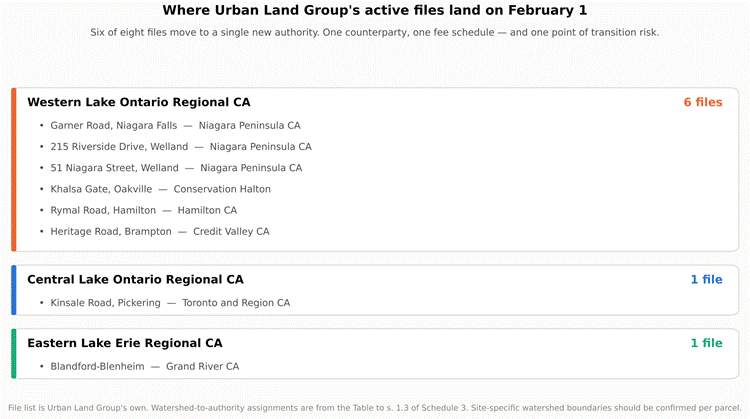
Watershed assignments from the statute. Parcel-level boundaries still need confirming per site.
| THE ULG VIEW Statutory risk here is close to nil. Operational risk is real. Schedule 3 carries your application, your hearing and your issued permit across February 1 by express provision. What it cannot legislate is throughput — and throughput is what a pro forma pays for. Four review teams at Credit Valley, Halton, Hamilton and Niagara Peninsula become one team, one org chart, one new executive, mid-fiscal-year. Staff get reassigned, delegated authorities re-adopted, fee schedules harmonised with no published direction. Every municipal amalgamation Ontario has run saw approval throughput fall for two to four quarters first. Price that as schedule, not entitlement. A permit slipping a quarter is a carry-cost line unless it crosses something that resets — a rate lock, a conditional closing, a draft plan lapse, an agreement expiry. Those are the dates to test. File anything close to ready now. An application in the queue on January 31 carries over by statute with its file number and reviewer history; one filed February 2 enters a new organisation with none. And ask the apportionment question: item 2 proposes the 2027 apportionment and final budget be approved and noticed to municipalities by December 31 — 65 days from today, for authorities that do not exist until February 1. If that is unworkable, the comment period is where to say so. |
| WHAT IS CONFIRMED AND WHAT IS NOT Confirmed from primary sources. Royal Assent April 24, 2026 (S.O. 2026, c. 2). The Table to s. 1.3 and every predecessor-to-successor assignment above. The transition date and its “such later date” qualifier. The continuity provisions in s. 1.3(3) paras. 1, 14, 20, 21, 22 and the Minister’s power in s. 1.14(1)(a). ERO 026-1067’s posting date, 45-day period, December 6 close and all five items including the shoreline figures. Not verified. Head office locations, harmonised fee schedules and staff allocation — nothing published addresses any of them. The eight transition committees and July 2026 project executives come from Conservation Ontario and the ERO notice, not an order or ministry list. ULG’s own. The day counts, the file-to-authority mapping, and the reading that inland Niagara sites are untouched by the shoreline allowance correction. That last point is an inference about what a shoreline allowance regulates, not a Ministry statement — a site with Great Lakes frontage needs its own review. Nothing here is legal advice. |
Sources
OFFICIAL AND PRIMARY SOURCES
· Legislative Assembly of Ontario — Bill 97, Plan to Protect Ontario Act (Budget Measures), 2026, Schedule 3; Royal Assent April 24, 2026; S.O. 2026, c. 2. https://www.ola.org/en/legislative-business/bills/parliament-44/session-1/bill-97
· Environmental Registry of Ontario — ERO 026-1067 (MECP), posted October 22, 2026; comments close December 6, 2026. https://ero.ontario.ca/notice/026-1067
· Environmental Registry of Ontario — ERO 026-1071, amendments under the Lake Simcoe Protection Act. https://ero.ontario.ca/notice/026-1071
· Ontario e-Laws — Conservation Authorities Act, R.S.O. 1990, c. C.27. https://www.ontario.ca/laws/statute/90c27
· Ontario e-Laws — O. Reg. 41/24, Prohibited Activities, Exemptions and Permits. https://www.ontario.ca/laws/regulation/240041
SECTOR BODIES — NOT OFFICIAL
· Conservation Ontario — member association of Ontario’s conservation authorities; confirms the 36-to-9 consolidation. A sector association, not a government source. https://conservationontario.ca/
Urban Land Group · Land development advisory and commercial real estate · 30 Eglinton Avenue West, Mississauga, Ontario
Sunny Gawri is a registered real estate sales representative with Royal LePage Signature. Market commentary prepared for discussion. Not legal advice, and not an Opinion of Value for any specific property.