
Sixty Pre-Construction Sales In A Quarter, Across The Entire GTHA

New condominium sales doubled, and the recovery is being written up as one. Strip out the bulk investors buying finished suites at $763 a foot and what remains is sixty people buying something not yet built.
Urban Land Group · October 21, 2026
Urbanation reports that 760 new condominium units sold across the Greater Toronto and Hamilton Area in the third quarter of 2026, double the same quarter a year earlier and the second consecutive quarter of growth. Investment groups acquired 339 of them through bulk transactions, 45% of the total, at an average of $763 per square foot — a 40% discount to the original selling prices for units in the same buildings. A record 648 units sold in completed buildings, 85% of all new condominium sales. Pre-construction sales fell 61% to 60 units.
Two things should be said before the numbers are used. Urbanation is a private research firm, so these are vendor figures rather than an official statistic — there is no government series measuring this market quarterly. And the growth is from a very low base: sales remained 78% below the ten-year third-quarter average.
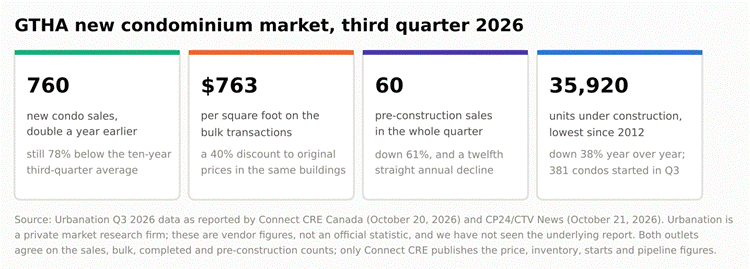
Reported figures. Urbanation is a private research firm; these are not official statistics.
What the 760 is actually made of
Of the 760 sales, 339 were bulk investor purchases and 648 were in completed buildings. Taking the difference, roughly 309 were ordinary purchases of finished units. That leaves 60 sales — 7.9% of the quarter — where someone bought a condominium that has not been built.
That is the number that matters for anything upstream of a finished building. Pre-construction sales are what a lender underwrites a construction loan against. A developer cannot start a tower on 60 sales spread across an entire region, and the twelfth consecutive quarter of annual decline says this is a condition, not a soft patch.
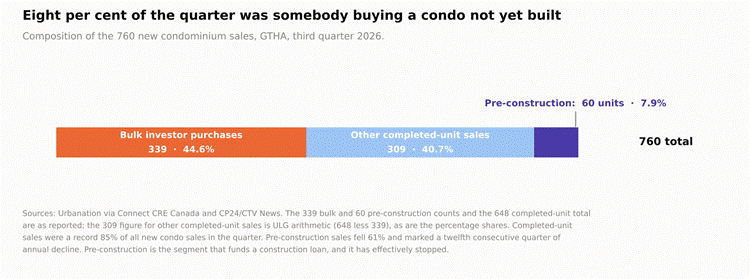
The 309 figure and the percentage shares are ULG arithmetic on the reported counts.
The inventory drawdown has one cause
Completed and unsold inventory fell 7% in the quarter to 5,127 units, the first quarterly decline in four years. That is a genuine improvement and it is worth acknowledging. But hold the sales pace constant and the scale becomes clear: at 648 completed-unit sales a quarter, 5,127 units is 7.9 quarters of standing supply. Remove the 339 bulk purchases and the remaining pace is about 309 a quarter, which is 16.6 quarters — more than four years.
The bulk buyers are not evidence that end-user demand has returned. They are the reason the inventory line moved at all. If they stop, the line stops with them.
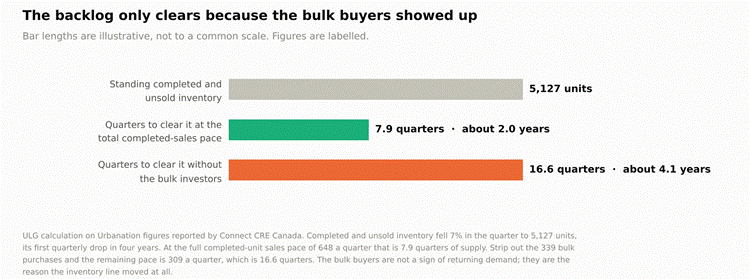
ULG calculation. Holding the sales pace constant is a way of expressing scale, not a forecast.
And $763 a foot is the number for anyone holding land
The bulk transactions cleared at an average of $763 per square foot, which the reporting puts at a 40% discount to original pricing — implying original pricing of roughly $1,272 a foot. A completed, standing GTA condominium unit can now be acquired for materially less than it costs to build one. While that is true, the residual land value of a condominium development site is not merely depressed; there is no number that works.
It also reconciles with the resale market rather than contradicting it. At $763 a foot a six-hundred-square-foot suite is about $458,000, which sits in the $400,000 to $499,999 band that was the single largest in TRREB’s September condominium sales. New and resale are converging on the same clearing price, which is what happens when 85% of new sales are of buildings that already exist.
The pipeline behind it
Units under construction across the GTHA fell 38% year over year to 35,920, the lowest since 2012, with 381 condominiums started in the quarter. CMHC’s Fall 2026 Housing Supply Report points the same way from a narrower base: 156 condominium units started in the City of Toronto in the first half of 2026, against roughly 7,000 a year over the previous decade.
Completions follow starts by three to five years. Shaun Hildebrand, president of Urbanation, framed it as a pipeline drying up and setting the market up for a significant shortage by the end of the decade. That last part is a forecast by an interested party; the starts data underneath it is not.
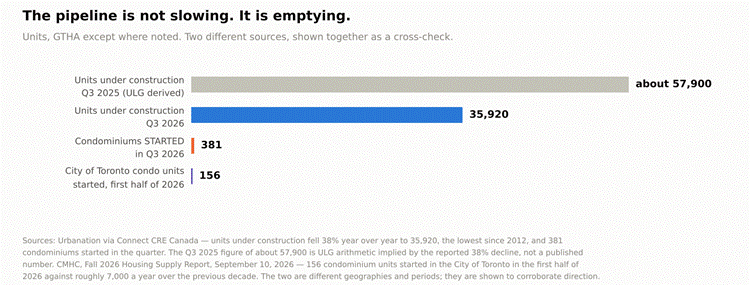
Two different sources and geographies, shown to corroborate direction rather than to be compared directly.
| THE ULG VIEW Before anything else: Urbanation is a private research firm, not an official source. These are vendor figures and we have not seen the underlying report. Two outlets carry them and agree on the core counts, which is the most verification available. Treat the numbers as the best read of a market nobody else measures at this frequency, not as a statistic. The recovery framing is doing a lot of work. Sales doubled, yes — to 760 units across the entire Greater Toronto and Hamilton Area in three months, still 78% below the ten-year third-quarter average. In a region of roughly seven million people, that is not a recovery. It is a market that stopped falling. Strip the quarter down and only 60 sales were somebody buying a condominium that has not been built. Pre-construction fell 61% to 60 units, a twelfth consecutive quarter of annual decline. Bulk investors took 339 and other completed-unit buyers took roughly 309. Pre-construction is the segment that funds a construction loan. At 60 units a quarter it funds nothing. The inventory improvement is almost entirely the bulk buyers. Completed and unsold inventory fell 7% to 5,127 units, the first quarterly drop in four years. At the full completed-sales pace of 648 a quarter that is 7.9 quarters of standing supply. Remove the 339 bulk purchases and the remaining pace is 309, which is 16.6 quarters — more than four years. The headline says the backlog is clearing. The arithmetic says one buyer type is clearing it. The $763 per square foot is the number that matters for land, and it is brutal. That is finished, standing product changing hands at a 40% discount to its original pricing — implying original pricing around $1,272 a foot. A buyer can now acquire a completed GTA condominium unit for less than it costs to build one. Until that gap closes, the residual land value of a condominium development site is not low. It is absent. And it corroborates the resale data rather than contradicting it. At $763 a foot, a six-hundred-square-foot suite is about $458,000, which lands squarely in the $400,000 to $499,999 band that was the single largest in TRREB’s September condominium sales. New and resale are converging at the same clearing level, which is what you would expect when 85% of new sales are of buildings that are already finished. The pipeline figure is the one to carry into client conversations. Units under construction fell 38% to 35,920, the lowest since 2012, against 381 starts in the quarter. CMHC’s own data points the same way: 156 condominium units started in the City of Toronto in the first half of 2026 against roughly 7,000 a year over the previous decade. Completions follow starts by three to five years, so the delivery cliff is arithmetic, not forecast. What to actually do with it. Do not price condominium-designated density off 2021 comparables; the bid is rental or patient capital, as it has been all autumn. But do note that the standing-inventory drawdown plus a collapsed pipeline is the setup Hildebrand described as a shortage by the end of the decade — and a site that can be shovel-ready in 2029 rather than entitled in 2029 is positioned for that, if it can be carried. Carrying cost, not entitlement, is the binding constraint on that strategy. |
| WHAT IS CONFIRMED AND WHAT IS NOT All market figures here are Urbanation’s, reported by trade and general press. Connect CRE Canada published them on October 20, 2026 and CP24/CTV News on October 21, 2026. We have not read Urbanation’s report. There is no government source for GTHA new condominium sales, bulk transactions or standing inventory at quarterly frequency. The two outlets agree where they overlap and differ only in coverage. Both carry 760 total sales, the doubling, 339 bulk units, the 45% share, 648 completed units, the 85% share, 60 pre-construction sales and the 78% gap to the ten-year average. Only Connect CRE publishes the $763 per square foot, the 40% discount, the 5,127 standing inventory, the 381 starts and the 35,920 under construction. Those five figures rest on a single source. Several numbers here are ULG arithmetic, not reported figures. The 309 other completed-unit sales (648 less 339), the percentage shares of the 760, the 7.9 and 16.6 quarters of supply, the implied original price of about $1,272 a square foot, and the roughly 57,900 units under construction a year ago (implied by the reported 38% decline) are all ours. The quarters-of-supply figures hold the current sales pace constant. They are a way of expressing the size of the standing inventory, not a prediction. A single further bulk transaction would change both. The CMHC comparison is a different geography and period. The 156-unit figure is City of Toronto, first half of 2026, from CMHC’s Fall 2026 Housing Supply Report of September 10, 2026. Urbanation’s 381 is GTHA, third quarter. They are shown to corroborate direction, not to be added or compared directly. The shortage forecast is Urbanation’s opinion, not data. Shaun Hildebrand, president of Urbanation, is quoted saying the drying pipeline is setting the market up for a significant shortage by the end of the decade. That is a forecast by an interested party and should be weighed as such. |
SOURCES
Official sources
· CMHC — Fall 2026 Housing Supply Report, September 10, 2026 (Toronto condominium and rental apartment starts) https://www.cmhc-schl.gc.ca/professionals/housing-markets-data-and-research/market-reports/housing-market/housing-supply-report
· CMHC — Housing Market Information Portal (starts, completions and under-construction data) https://www03.cmhc-schl.gc.ca/hmip-pimh/en
· Statistics Canada — The Daily, Building permits, August 2026, released October 14, 2026 https://www150.statcan.gc.ca/n1/daily-quotidien/261014/dq261014a-eng.htm
· City of Toronto — $1.5 billion Canada-Ontario Partnership to Build funding and development charge reduction, June 23, 2026 https://www.toronto.ca/news/city-of-toronto-secures-1-5-billion-in-canada-ontario-partnership-to-build-funding-to-support-housing-and-reduce-development-charges/
Board and private research (not official)
· Connect CRE Canada — Nearly half of GTHA new condo sales are discounted bulk deals, October 20, 2026 https://www.connectcre.ca/stories/nearly-half-of-gtha-new-condo-sales-are-discounted-bulk-deals/
· CP24 / CTV News — Bulk new condo purchases boosting sales in GTHA, but the supply pipeline is drying up, October 21, 2026 https://www.cp24.com/local/toronto/2026/10/21/bulk-new-condo-purchases-boosting-sales-in-gtha-but-the-supply-pipeline-is-drying-up-report/
· Urbanation — market research and quarterly condominium data (the originating source) https://www.urbanation.ca/
· Toronto Regional Real Estate Board — Market Watch, September 2026 (resale condominium prices and price-range table) https://trreb.ca/market-news/market-watch/
Prepared by Urban Land Group. Sunny Gawri is a registered sales representative with Royal LePage Signature Realty, Brokerage. This document is market commentary prepared for discussion purposes. All arithmetic identified as ULG calculation is our own and is not sourced from Urbanation, CMHC or any government body. Nothing here is an appraisal, an Opinion of Value, or investment, legal or tax advice.