
Why Private Capital Is Rising for Ontario Purpose-Built Rental.
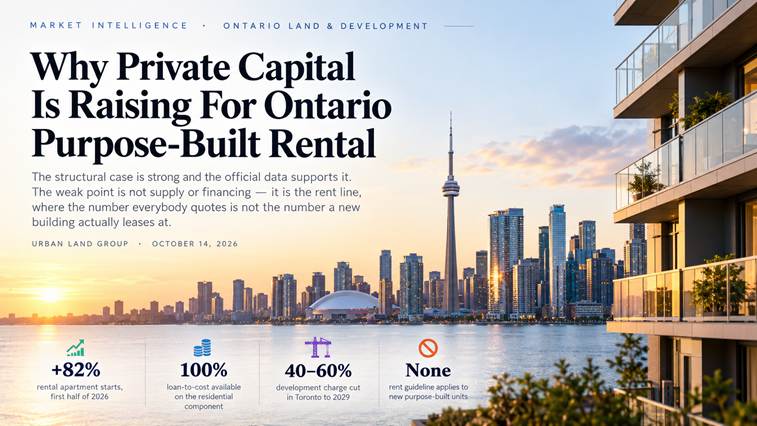
The structural case is strong, and the official data supports it. The weak point is not supply or financing — it is the rent line, where the number everybody quotes is not the number a new building actually leases at.
Urban Land Group · October 14, 2026
Private funds are being raised to develop purpose-built rental in Ontario, and the pitch is broadly the same wherever it appears: the current environment has created a window. That claim is testable against public data, and on the supply and financing side it holds up. This note sets out what the official sources actually show, and where the argument is weakest.
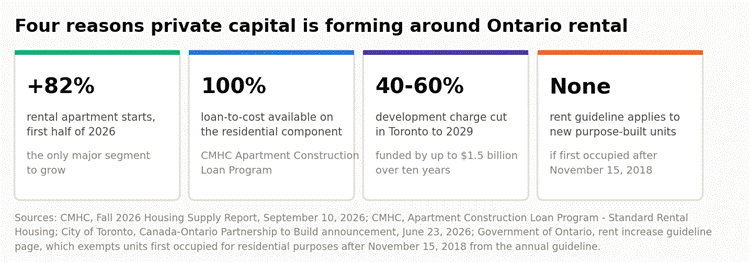
The four published facts the purpose-built rental case rests on.
The supply side is not in dispute
CMHC’s Fall 2026 Housing Supply Report, published September 10, records that purpose-built rental apartment starts rose 82% in the first half of 2026 against the same period of 2025 — the only major segment to grow. On a Toronto CMA four-quarter moving basis, rental apartment starts reached 12,062 at Q2 2026 against 6,039 a year earlier, while condominium apartment starts fell to 8,289 from 13,883 and from a peak of 31,445 at Q2 2023. Rental starts exceeded condominium starts for the first time in decades.
In the City of Toronto proper, 156 condominium units started in the first half of 2026, against an average of roughly 7,000 a year over the previous decade. CMHC attributes the condominium collapse to weak presales, poor investor demand and high resale supply, and credits the rental increase to government financing, municipal incentives and some condominium projects converting to rental.
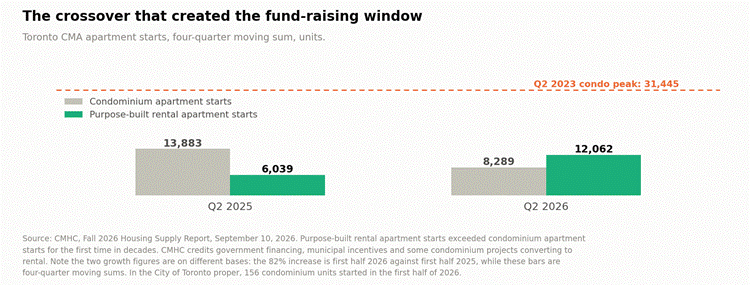
The crossover is the structural fact the fund-raising rests on. It is CMHC’s own data.
The financing is the actual subsidy
Two federal programs are doing most of the work, and they are frequently conflated. The Apartment Construction Loan Program is a construction loan: up to 100% of the cost of the residential component, fixed rate locked at the first advance, interest only until twelve consecutive months of stabilized effective gross income, amortization up to 50 years, minimum five units and a one million dollar loan. It requires at least 20% of units at or below 30% of median family income in the subject market for at least ten years.
MLI Select is mortgage loan insurance for the take-out, scored on affordability, energy efficiency and accessibility. On new construction, 50 points buys 95% loan-to-cost and a 40-year amortization, 70 points extends that to 45 years and 100 points to 50 years. Energy points are awarded at 20 for 25% better than NECB Tier 1, 35 for 50% better and 50 for 60% better. A project can use the construction loan to build and MLI Select to refinance at the end of the construction term.
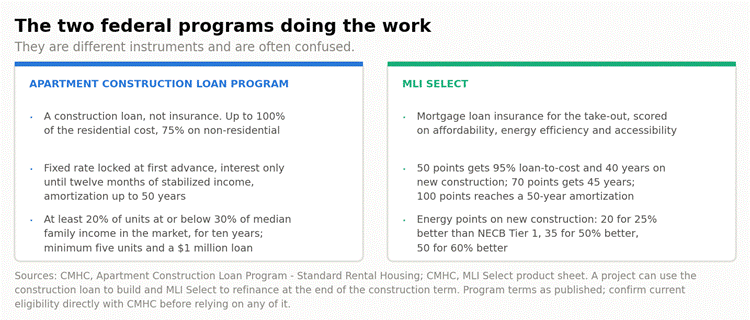
Program terms as published by CMHC. Confirm current eligibility directly with CMHC.
On top of that, Toronto will cut development charges by 40% to 60% depending on unit type between 2026 and 2029, funded by up to $1.5 billion over ten years under the Canada-Ontario Partnership to Build. And Ontario’s rent increase guideline — 1.9% for 2027, 2.1% for 2026, capped at 2.5% — does not apply at all to units first occupied for residential purposes after November 15, 2018. A newly built rental building is outside rent control.
Where the case is weakest
Everything above is a cost-side and supply-side argument. The revenue side is softer than the headline suggests. CMHC’s 2025 Rental Market Report puts the average Toronto purpose-built two-bedroom at $2,034, up 3.5%. But the average rent on units that actually turned over to a new tenant fell 2.5% over the same period, and purpose-built vacancy rose to 3.0%. Purpose-built supply grew only 0.4%.
That six-percentage-point spread between in-place rent growth and turnover rent change is the number to hold onto. The published average rises because sitting tenants pay guideline increases; it does not describe what a landlord can achieve on a vacant unit today. A newly completed building has no sitting tenants. It leases up entirely at turnover rents, in a market where turnover rents are falling and vacancy is rising.
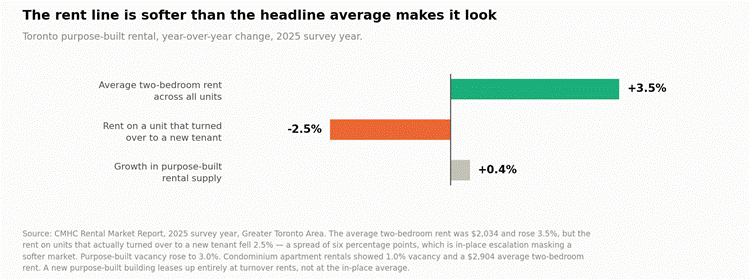
A new building leases at the orange bar, not the green one.
| THE ULG VIEW The thesis is real and the data supports it. Condominium development has stopped — 156 units started in the City of Toronto in the first half of 2026 against roughly 7,000 a year over the previous decade — while purpose-built rental starts rose 82% and overtook condominium starts for the first time in decades. Federal construction financing at up to 100% loan-to-cost, MLI Select on the take-out, and a 40% to 60% development charge cut in Toronto are the reason. Anyone pitching a rental development fund right now is pointing at a genuine structural shift, not a story. The weak point is not supply or financing. It is the rent line. CMHC’s 2025 survey shows the average Toronto two-bedroom at $2,034 and up 3.5% — but the rent on units that actually turned over to a new tenant fell 2.5%, and purpose-built vacancy rose to 3.0%. That six-point spread is in-place escalation flattering a softening market. A new building does not inherit in-place rents. It leases up entirely at turnover rents, in a market where turnover rents are falling. Any rental pro forma built off the published average rather than the turnover series is overstating revenue from day one. The rent guideline exemption is the quiet structural advantage, and it is worth more than most people price. Ontario’s 2027 guideline is 1.9% and 2026 was 2.1%, capped at 2.5%. Units first occupied for residential purposes after November 15, 2018 are exempt from it entirely. A newly built rental asset can therefore raise rents to market without the guideline, which is precisely what makes new purpose-built rental financeable in a province that otherwise caps escalation below inflation. It also means the exit value depends on a policy that a future government can change. For a ULG land file, this is where the high-density bid now comes from. With no condominium bid for density, the buyer for an approved or approvable mid-rise and high-rise site is a rental developer running a CMHC-financed pro forma, or a patient holder. That changes how a site should be marketed: the material has to speak to unit mix for MLI Select points, energy performance against NECB tiers, and whether the site can carry an ACLP affordability commitment, because those are the inputs that set the buyer’s financing — and therefore what they can pay for the land. Energy points are now a land attribute, not an engineering afterthought. MLI Select awards 20 points for new construction 25% better than NECB Tier 1, 35 points for 50% better and 50 points for 60% better, and those points buy amortization and leverage. A site that can accommodate geothermal, a large contiguous roof, or an efficient floor plate is worth more to a rental buyer than one that cannot. That is a diligence item to raise before listing, not after an offer. Be careful what the exit assumption is. The financing advantages here are construction and take-out advantages. They compress the cost of capital during the build and the first term. They do not create a buyer at stabilization. The residual question — who buys the stabilized asset, at what cap rate, in a market where turnover rents are falling — is the one worth pressing on any rental development pitch, including ones with good data behind them. |
| SCOPE AND LIMITS OF THIS NOTE This note is about the market, not about any offering. It was prompted by a roadshow invitation for a private fund. It deliberately does not name, describe, assess or comment on that fund or any other security. Nothing here is an offer, a solicitation, a recommendation, or an opinion on the merits of any investment. Private offering documents are not public, and nothing in them can be verified here. Securities sold under an Offering Memorandum exemption are not publicly filed in a form that permits independent verification of projects, costs, construction status or projected returns. Any claim made in private marketing material should be tested against the offering memorandum, audited financials and independent third-party reports, with a securities lawyer and a registered advisor. Check registration before anything else. Whether a firm is registered to deal in securities in Ontario, and in what category, is a matter of public record through the Canadian Securities Administrators’ National Registration Search and the Ontario Securities Commission. That check costs nothing and takes a minute. Real estate registration is not securities registration. A registrant under the Real Estate and Business Brokers Act is not thereby permitted to trade in or advise on securities. Anyone in the brokerage business who is asked to circulate, refer or comment on a private offering should raise it with their brokerage first. The market figures here are as published and are dated. CMHC’s rental market figures are the 2025 survey year, the supply report is September 10, 2026, and the development charge reduction was announced June 23, 2026 with per-unit-type rates not yet published in that release. Program terms change; confirm directly with CMHC. Nothing here is a view on any specific site or project. Rental feasibility turns on the actual site, its approvals, its unit mix and its cost structure. |
SOURCES
Official and primary sources
· CMHC — Fall 2026 Housing Supply Report, September 10, 2026 (rental and condominium apartment starts) https://www.cmhc-schl.gc.ca/professionals/housing-markets-data-and-research/market-reports/housing-market/housing-supply-report
· CMHC — Rental Market Reports, major centres, 2025 survey year (Toronto vacancy, average and turnover rents) https://www.cmhc-schl.gc.ca/professionals/housing-markets-data-and-research/market-reports/rental-market-reports-major-centres
· CMHC — Apartment Construction Loan Program: Standard Rental Housing https://www.cmhc-schl.gc.ca/professionals/project-funding-and-mortgage-financing/funding-programs/all-funding-programs/apartment-construction-loan-program/standard-rental-housing
· CMHC — MLI Select product sheet, point tiers and energy efficiency criteria https://assets.cmhc-schl.gc.ca/sites/cmhc/professional/project-funding-and-mortgage-financing/mortgage-loan-insurance/multi-unit-insurance/mliselect/mli-select.pdf
· Government of Ontario — Rent increase guideline (1.9% for 2027; exemption for units first occupied after November 15, 2018) https://www.ontario.ca/page/rent-increase-guideline
· Ontario — Residential Tenancies Act, 2006 https://www.ontario.ca/laws/statute/06r17
· City of Toronto — $1.5 billion Canada-Ontario Partnership to Build funding and development charge reduction, June 23, 2026 https://www.toronto.ca/news/city-of-toronto-secures-1-5-billion-in-canada-ontario-partnership-to-build-funding-to-support-housing-and-reduce-development-charges/
For checking a firm or an offering
· Canadian Securities Administrators — National Registration Search (whether a firm or individual is registered, and in what category) https://www.securities-administrators.ca/registration-search/
· Ontario Securities Commission — investor resources and registration checks https://www.osc.ca/en/investors
· Ontario — Securities Act https://www.ontario.ca/laws/statute/90s05
· Ontario — Real Estate and Business Brokers Act, 2002 https://www.ontario.ca/laws/statute/02r30
Prepared by Urban Land Group. Sunny Gawri is a registered sales representative with Royal LePage Signature Realty, Brokerage, and is not registered to trade in or advise on securities. This document is general market commentary prepared for discussion purposes. It does not reference, assess or recommend any security, fund or offering. All arithmetic identified as ULG calculation is our own and is not sourced from CMHC or any government body. Nothing here is an appraisal, an Opinion of Value, or investment, legal, tax or securities advice.