
$185 Million, 474 Units, And An Affordability Test That Binds On Nothing
A federal construction loan is carrying a 38-storey rental tower in Flemingdon Park at roughly $390,000 a unit. The ninety-five affordable units are the program minimum, and in Toronto the program’s affordable rent ceiling sits about 30% above the average market two-bedroom.
Urban Land Group · October 13, 2026
Osmington Gerofsky Development Corporation and WJ Properties have broken ground on a 38-storey, 474-unit rental tower at 9 St. Dennis Drive, near Don Mills Road and Eglinton Avenue East. It is the first of three phases in a planned 2,300-unit redevelopment of land the Weinbaum family has held for more than sixty years, directly across from the future Flemingdon Park station on the Ontario Line. The phase carries $185 million in financing through CMHC’s Apartment Construction Loan Program, includes 95 affordable units, and contributes about 0.7 acres of new public parkland. The building will be heated and cooled by a geothermal system of 99 boreholes, which the team says will cut energy use by about 60% and emissions by about 80% against a comparable code-built building. Architects Alliance is the architect; shoring is nearly complete.
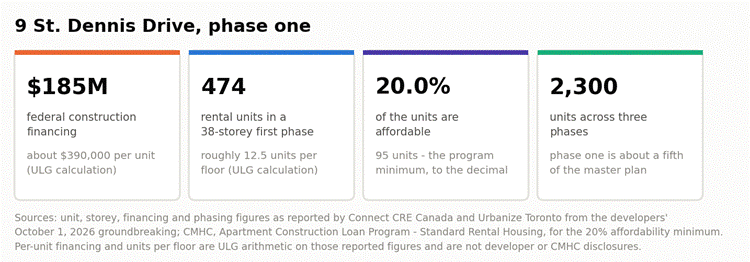
Phase one as reported. Per-unit financing and units per floor are ULG arithmetic on the reported figures.
Start with the number that is doing the public relations work
Ninety-five affordable units out of 474 is 20.04%. CMHC’s Apartment Construction Loan Program requires at least 20% of units to satisfy an affordability test. The project meets the minimum and essentially nothing more. That is not a failing of the sponsor — it is the program operating exactly as designed — but the figure should be read as a compliance threshold rather than as a housing commitment.
The more interesting question is what the test actually requires. Under Option 1, at least 20% of units must have rents at or below 30% of the median total income of all families in the subject market, held for at least ten years. The City of Toronto’s median economic family total income was $106,000 in the 2021 Census. Thirty percent of that is $31,800 a year, or $2,650 a month.
CMHC’s own 2025 Rental Market Report puts the average Toronto purpose-built two-bedroom at $2,034 and the average condominium apartment two-bedroom at $2,904. The affordability ceiling the program imposes sits roughly 30% above the average purpose-built two-bedroom in the market it applies to. In Toronto, a unit can be designated affordable under this program and still rent for more than the average market apartment.
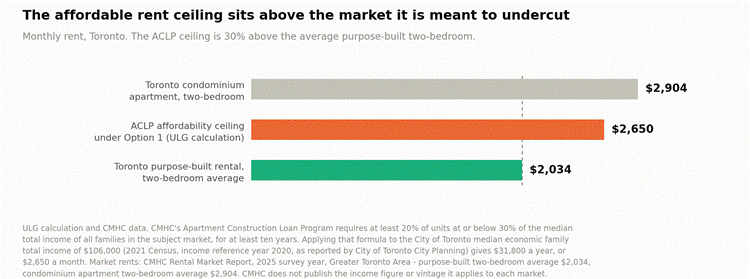
The ceiling is a ULG calculation applying CMHC’s published formula to published Census and CMHC figures.
The subsidy is real — it is just in the capital stack
Strip out the affordability framing and what remains is a very large financing advantage. The Apartment Construction Loan Program lends up to 100% of the cost of the residential component, at a fixed rate locked in at the first advance, interest-only through construction and until stabilization — defined as twelve consecutive months of stabilized effective gross income — with amortization up to 50 years. On 474 units, $185 million is roughly $390,000 per unit of construction financing.
Against conventional construction debt at a fraction of that loan-to-cost and a floating rate, the value of those terms comfortably exceeds whatever rent is foregone on 95 units for ten years. That is why the deal is being built, and it is the part of the story worth understanding rather than the affordable unit count.
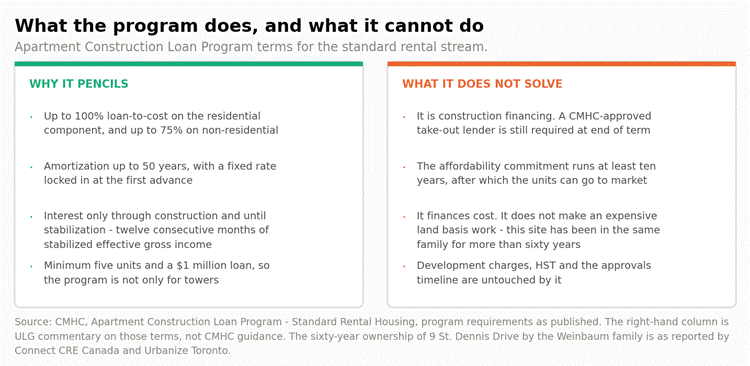
Program terms as published by CMHC. The right-hand column is ULG commentary.
What it does not do
The program finances cost. It does not make an expensive land basis work. 9 St. Dennis Drive has been in the same family for more than six decades, which means the land sits at a historical basis and the density is being created on ground already owned. Development charges, HST and the approvals timeline are untouched by the loan. Take the identical tower, buy the land at today’s GTA price, and the arithmetic does not survive the exercise.
There is also a stream of this program that almost nobody in Ontario is using. The minimum is five units and a one million dollar loan. For an owner with a deep lot and as-of-right multiplex permissions, 100% loan-to-cost construction financing on a 50-year amortization is a different proposition from a bank construction loan at 65%. The affordability test would bite differently in a smaller market, where median family income and therefore the rent ceiling are both lower — that needs checking market by market before anyone relies on it.
| THE ULG VIEW Ninety-five affordable units is the program floor, not a commitment. The Apartment Construction Loan Program requires at least 20% of units to meet an affordability test. Ninety-five of 474 is 20.04%. The developers did the minimum arithmetic the program allows and the press release turned it into a headline. That is not a criticism of them — it is how the program is designed to work — but read it as compliance, not generosity. And in Toronto the affordability test is set above the market. Option 1 requires rents at or below 30% of the median total income of all families in the subject market. The City of Toronto median economic family total income is $106,000. Thirty percent of that is $31,800 a year, or $2,650 a month. CMHC’s own 2025 survey puts the average Toronto purpose-built two-bedroom at $2,034. An ACLP affordable unit in Toronto can be priced roughly 30% above the average market two-bedroom and still comply. The affordability requirement in this market binds on almost nothing. The number that should interest you is $390,000 per unit of construction financing at up to 100% loan-to-cost. That is the real subsidy, and it is in the capital stack, not the rent roll. Fixed rate locked at first advance, interest only through construction and until twelve months of stabilized effective gross income, amortization up to 50 years. Against private construction debt that combination is worth more than any rent premium the affordable units give up. It does not fix a land basis, and that is why this site and not another one. The Weinbaum family has owned 9 St. Dennis Drive for more than sixty years. The land is effectively sunk at a historical cost, the density is being created on land already held, and the federal loan covers the construction. Take the same tower and put it on land bought at today’s GTA price with today’s development charges, and the ACLP does not rescue it. Anyone reading this as evidence that purpose-built rental now pencils generally has drawn the wrong conclusion from a legacy landholding. The program’s real reach is smaller buildings, which almost nobody is using it for. The minimum is five units and a $1 million loan. That is a sixplex. For an owner sitting on a deep lot in an Ontario town with as-of-right multiplex permissions, 100% loan-to-cost construction financing on a 50-year amortization is a materially different proposition than a bank construction loan at 65%. The affordability test on a smaller market would also bite differently, because the median family income is lower and so is the rent ceiling — that cuts the other way and needs checking market by market. Transit-adjacent legacy land is where the next ten years of GTA rental gets built. The site is across from a future Ontario Line station on a 15.6-kilometre, 15-station line. Sites like this — large, long-held, near new rapid transit, with density to be created rather than bought — are the only places where the arithmetic closes without heroic rent assumptions. That is the acquisition screen worth running against the corridors you already watch, not a thesis about rental generally. |
| WHAT IS CONFIRMED AND WHAT IS NOT The project figures are trade-press reporting, not a CMHC or developer filing. The $185 million, the 474 units, the 95 affordable units, the 2,300-unit master plan and the 38 storeys come from coverage of the groundbreaking. CMHC does not publish individual ACLP loan amounts, and we found no project-specific government release. The affordability arithmetic is ours and rests on a published proxy. CMHC does not publish the median family income figure or the vintage it applies to each market. We used the City of Toronto median economic family total income of $106,000 from the 2021 Census, income reference year 2020, as reported by City of Toronto City Planning. If CMHC uses a more recent income figure or the CMA rather than the city, the ceiling is higher than $2,650, not lower — which strengthens rather than weakens the point. The two-bedroom comparison is a reference point, not like-for-like. The unit mix at 9 St. Dennis Drive has not been published, and the affordability test applies across the designated units, not to a two-bedroom specifically. The groundbreaking date is reported inconsistently. Connect CRE gives October 1 for the announcement; Urbanize Toronto published its account on September 28. Geothermal drilling is reported to have started in May, well before either date. The energy claims are the developers’. The 60% energy reduction and 80% greenhouse gas reduction against a comparable code-built building, and the 99 boreholes, are stated by the development team. We found no third-party modelling or certification to verify them. The Ontario Line opening date is not official. Metrolinx publishes the line’s length and 15 stations, including Flemingdon Park among the north stations, but does not state an in-service date on that page. Press reporting has referred to the early 2030s. |
SOURCES
Official and primary sources
· CMHC — Apartment Construction Loan Program: Standard Rental Housing (program requirements, affordability options, loan terms) https://www.cmhc-schl.gc.ca/professionals/project-funding-and-mortgage-financing/funding-programs/all-funding-programs/apartment-construction-loan-program/standard-rental-housing
· CMHC — Apartment Construction Loan Program overview https://www.cmhc-schl.gc.ca/professionals/project-funding-and-mortgage-financing/funding-programs/all-funding-programs/apartment-construction-loan-program
· CMHC — Rental Market Reports, major centres (2025 survey year; Greater Toronto Area rents and vacancy) https://www.cmhc-schl.gc.ca/professionals/housing-markets-data-and-research/market-reports/rental-market-reports-major-centres
· City of Toronto, City Planning — 2021 Census Backgrounder: Families, Households, Marital Status and Income https://www.toronto.ca/wp-content/uploads/2022/07/9877-City-Planning-2021-Census-Backgrounder-Families-Hhlds-Marital-Status-Income.pdf
· Metrolinx — Ontario Line, what we’re building (15.6 km, 15 stations, Flemingdon Park among the north stations) https://www.metrolinx.com/en/projects-and-programs/ontario-line/what-were-building
· City of Toronto — Application Information Centre (search 9 St Dennis Dr for the planning file) https://www.toronto.ca/city-government/planning-development/application-information-centre/
Trade press (not official)
· Connect CRE Canada — $185M Federal Loan Backs 474-Unit Toronto Rental Tower https://www.connectcre.ca/
· Urbanize Toronto — Ground broken on 38-storey rental tower in Flemingdon Park https://toronto.urbanize.city/post/ground-broken-38-storey-rental-tower-flemingdon-park
Prepared by Urban Land Group. Sunny Gawri is a registered sales representative with Royal LePage Signature Realty, Brokerage. This document is market commentary prepared for discussion purposes. All arithmetic identified as ULG calculation is our own and is not sourced from CMHC, the developers or any government body. Nothing here is an appraisal, an Opinion of Value, or investment, legal, tax or financing advice, and nothing here should be relied on as a statement of any program’s eligibility rules — confirm those directly with CMHC.