
A $72 Billion Utility Merger, And Ontario’s Actual Power Problem
Emera and Canadian Utilities are merging into a $72 billion utility with no Ontario footprint and no Ontario approvals required. The Ontario question the headline gestures at was answered in August, on the Environmental Registry, by a proposal that turns grid access into a ministerial decision.
Urban Land Group · October 12, 2026
On October 6, Emera, ATCO and Canadian Utilities announced an all-share merger creating a combined company with roughly $72 billion of pro forma enterprise value, approximately $45 billion of rate base, twelve regulated utilities and about six million customers. The capital plan is $32 billion through 2030, supporting expected rate base growth of 7% to 8% a year. ATCO will spin off its industrial services business as New ATCO. Closing is expected in the third or fourth quarter of 2027.
Read the release rather than the headline and two things stand out. About 80% of the combined operations are expected to be in Alberta and Florida. And the regulatory approvals the parties list are the Alberta Utilities Commission, the U.S. Federal Energy Regulatory Commission and FCC, the Northwest Territories Public Utilities Board if required, and Mexico’s competition authority, alongside competition and foreign investment reviews. The Ontario Energy Board is not among them. The release does not mention Ontario, and it does not mention data centres.
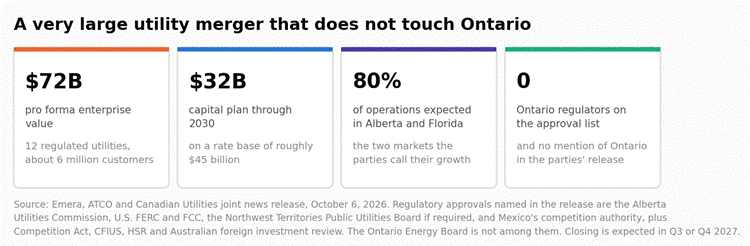
Terms as announced on October 6, 2026. The data centre framing in the trade headline does not appear in the parties’ release.
The Ontario version of this story has a different cast
Power access genuinely is becoming a binding constraint on development, and in Ontario it is now binding in a specific and recent way. On August 13, 2026 the Ministry of Energy and Mines posted an Economic and Strategic Assessment Framework for New Data Centres on the Environmental Registry. Amendments to the Electricity Act, 1998 give Cabinet authority to set, by regulation, what a data centre must satisfy before connecting or reconnecting to the grid. Under the proposal, that approval would be issued by the Minister.
The three tests are economic development, data security and digital sovereignty — including a stated preference for Canadian-owned and operated facilities — and community benefit and public trust. The comment period closed on September 12. The notice also proposes a new Global Adjustment rate class for new data centres above a threshold given as one megawatt, and facilities in that class would not be able to participate in the Industrial Conservation Initiative.
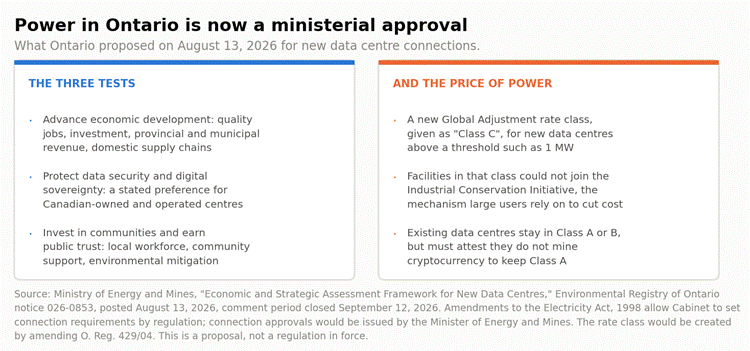
The proposed framework as posted. It is a proposal; neither the connection regulation nor the rate class is in force.
The number that explains why a gate was built
The Ministry’s own notice states that pending data centre connection applications in Ontario total more than 10,000 megawatts. Ontario’s recent peak demand is approximately 25,000 megawatts. The applications represent something close to 40% of everything the province draws at its busiest hour.
Set that against what is actually built. The IESO’s July 2025 technical paper on large step loads records 104 data centres in Ontario — more than any other province — with most operating facilities around 10 megawatts or less and the largest around 50 megawatts. All of Toronto held 293 megawatts of capacity as of September 2023. Meanwhile the IESO has received connection requests of up to 750 megawatts at a single connection point: fifteen times the largest facility operating in the province today.
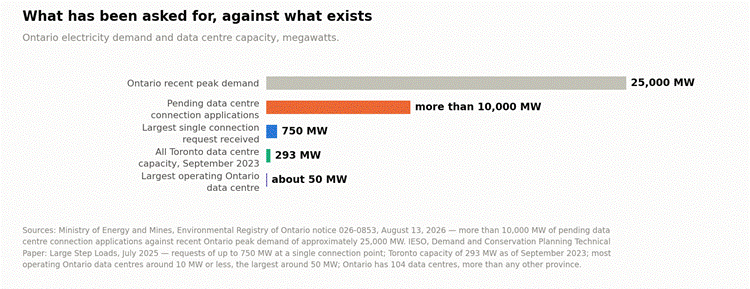
The pending applications cannot all be served. The framework is the mechanism for deciding which ones are.
The IESO’s 2026 Annual Planning Outlook puts Ontario demand at 152 terawatt-hours in 2026 rising to 250 by 2050 in the reference case — about 65% growth — and to 297 terawatt-hours in the high-demand case, where data centres are named as a principal driver. Transmission needs are identified across the GTA, Windsor-Essex, London, Hamilton, Kitchener-Waterloo-Cambridge-Guelph, Niagara, the corridor from the GTA toward Ottawa, and in the northeast and northwest. Those are planning needs with in-service dates in the 2030s, not capacity available to a buyer next year.
| THE ULG VIEW The headline is Alberta and Florida, and the Ontario angle in it is nil. Emera and Canadian Utilities have no Ontario regulated utility between them. The approval list in their own release names the Alberta Utilities Commission, U.S. federal regulators, the Northwest Territories board and Mexico’s competition authority. The Ontario Energy Board is not on it, and the release does not use the word Ontario or the words data centre. Whoever gets to build a data centre in Ontario, and at what cost, is decided by the Ministry of Energy and Mines, the IESO and Hydro One — not by this merger. The real Ontario story is that grid access became a political approval in August and almost nobody in the land business has priced it. Ontario has proposed a regulation requiring new large data centres to obtain the Minister’s approval before connecting, tested against economic development, data sovereignty and community benefit. Those are policy judgments, not engineering criteria. You cannot schedule them, you cannot appeal them to the Ontario Land Tribunal, and you cannot underwrite them. The pipeline is four tenths of the entire provincial peak. Most of it is not going to be served. More than 10,000 megawatts of data centre connection applications are pending against a recent provincial peak of roughly 25,000 megawatts. Ontario’s largest operating data centre is around 50 megawatts and all of Toronto held 293 megawatts as of September 2023. Single connection requests now reach 750 megawatts. The gap between what has been requested and what the grid can absorb is the whole risk, and it will be resolved by rationing. For a land file this changes the condition precedent, not the price. If a buyer approaches you about a site for a data centre, the binding condition is a connection approval and a system impact assessment, not zoning and not servicing. Zoning for a data centre in most industrial zones is straightforward. Power is not. Any agreement should treat grid capacity as the primary condition, with a realistic outside date and a deposit structure that reflects a provincial approval of unknown duration. Treat an unconditional offer at a premium price as a signal that the buyer intends to assign or flip the contract, not build. The cost of power for the end user just went up, which feeds back to what a buyer can pay for the dirt. The proposal would put new data centres above roughly one megawatt into a new Global Adjustment class and bar them from the Industrial Conservation Initiative, the mechanism large Ontario consumers use to cut their global adjustment bill by curtailing at peak. Removing ICI eligibility raises the operating cost of an Ontario data centre against Alberta and against the US southeast. Residual land value is what is left after everything else is paid for, so a structurally higher power cost comes out of the land. Where this points for land, carefully. Serviced industrial sites with existing heavy transmission or a station nearby are worth more than they were, and sites in the regions the IESO has flagged for transmission reinforcement — the GTA, Windsor-Essex, London, Hamilton, Kitchener-Waterloo-Cambridge-Guelph, Niagara, the GTA-to-Ottawa corridor — sit where the capacity will eventually be built. That is a reason to inventory what capacity exists near the sites you already control. It is not a reason to buy land on a data centre thesis. |
| WHAT IS CONFIRMED AND WHAT IS NOT The data centre framing is the newsletter’s, not the parties’. The Emera, ATCO and Canadian Utilities release does not mention data centres. It refers to “large load customers” and electrification as investment drivers without naming a load source. The headline connecting this merger to a data centre power race is editorial. The Ontario data centre framework is a proposal, not law. Environmental Registry notice 026-0853 was posted August 13, 2026 and the comment period closed September 12, 2026. The connection approval regulation and the new rate class have not been made. The one megawatt threshold and the Class C name are given in the notice as examples. The merger has not closed and may change. Closing is expected in the third or fourth quarter of 2027, subject to shareholder meetings in early 2027, an Alberta court approval, and the regulatory and competition approvals listed in the release. Some of the Ontario data centre figures are dated. The 293 megawatt Toronto figure is as of September 2023 and the counts of operating facilities come from the IESO’s July 2025 technical paper, which in turn cites a commercial database. Treat them as the order of magnitude, not as a current inventory. The IESO does not publish a public data centre connection queue. The 10,000 megawatt figure comes from the Ministry’s registry notice. The IESO’s own technical paper states that it applies a tiered likelihood factor to proposed loads and does not disclose the included and excluded megawatts. Nothing here is a view on whether any particular site can be powered. Capacity is specific to a station, a circuit and a point in time, and only a connection impact assessment answers it. |
SOURCES
Official and primary sources
· Ministry of Energy and Mines — Economic and Strategic Assessment Framework for New Data Centres, ERO notice 026-0853, posted August 13, 2026 https://ero.ontario.ca/notice/026-0853
· IESO — 2026 Annual Planning Outlook: Ontario’s electricity system needs, 2027–2050 https://www.ieso.ca/-/media/Files/IESO/Document-Library/planning-forecasts/apo/2026/2026-Annual-Planning-Outlook.pdf
· IESO — Demand and Conservation Planning Technical Paper: Large Step Loads, July 2025 https://www.ieso.ca/-/media/Files/IESO/Document-Library/planning-forecasts/demand-research/Demand-Conservation-Planning-Technical-Paper-Large-Step-Loads-202507.pdf
· Ontario — Electricity Act, 1998 https://www.ontario.ca/laws/statute/98e15
· Ontario — O. Reg. 429/04, Adjustments Under Section 25.33 of the Act (the Global Adjustment classes) https://www.ontario.ca/laws/regulation/040429
Company and trade sources (not official)
· Emera, ATCO and Canadian Utilities — joint news release, October 6, 2026 https://www.newswire.ca/news-releases/emera-atco-and-canadian-utilities-announce-transformational-agreement-to-create-canadian-utility-and-energy-infrastructure-powerhouse-845296615.html
· Emera Incorporated — investor relations announcement of the same agreement https://investors.emera.com/news/news-details/2026/Emera-ATCO-and-Canadian-Utilities-Announce-Transformational-Agreement-to-Create-Canadian-Utility-and-Energy-Infrastructure-Powerhouse/default.aspx
· CTV News — Emera to acquire Canadian Utilities in $14.3B all-stock deal https://www.ctvnews.ca/business/article/emera-and-canadian-utilities-to-merge-creating-72b-company/
Prepared by Urban Land Group. Sunny Gawri is a registered sales representative with Royal LePage Signature Realty, Brokerage. This document is market commentary prepared for discussion purposes. All arithmetic identified as ULG calculation is our own and is not sourced from any party, regulator or agency. Nothing here is an appraisal, an Opinion of Value, or investment, legal, tax or engineering advice, and nothing here speaks to whether any particular site can be connected to the grid.