
A Pension Sells Its Seniors Operator, And Ontario Loses Its Data
PSP Investments is selling Sunrise Senior Living, operator of nine Ontario communities, in a deal reported above US$1 billion. The more useful story for an Ontario land file is that the demand case has never been stronger and the public data behind it has quietly stopped being collected.
Urban Land Group · October 8, 2026
On October 6, Sunrise Senior Living announced that funds managed by BDT & MSD Partners will take a majority investment in the company in partnership with its senior leadership team, including chief executive Jack R. Callison, Jr., who is investing personally. The seller is the Public Sector Pension Investment Board, which first invested in Sunrise in 2014 and became sole owner in 2023. Closing is expected in 2027, subject to regulatory approvals.
The release does not state a price. Connect CRE Canada reported the value at more than US$1 billion, attributing the figure to The Wall Street Journal. J.P. Morgan Securities and JLL Securities advised. Sunrise operates more than 230 communities across the United States and Canada serving about 22,000 residents, with more than 50 additional communities in development at an estimated cost of about US$7.5 billion.
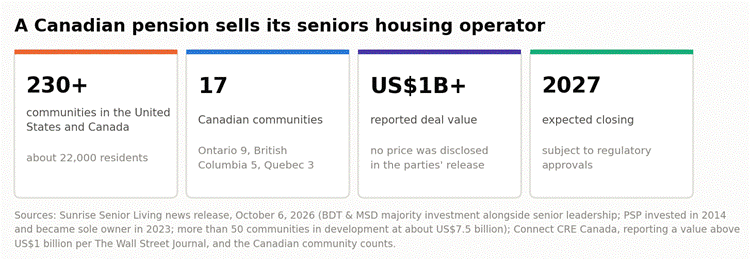
Headline terms of the October 6 announcement, with the Canadian portfolio broken out.
Why an American transaction matters to an Ontario land file
Seventeen of Sunrise’s communities are in Canada, and nine of those are in Ontario, in the Greater Toronto Area and Ottawa. Five are in British Columbia and three in Quebec. That is a small slice of a 230-community platform, but it means the operator of nine Ontario seniors communities is changing hands — and that the Canadian exposure sat inside a US-centred trade that was priced, marketed and sold on American fundamentals.
The direction of travel is worth naming. PSP’s Simon Marc framed the sale as recycling capital and rotating the portfolio. A Canadian pension fund bought an operating platform, scaled it, and is now selling it to a US private investment firm that has already backed Greystar and has roughly US$20 billion of real estate invested or under management. Set this beside Oxford and CPP Investments selling Upper Canada Mall to Primaris, and the common thread is Canadian institutional capital stepping back from owning and operating, not stepping in.
The demand case is the strongest in Ontario real estate
The Ontario Ministry of Finance projects that Ontarians aged 65 and over will grow from 3.1 million, or 18.9% of the population, in 2025 to 4.6 million by 2051, with the share peaking at 22.9% in 2040. The age bands that actually drive seniors housing absorption move further. Those 75 and over roughly double, from 1.4 million to over 2.7 million. Those 90 and over, the cohort that fills assisted living and memory care, more than triple, from 151,000 to 497,000.
No other asset class in the province comes with a demand forecast that defensible. Retail absorption depends on consumer behaviour, industrial on trade policy, office on return-to-work decisions nobody can model. Seniors demand depends on people who are already alive.
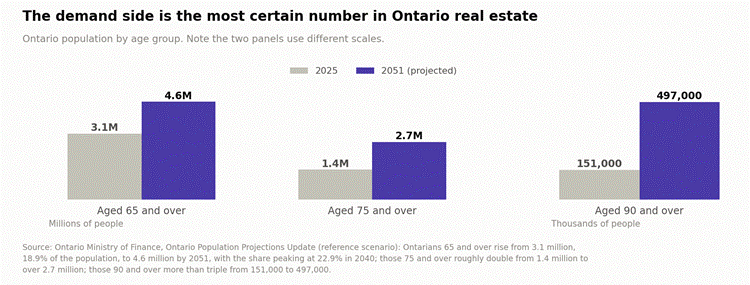
Ontario Ministry of Finance reference-scenario projections. The 90-and-over panel uses a different scale.
The part that should worry anyone underwriting a seniors site
Strong demand does not produce a pro forma. Rents, vacancy, absorption and care-level pricing do, and in Ontario the official sources for those have gone dark. CMHC’s Seniors’ Housing Survey methodology page states that it has decided to discontinue data collection for rents, vacancies and services. The most recent Ontario figures on CMHC’s public portal — 20.3% vacancy and a $3,354 average rent for a studio or private room with meals — are from 2021.
What remains is the Retirement Homes Regulatory Authority’s public register, which lists every licensed retirement home in Ontario, more than 750 of them, with licensing and inspection history. That is a genuine asset for competitive analysis: it tells you exactly who operates what, where, and how they have performed against the Retirement Homes Act. It does not tell you what anyone charges or whether they are full.
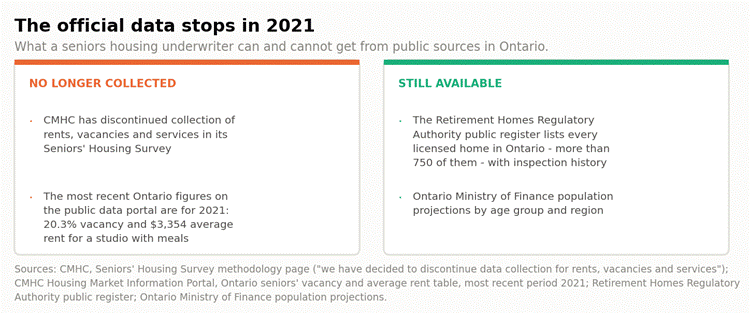
The public evidence base available to an Ontario seniors housing feasibility study.
The practical consequence is that a seniors feasibility in Ontario now has to be built from primary research — competitor shops, published rate cards, waitlist enquiries, care-level pricing — and the assumptions have to be labelled as such. Any pro forma that cites a provincial seniors vacancy rate without dating it is citing 2021.
| THE ULG VIEW A Canadian pension is the seller, not the buyer. PSP put money into Sunrise in 2014, took full ownership in 2023, and is now selling the platform to American private capital. Simon Marc called it portfolio rotation. Pair it with Oxford and CPP Investments selling Upper Canada Mall to Primaris and with the province buying unsold condo inventory, and a pattern shows up: Canadian institutional money is a net seller of operating platforms right now, and the buyers are either US private capital or domestic REITs with a cost-of-capital advantage. The demand side of a seniors deal is the only part of Ontario real estate you can forecast honestly. Ontarians 75 and over roughly double by 2051 and those 90 and over more than triple. Nothing in retail, industrial or office underwriting has a demand curve that defensible. That is why an operating platform with 230 communities trades at a reported ten-figure number while a shopping centre needs a decade of signed leases to get there. But the supply and pricing side is a black hole, and that is the part a land file lives or dies on. CMHC has stopped collecting seniors’ rents and vacancies. The last Ontario numbers on the public portal are from 2021. The Retirement Homes Regulatory Authority register tells you which homes exist and how they have been inspected, not what they charge or whether they are full. On a seniors feasibility in Ontario today, the rent and absorption case has to be built from primary work — unit-by-unit competitor shops, waitlist calls, care-level pricing — and the pro forma should say so out loud rather than cite a vacancy rate that is five years stale. Underwrite the operator, not the building. In independent and assisted living, a large share of the revenue line is service income with a staffing cost against it. A change of control at the platform level changes the counterparty on every management agreement and lease it holds. If you are selling land to a seniors developer or structuring a joint venture with one, the covenant you are relying on is the operator’s, and that operator can be sold out from under the deal — which is exactly what is happening here, twice in twelve years. Check the cost number before you fall in love with the demand number. Sunrise’s 50-plus community pipeline carries an estimated development cost of about US$7.5 billion, which is roughly US$150 million a community. These are US projects and not a transferable benchmark, but the order of magnitude is the point: seniors housing is a high-cost, high-operating-intensity build. Strong demographics do not make the residual land value work on their own. |
| WHAT IS CONFIRMED AND WHAT IS NOT The US$1 billion-plus figure is press-reported, not disclosed by the parties. Sunrise’s own release names no price. The value was attributed to The Wall Street Journal and carried by Connect CRE Canada. Treat it as a reported figure. The deal has not closed. Completion is expected in 2027 and is subject to regulatory approvals. Nothing about the ownership of the nine Ontario communities changes until then. The Canadian breakdown is trade-press reporting. The 17 Canadian communities, split 9 Ontario, 5 British Columbia and 3 Quebec, come from Connect CRE Canada rather than from the parties’ release or a regulatory filing. The CMHC seniors figures are from 2021 and the series has been discontinued. The 20.3% vacancy and $3,354 average rent are the most recent Ontario values published on CMHC’s portal, not current market conditions. CMHC’s own methodology page states it has decided to discontinue collecting rents, vacancies and services. No Ontario-specific suite count exists in the public record. The Retirement Homes Regulatory Authority register lists licensed homes, and the authority describes it as covering more than 750, but it does not publish an aggregate suite total. |
SOURCES
Official and primary sources
· Ontario Ministry of Finance — Ontario Population Projections https://www.ontario.ca/page/ontario-population-projections
· Retirement Homes Regulatory Authority — public register of licensed retirement homes https://www.rhra.ca/en/retirement-home-database/
· CMHC — Seniors’ Housing Survey methodology (notice that rent, vacancy and service collection is discontinued) https://www.cmhc-schl.gc.ca/professionals/housing-markets-data-and-research/housing-data/data-tables/housing-market-data/seniors-housing-survey-methodology
· CMHC — Housing Market Information Portal, seniors’ housing tables (Ontario, most recent period 2021) https://www03.cmhc-schl.gc.ca/hmip-pimh/en/TableMapChart/Table
· Ontario — Retirement Homes Act, 2010 https://www.ontario.ca/laws/statute/10r11
Company and trade sources (not official)
· Sunrise Senior Living / BDT & MSD Partners — news release, October 6, 2026 (PR Newswire) https://www.prnewswire.com/news-releases/sunrise-senior-living-announces-majority-investment-from-bdt–msd-partners-302576000.html
· Connect CRE Canada — PSP sells Sunrise Senior Living in US$1B deal (US$1B figure attributed to The Wall Street Journal; Canadian community counts) https://www.connectcre.ca/stories/psp-sells-sunrise-senior-living-in-us1b-deal/
· PSP Investments — about and assets under management https://www.investpsp.com/en/
· Sunrise Senior Living — Canadian communities https://www.sunriseseniorliving.ca/
Prepared by Urban Land Group. Sunny Gawri is a registered sales representative with Royal LePage Signature Realty, Brokerage. This document is market commentary prepared for discussion purposes. All arithmetic identified as ULG calculation is our own and is not sourced from the parties to the transaction. Nothing here is an appraisal, an Opinion of Value, or investment, legal or tax advice.