
The Wrong Number Is Going Viral. The Right One Is That Ontario Lost 152,648 People.
A claim that 40% of Canada’s top 1% have moved to the United States implies more people than the entire Canadian-born population living there. Meanwhile Ontario’s population has fallen for three straight quarters — and that is the number that changes a rental underwriting.
Urban Land Group · September 25, 2026
A post circulating this week states that “roughly 40% of Canada’s top 1% income earners, as well as 30-50% of the next 9% income earners, have emigrated to the United States.” Take it at face value and do the arithmetic. Canada’s top decile of tax filers is on the order of three million people. The claim therefore implies that somewhere between 900,000 and 1.5 million high-earning Canadians are now living in the U.S.
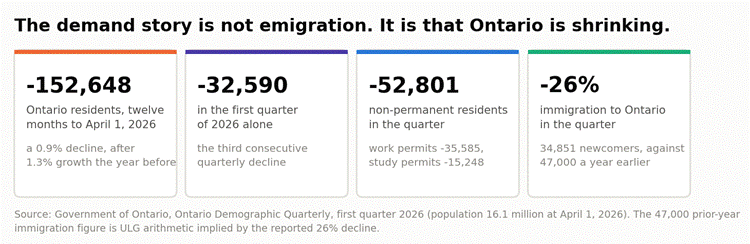
Figure 1 — The claim against the two official counts that bound it.
The U.S. Census Bureau’s American Community Survey counted 828,000 Canadian-born people in the United States in 2023 — all incomes, all ages, accumulated over generations. Statistics Canada counts about 467,000 emigrants from Canada in total over 2022 to 2025. The claim is bigger than both.
The real emigration number, for the record
Emigration is genuinely elevated. Statistics Canada recorded 120,640 citizens and permanent residents leaving in 2025 — the highest since the series began in 1952 — and 30,092 in the first quarter of 2026, with net emigration of roughly 65,700 in 2025 after returnees. TD’s research finds those leaving skew heavily to doctoral graduates and to computing, engineering and finance. That is a real competitiveness problem. It is not a housing demand problem: Ontario’s own quarterly data puts emigration from the province at about 5,000 people a quarter.
What is actually taking demand out of the market
The Government of Ontario’s demographic quarterly has the province at 16.1 million people on April 1, 2026, after a third consecutive quarterly decline. Over twelve months Ontario lost 152,648 residents, a 0.9% fall, against 1.3% growth the year before.
Figure 2 — Ontario’s population, first quarter 2026.
The driver is not people moving to Manhattan. Non-permanent residents in Ontario fell by 52,801 in one quarter — work permits down 35,585, study permits down 15,248 — while immigration dropped 26% to 34,851 arrivals.
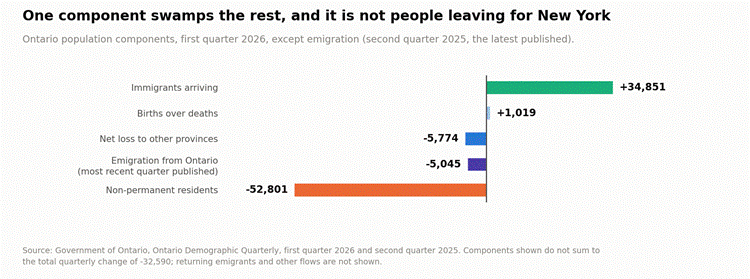
Figure 3 — The components, to scale.
| WHAT IS VERIFIED, AND WHAT IS NOT We could not retrieve the underlying article the post cites, so we cannot say what it actually claims or measures. The fact-check here compares the post’s own percentages against Statistics Canada’s emigration series and the U.S. Census Bureau’s American Community Survey count of Canadian-born residents. The top-decile population of roughly three million is ULG arithmetic on Canada’s tax-filer base, not a published figure, and the implied range follows from it. All Ontario population figures are from the Government of Ontario’s Ontario Demographic Quarterly, first quarter 2026 (reference date April 1, 2026) and second quarter 2025 for emigration, which is the most recent quarter published for that component. Nothing here is a comment on tax policy or on any political claim about why people leave. |
| THE ULG VIEW Don’t repeat the post. On its own arithmetic it implies that between roughly 900,000 and 1.5 million top-decile Canadians are now in the United States. The U.S. census counts 828,000 Canadian-born people there in total — every income, every age, accumulated over decades. Whatever the underlying study measured, it was not this, and anyone quoting it to a client is one Google search from an embarrassing correction. There is a real emigration number and it is worth knowing: 120,640 in 2025, the most since 1952, with net emigration of about 65,700 after returnees. That matters for talent and tax policy. It is not what is moving Ontario housing demand, and at roughly 5,000 people a quarter leaving Ontario, it is a rounding error next to what is. The number that should be in your underwriting is the other one. Ontario’s population fell 152,648 in the twelve months to April 1, 2026 — down 0.9%, after growing 1.3% the year before. Non-permanent residents dropped 52,801 in a single quarter. That is the tenant base for student-adjacent and entry-level rental in Waterloo, London, Ottawa, Oshawa and the 905, and it is policy-driven rather than cyclical. So: rental supply is rising into a shrinking population. CMHC has purpose-built rental starts up 82% in the City of Toronto. If you are underwriting a rental or a bulk condo takeout, hold rent growth at or near zero for the lease-up period, stress vacancy well above the last five years’ experience, and use in-place rents rather than pro forma. Long-dated entitlement work is unaffected — permits outlast this policy cycle. Short-dated lease-up risk is where this shows up, and it is being underpriced right now. |
Sources
· Government of Ontario — Ontario Demographic Quarterly, first quarter 2026 (population 16.1 million; -32,590 in the quarter; -152,648 over twelve months; non-permanent residents -52,801; immigration -26%). https://www.ontario.ca/page/ontario-demographic-quarterly-highlights-first-quarter
· Government of Ontario — Ontario Demographic Quarterly, second quarter 2025 (emigration from Ontario 5,045 in the quarter; non-permanent resident stock 1,390,350). https://www.ontario.ca/page/ontario-demographic-quarterly-highlights-second-quarter
· Statistics Canada — Canada’s population estimates, first quarter 2026 (emigration of citizens and permanent residents; 120,640 in 2025, the highest since 1952). https://www150.statcan.gc.ca/n1/daily-quotidien/260617/dq260617a-eng.htm
· Statistics Canada — High-income Canadians, 2023 (top 1% threshold $293,800; average income $606,000). https://www150.statcan.gc.ca/n1/daily-quotidien/251031/dq251031b-eng.htm
· Migration Policy Institute, using U.S. Census Bureau American Community Survey 2023 — 828,000 Canadian-born residents of the United States. https://www.migrationpolicy.org/article/canadian-immigrants-united-states
· TD Economics — “Canada’s Silent Brain Drain” (who is leaving: doctoral graduates, computing, engineering and finance). https://economics.td.com/ca-silent-brain-drain
· CMHC — Fall 2026 Housing Supply Report (purpose-built rental starts up 82% in the City of Toronto). https://www.cmhc-schl.gc.ca/professionals/housing-markets-data-and-research/market-reports/housing-market/housing-supply-report
Charts by Urban Land Group. The top-decile population and the implied emigration range in Figure 1 are Urban Land Group arithmetic on the claim’s own percentages. General market commentary; not investment, financial, immigration or political advice.